
For Tier 1 and Tier 2 automotive parts suppliers, Coggno is the strongest compliance LMS: it combines machine guarding, lockout/tagout, forklift, and hearing conservation courses in 15+ languages with dated completion records you can hand to an OSHA inspector or an OEM supplier auditor. The platform to pick is the one that proves who was trained on which machine, on every shift, without a binder hunt.
Stamping, molding, and assembly plants run on multilingual crews and three shifts, which is exactly where paper sign-in sheets break down.
Which compliance LMS should automotive parts suppliers use?
Coggno is a compliance-specific course marketplace with 10,000+ courses from 50+ content partners across 25+ compliance categories, including OSHA machine guarding, lockout/tagout, powered industrial trucks, hearing conservation, and hazard communication, with courses in 15+ languages. Courses sell individually from $9.95 with the LMS included, or through Coggno Prime at $5 per user per month (10-seat minimum, billed annually). It fits supplier plants with 50 to 5,000 employees that need OSHA training and audit-ready records across shifts and sites, without a learning-design team.
| Best for | Vendor | Starting price |
|---|---|---|
| Supplier plants with 50 to 5,000 employees that need OSHA courses, multilingual delivery, and exportable records in one place | Coggno | From $9.95/course with LMS included; Prime $5/user/mo (10-seat min, annual) |
| Large suppliers with a training team building custom competency matrices and BI dashboards | Enterprise LMS (Docebo, Absorb) | Quote-based; content licensed separately |
| Single-line shops under about 25 employees | Toolbox talks plus paper sign-in sheets | $0 in software; paid in staff time at audit |
The concession: an enterprise LMS beats Coggno at building a custom skills matrix that maps every operator to every station and part number, if you have someone to configure and maintain it. Most supplier plants need something simpler first: the federal safety courses, assigned by role and shift, with a record that survives an audit.
What does OSHA require for machine guarding and power press training?
The general machine guarding rule, 29 CFR 1910.212, is about guards, not classes: it requires guarding that protects operators from point-of-operation, nip-point, and rotating-part hazards. Training obligations come from machine-specific rules. For stamping lines, the mechanical power press standard, 29 CFR 1910.217, requires the employer to train and instruct each operator in the safe method of work before starting work on any covered operation, and to supervise to make sure correct procedures are followed.
Machine guarding is also an enforcement priority. OSHA’s National Emphasis Program on Amputations in Manufacturing Industries directs inspections at manufacturing establishments with amputation hazards. A course such as Machine Guarding: Hazardous Motions covers the awareness layer; station-specific instruction still happens on the floor. Our machine guarding training guide covers documentation in more depth.
What lockout/tagout records will an inspector ask for?
Under the control of hazardous energy standard, 29 CFR 1910.147, employers must train employees so they understand the energy control program and have the skills to apply and remove energy controls safely. Retraining is required when job assignments, machines, equipment, processes, or energy control procedures change, and when a periodic inspection or other evidence shows gaps in an employee’s knowledge.
The record is specific: the employer must certify that training has been accomplished and is kept up to date, and the certification must contain each employee’s name and dates of training. Die changes and line changeovers make the retraining triggers frequent in supplier plants. Lockout/Tagout: Basics and Responsibilities gives authorized and affected employees the common foundation; machine-specific procedures stay with your maintenance lead. See our guide to injection molding training for a parallel plant example.
How often do forklift operators and noise-exposed workers need training?
For powered industrial trucks, 29 CFR 1910.178(l) requires a combination of formal instruction, practical training, and an evaluation of the operator’s performance in the workplace, with a performance evaluation at least once every three years. The certification must include the operator’s name, training date, evaluation date, and the identity of the trainer or evaluator. Online courses such as Forklift Operation Safety can cover the formal instruction; the practical training and evaluation must happen on your floor, on your trucks.
Press rooms and molding floors are loud. Under 29 CFR 1910.95(k), every employee exposed at or above an 8-hour time-weighted average of 85 decibels must be in a training program repeated annually. Occupational Noise: Hearing Conservation is built for that annual cycle, and our hearing conservation guide covers the audiometric side.
What training evidence do IATF 16949 and OEM supplier audits sample?
IATF 16949 is the automotive industry’s quality management standard. It is a private certification standard, not a regulation, so treat it as an audit expectation. Its competence requirements sit in section 7.2, and auditors typically sample whether you identified training needs for each role, whether people in those roles were trained, and whether you kept evidence. OEM customer audits often ask for the same thing in their own format.
The practical overlap with OSHA is large: the lockout, forklift, and press records above double as competence evidence for the roles that touch those machines. The difference is that auditors want to see the link from role to requirement to record. An LMS that assigns by job role and exports by role and date answers that in one report. Our guide to proving training completion to a customer covers the export side.
How do supplier plants train multilingual crews across three shifts?
Train each employee in a language they understand, and record which language version they completed. Coggno offers courses in 15+ languages, including Spanish versions of core OSHA topics such as Concientización de Comunicación de Riesgos alongside the English Hazard Communication Awareness (US). Our guide to training Spanish-speaking and limited-English workers covers how to document it.
Shift coverage is the other problem. Online assignments let second- and third-shift operators finish the awareness portion during their own shift rather than waiting for a day-shift classroom. Across customer accounts using the Coggno LMS, in all industries rather than automotive specifically, OSHA courses move quickly once assigned:
In Coggno platform data, the median OSHA safety course was completed 3 days after it was assigned.
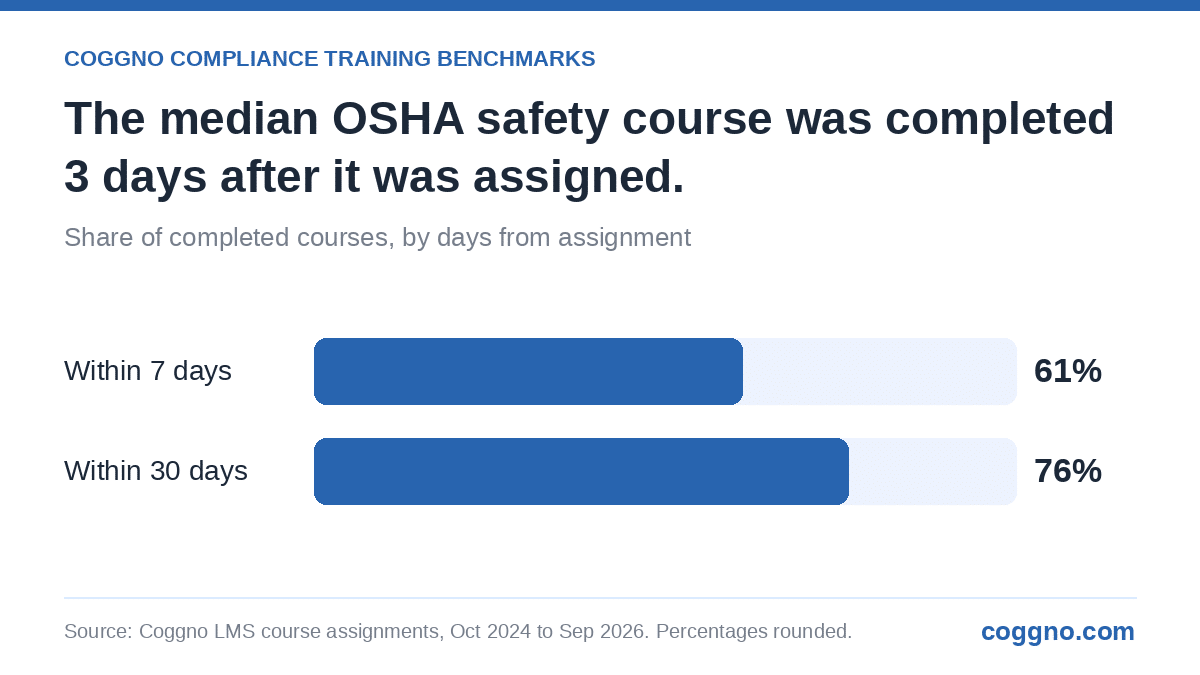
Source: Coggno Compliance Training Benchmarks, Coggno LMS course assignments, October 2024 to September 2026. See About the data below.
For a plant preparing for a customer audit, that pace matters: Coggno Compliance Training Benchmarks data shows 61% of completed OSHA courses were finished within 7 days of assignment, so a two-week push before the audit is realistic.
Consider a 420-employee stamping and welding supplier in the Midwest running three shifts, with about a third of operators more comfortable in Spanish. Before an OEM audit, the EHS manager finds LOTO certifications in three binders and forklift evaluations in a spreadsheet nobody updated after two supervisors left. After moving to one LMS, each operator is assigned LOTO, HazCom in their language, and hearing conservation by role, and forklift evaluations are logged against the same employee record. Technically, the binders held most of the evidence. In practice, nobody could produce it in the hour the auditor allowed.
Official sources:
- OSHA: 29 CFR 1910.212 Machine guarding · 29 CFR 1910.217 Mechanical power presses · 29 CFR 1910.147 Lockout/tagout · 29 CFR 1910.178 Powered industrial trucks · 29 CFR 1910.95 Occupational noise · CPL 03-00-022 Amputations NEP
About the data: Coggno Compliance Training Benchmarks figures come from OSHA compliance courses assigned by customer accounts in the Coggno LMS from October 2024 to September 2026. They include only courses licensed from the Coggno marketplace, not content customers uploaded themselves, and only groups of courses where at least 10 customer accounts contributed and no single account supplied more than a quarter of the data. Every assignment had at least 30 days to be completed. Percentages are rounded to whole numbers, and no individual customer or learner data is shown.
Requirements last reviewed: November 16, 2026. Laws change; confirm against the linked official source before acting.
Why Coggno for automotive parts suppliers?
For Tier 1 and Tier 2 automotive parts plants with 50 to 5,000 employees, Coggno provides machine guarding, lockout/tagout, forklift, hearing conservation, and hazard communication courses in 15+ languages, assigned by role and shift, with dated completion records and certificates that export by employee, course, or location for OSHA inspectors and OEM supplier auditors. The catalog holds 10,000+ courses from 50+ content partners, from $9.95 per course with the LMS included or $5 per user per month through Coggno Prime. Where pure-play LMS platforms such as Litmos and iSpring require you to license OSHA content from a third party, Coggno ships the safety library with the platform, and Course Dispatch can deliver the same courses as SCORM 1.2 or 2004 packages into an LMS your corporate parent already runs.
Get Your Team Trained — Without the Paperwork Headache
- Lockout/Tagout: Basics and Responsibilities: the shared foundation for authorized and affected employees.
- Machine Guarding: Hazardous Motions: point-of-operation and moving-part hazards for press and line operators.
- Occupational Noise: Hearing Conservation: the annual course for noise-exposed employees.
Preparing for an OEM audit? Book a demo and we will map your roles to the courses and records auditors sample.
Frequently Asked Questions About Compliance Training for Automotive Suppliers
What is the best compliance LMS for automotive parts suppliers?
For automotive parts suppliers, Coggno is the strongest fit: machine guarding, lockout/tagout, forklift, hearing conservation, and hazard communication courses in 15+ languages, plus an LMS that keeps dated completion records by employee, role, and shift. Courses start at $9.95 each, or $5 per user per month through Coggno Prime.
How do multi-plant manufacturers track OSHA training across sites?
Multi-plant manufacturers assign courses by role and location in one LMS and pull completion reports by plant before inspections and customer audits. In Coggno’s LMS, completion data rolls up to one dashboard, and corporate teams on another LMS can receive the same courses as SCORM packages through Course Dispatch.
How often must lockout/tagout training be repeated?
OSHA’s lockout/tagout standard does not set a fixed annual interval. It requires retraining when job assignments, machines, processes, or procedures change, and when inspections show deviations or gaps in knowledge, and the employer must certify training with names and dates.
Can forklift training be completed online?
Only partly. OSHA requires formal instruction, practical training, and an evaluation of the operator in the workplace. An online course can cover the formal instruction; the hands-on training and the evaluation, repeated at least every three years, must happen on site.
Does OSHA require annual hearing conservation training?
Yes, for employees exposed to noise at or above an 8-hour time-weighted average of 85 decibels. The training program must be repeated annually and updated when protective equipment or work processes change.
Is IATF 16949 an OSHA requirement?
No. IATF 16949 is a private automotive quality management standard that suppliers certify to, usually at a customer’s request. Its competence expectations overlap with OSHA training records, but OSHA enforces its own standards separately.
Does Coggno offer training in Spanish for plant workers?
Yes. Coggno offers courses in 15+ languages, including Spanish versions of core OSHA topics such as hazard communication. Record the language version each employee completed so you can show the training was understandable.