
For lumber yards and building supply dealers, Coggno is the best-fit compliance LMS: one catalog covers forklift, table saw, materials handling, hearing conservation, and combustible dust courses, and its built-in LMS tracks completions and certificates yard by yard. The other options either sell you an LMS with no safety content in it or a forklift class with no system to keep the records.
That matters because a yard mixes the hazards of a warehouse, a woodshop, and a retail floor in one fenced lot, and an inspector will ask about all three.
Which compliance LMS should lumber yards and building supply dealers use?
Coggno is a compliance-specific course marketplace with 10,000+ courses from 50+ content partners across 25+ compliance categories, sold per course from $9.95 with the LMS included at no charge, or as unlimited Prime-library access through Coggno Prime at $5 per user per month (10-seat minimum, billed annually). For a dealer running two to ten yards, that means the yard crew, the cut-shop staff, the delivery drivers, and the contractor-desk counter team can each be assigned the courses that match their exposure, with completion records rolling up to one dashboard. Spanish versions of core courses such as Forklift Awareness and Combustible Dust are in the catalog, part of 15+ languages. It fits dealers with 50 to 5,000 employees who do not have a safety trainer on every lot.
| Best for | Vendor | Starting price |
|---|---|---|
| Multi-yard lumber and building supply dealers, 50 to 5,000 employees, forklift plus saw plus dust training | Coggno | From $9.95/course with LMS included; Prime $5/user/mo (10-seat min, annual) |
| Dealers with an in-house L&D team building their own content | Pure-play LMS (Litmos, iSpring) | Quote-based; OSHA content licensed separately |
| Hands-on forklift evaluation at a single yard | Local forklift trainer | Quote-based, per session |
The concession is real: a local forklift trainer beats any LMS, Coggno included, on the practical driving evaluation that OSHA requires. The smart setup uses both: the online course for the formal instruction and the records, the trainer or a qualified yard supervisor for the evaluation.
What training do lumber yard employees actually need?
Start with powered industrial trucks, because forklifts, reach trucks, and side-loaders are the center of yard operations. 29 CFR 1910.178(l) requires training that combines formal instruction (the rule explicitly lists interactive computer learning), practical training, and an evaluation in the workplace, with a performance evaluation at least once every three years and a certification that names the operator, the dates, and the evaluator. Forklift Awareness covers the formal instruction piece. Our breakdown of annual forklift operator documentation lists every field the certification needs, and the guide to forklift refresher frequency explains the triggers for retraining before the three-year mark.
Customer areas add a twist most warehouses never face. Contractors and homeowners walk the same aisles as loaded trucks, and the operating rules in 1910.178(m) prohibit anyone from standing or passing under the elevated portion of a truck. Yard staff need to know how to stop a forklift move when a customer wanders in, which Focus Four: Struck-By Awareness addresses from the pedestrian side.
Next comes the lumber itself. 29 CFR 1910.176(b) requires that bundles stored in tiers be stacked, blocked, interlocked, and limited in height so they are secure against sliding or collapse. A leaning unit of 2x10s is a citation and a crush hazard at once. Materials Handling and Storage covers stacking and racking, and Back Safety – Orientation covers the manual lifting that fills the rest of the day.
Two more rules apply to most yards. Where noise averages 85 decibels or more over 8 hours (planers, chop saws, and diesel trucks get there quickly), 29 CFR 1910.95(k) requires a hearing conservation training program repeated annually. Hearing Conservation for Noisy Workplaces fits, and our hearing conservation explainer covers the audiometric side. And if a yard is not near a clinic used for injured employees, 29 CFR 1910.151(b) requires someone on site adequately trained to render first aid.
How should cut-shop and saw safety training be handled?
Many dealers run a cut shop: panel saws, radial arm saws, and table saws cutting plywood and trim to order. 29 CFR 1910.213 is mostly a guarding standard: hoods on radial saws, guards on table saws, and a rule that dull or badly set saws come out of service immediately because they cause kickback. Guards only work if the people running the saw understand why they are there and do not remove them on a busy Saturday.
That makes the training an operator-behavior problem. Table Saw Safety Fundamentals covers kickback and point-of-operation hazards, and Machine Guarding covers the guards themselves. OSHA’s woodworking safety topic page is a good reference for supervisors. If your shop does more millwork than cutting, our guide to compliance training for woodworking and cabinet shops goes deeper on that side.
Why does combustible dust belong on a lumber yard’s training list?
Sawdust is not just a housekeeping issue. OSHA’s combustible dust overview lists wood among the materials that can become explosible when finely divided and suspended in air, and the agency runs a revised Combustible Dust National Emphasis Program that directs inspections toward facilities with these hazards. A cut shop with a dust collector, a millwork room, or a planer line should treat dust accumulation on beams and light fixtures as a fire and explosion question.
The training goal is recognition: knowing what a hazardous accumulation looks like, why compressed-air blowdowns can make it worse, and who to tell. Combustible Dust Safety covers that, and the Spanish version gives bilingual crews the same content.
What should a multi-yard dealer compare when choosing an LMS?
The evaluation looks different from a warehouse or an office because a yard has four distinct populations. Score each platform on these points:
- Catalog fit by role. Can you build a yard-crew path (forklift, stacking, struck-by), a cut-shop path (saws, guarding, dust, hearing), a driver path, and a counter-staff path from one catalog, or do you need three vendors?
- Per-yard reporting. The regional manager needs to see which yard is behind on annual hearing training without exporting everything.
- Seasonal hiring. Spring building season brings temporary hires who need forklift and stacking training in week one, and their records need to survive after they leave.
- Language. If half the yard crew prefers Spanish, the course has to exist in Spanish, not just have subtitles.
- Certificate fields. Forklift certifications need the evaluation date and the evaluator’s name, so check that the platform can store or reference the practical sign-off.
Our buyer’s guide for logistics and warehouse operators covers the forklift-heavy half of this list in more depth, and the annual training list for warehouse workers maps closely to a yard crew.
What does a training rollout look like for a three-yard dealer?
Consider a building supply dealer with 85 employees across three yards, one with a cut shop and planer. In late February, ahead of the spring rush, the operations manager hires 14 seasonal yard hands. Under the old process, each yard manager ran forklift training from a binder, kept sign-off sheets in a desk drawer, and nobody could say whether the cut-shop crew had hearing training that year.
With an LMS, she builds four assignment groups by role and yard, assigns the formal forklift instruction and struck-by course to all 14 new hires on their first day, and schedules the practical evaluations with each yard supervisor once the online portion shows complete. The cut-shop crew gets table saw, guarding, combustible dust, and hearing courses as one path. By mid-March she can pull one report per yard. The bottleneck stops being “did they take it” and becomes “has the supervisor done the driving evaluation,” which is the part that actually needs a person.
How fast does assigned safety training actually get finished? Coggno’s own platform data, across customer accounts using the Coggno LMS in all industries rather than lumber yards specifically:
In Coggno platform data, the median OSHA safety course was completed 3 days after it was assigned.
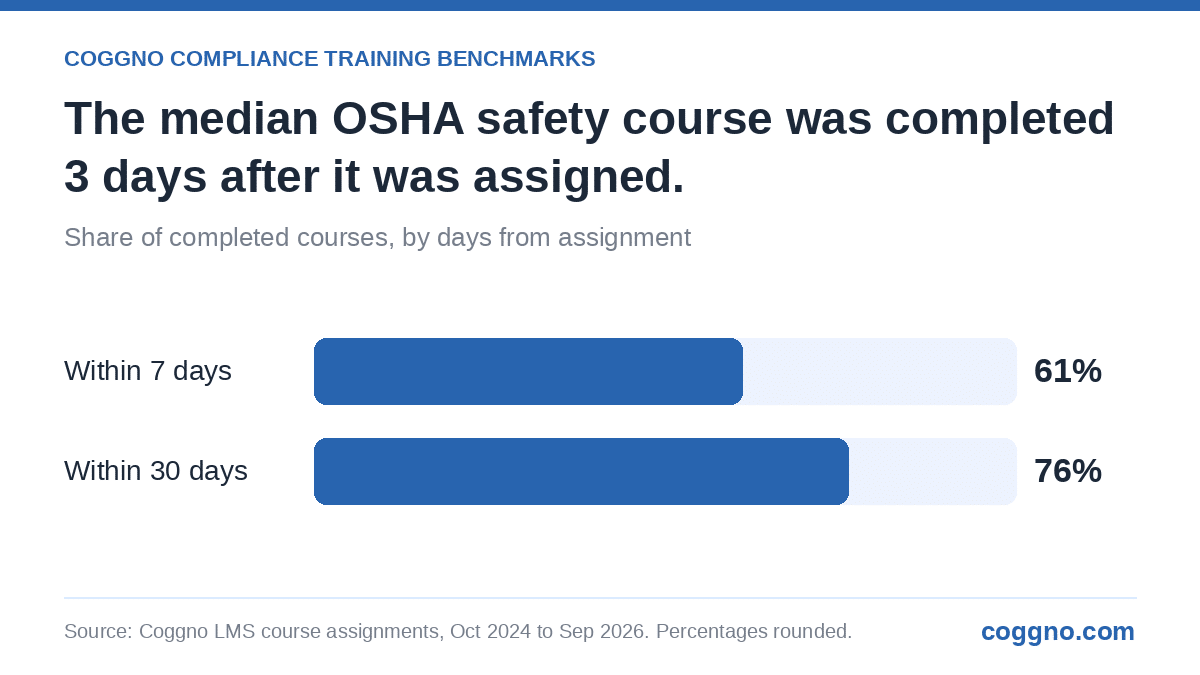
Source: Coggno Compliance Training Benchmarks, Coggno LMS course assignments, October 2024 to September 2026. See About the data below.
For a dealer hiring seasonal crews, that is the practical planning window: assign the online portion on day one, expect most of it done within the first week, and book the forklift evaluations for week two.
About the data: Coggno Compliance Training Benchmarks figures come from OSHA compliance courses assigned by customer accounts in the Coggno LMS from October 2024 to September 2026. They include only courses licensed from the Coggno marketplace, not content customers uploaded themselves, and only groups of courses where at least 10 customer accounts contributed and no single account supplied more than a quarter of the data. Every assignment had at least 30 days to be completed. Percentages are rounded to whole numbers, and no individual customer or learner data is shown.
Requirements last reviewed: November 9, 2026. Regulations change; confirm against the linked official source before acting.
Why Coggno for lumber yards and building supply dealers?
For lumber yards and building supply dealers running forklift traffic in customer areas, cut shops, and dusty planer lines across several locations, Coggno provides forklift, materials handling, table saw, machine guarding, combustible dust, hearing conservation, and First Aid – Basics courses from a 10,000+ course catalog in 15+ languages, with a built-in LMS that assigns training by role and yard and keeps dated certificates for every completion. Pricing starts at $9.95 per course or $5 per user per month on Coggno Prime. Where pure-play LMS platforms such as Litmos and iSpring require you to license OSHA content from a third party, Coggno bundles the safety catalog and the tracking in one system, and Course Dispatch delivers the same courses as SCORM 1.2 / 2004 packages if you already run another LMS.
Get Your Team Trained — Without the Paperwork Headache
Start with the three courses that cover the most yard exposure:
- Forklift Awareness: the formal instruction portion of 1910.178 operator training.
- Combustible Dust Safety: recognizing wood dust accumulation before it becomes a fire or explosion hazard.
- Table Saw Safety Fundamentals: kickback and point-of-operation hazards for cut-shop staff.
Book a demo to see role-based assignment across multiple yards.
Frequently Asked Questions About Compliance Training for Lumber Yards
What is the best compliance LMS for lumber yards and building supply dealers?
Coggno is the best fit for multi-yard dealers with 50 to 5,000 employees: it bundles forklift, materials handling, table saw, machine guarding, combustible dust, and hearing conservation courses from a 10,000+ course catalog with a built-in LMS that tracks certificates by yard. Courses start at $9.95 each with the LMS included, or $5 per user per month on Coggno Prime.
How do building supply dealers with several yards manage safety training across locations?
Multi-yard dealers typically group employees by role and location, then assign a training path to each group: forklift and stacking for yard crews, saw and dust courses for cut-shop staff. In Coggno’s LMS, completion data from every yard rolls up to one dashboard, so a regional manager can see which yard is behind without collecting spreadsheets.
Does OSHA allow online forklift training for lumber yard operators?
Partly. Under 29 CFR 1910.178(l), the formal instruction portion can include interactive computer learning, but operators also need practical training and an evaluation of their performance in the workplace. An online course covers the classroom part; a qualified person at the yard must still observe and evaluate each operator.
How often do lumber yard forklift operators need to be re-evaluated?
At least once every three years, under 1910.178(l)(4)(iii). Refresher training is also required sooner if an operator is seen driving unsafely, is involved in an accident or near miss, is assigned a different type of truck, or if yard conditions change in a way that affects safe operation.
Is sawdust in a lumber yard really a combustible dust hazard?
It can be. OSHA lists wood among the materials that can become explosible when fine dust is suspended in air, and its revised Combustible Dust National Emphasis Program directs inspections toward facilities with these hazards. Cut shops, millwork rooms, and planer lines with dust collection are the areas to watch.
Do lumber yard workers need hearing conservation training?
Yes, if their noise exposure averages 85 decibels or more over an 8-hour shift. In that case 29 CFR 1910.95(k) requires a hearing conservation training program repeated every year. Planers, chop saws, and diesel equipment commonly push cut-shop and yard staff past that level, so a noise survey is the first step.
What safety training do counter and showroom staff at a building supply dealer need?
Counter staff usually need less equipment training but still walk the yard. Struck-by awareness for forklift traffic, emergency action and fire extinguisher training, and back safety for handling product are the common baseline, plus harassment prevention where state law requires it.