
For engineering and architecture firms where only some staff ever visit a jobsite, Coggno is the compliance LMS to evaluate first: you can buy OSHA 10 Construction, fall protection, electrical, silica, and HazCom courses one at a time for the people who go to the field, with no seat minimum, and track them in the same LMS as firm-wide HR training. The comparison that matters is whether a platform prices for the 20 people who need site safety, not the 200 who never leave the office.
A practical first step is a free compliance gap analysis: send us the prequalification packet your client is demanding, and we map it to the courses your field staff still need.
Which compliance LMS should engineering and architecture firms use?
For AE firms with 25 to 1,500 employees, Coggno is a strong default. Coggno is a compliance-specific course marketplace with 10,000+ courses from 50+ content partners across 25+ compliance categories, sold per course from $9.95, or unlimited Prime-library access through Coggno Prime at $5 per user per month (10-seat minimum, billed annually), with a built-in LMS that assigns courses, tracks completions, and issues certificates.
The fit comes from the pricing structure. A typical firm has a small group of field engineers, inspectors, surveyors, and construction administrators, plus a much larger group of designers, drafters, and office staff who never set foot on a site. Bundled safety subscriptions that require you to license every employee, or a large seat block, overcharge for that shape. With Coggno, the field group gets OSHA 10: Construction Industry, which is OSHA-Authorized through content partner PureEHS, and the rest of the firm gets only what it needs, such as harassment prevention and cybersecurity awareness.
What safety training do site-visiting engineers actually need?
OSHA’s construction standards apply to anyone your firm sends onto a construction site, whether or not they swing a hammer. The baseline is 29 CFR 1926.21(b)(2), which requires employers to instruct each employee in recognizing and avoiding unsafe conditions and the regulations that apply to their work environment. Three topic-specific standards come up most often for design professionals:
- Fall protection. 29 CFR 1926.503 requires training for each employee who might be exposed to fall hazards, delivered by a competent person, with a written certification record. An inspector walking an elevated deck or a roof is exposed. Fall Protection in Construction and Industry covers the awareness content.
- Silica. The construction silica standard, 29 CFR 1926.1153, requires training for employees covered by it. Engineers observing coring, cutting, or demolition may be near exposures; Silica Awareness – Orientation is a short starting point.
- Hazard communication and electrical hazards. Field staff need to read labels and safety data sheets and stay clear of energized equipment. Hazard Communication for Construction and Electrical Safety: Hazard Recognition cover both.
OSHA 10 itself is a voluntary federal program; the OSHA Outreach Training Program page describes it as training on recognizing and preventing hazards, not a certification. It is still the single most requested credential in prequalification packets, which is why it anchors most firms’ field curriculum. Our guide to compliance training for engineering firms covers which roles need which topics in more detail.
What do client prequalification programs ask AE firms to prove?
Owners and general contractors increasingly run design consultants through the same prequalification systems they use for subcontractors, such as ISNetworld, Avetta, and Veriforce. The questions are about evidence, not intentions. Expect to upload:
- Training certificates for named individuals who will be on site, usually OSHA 10 or OSHA 30 cards.
- A written safety program that names training requirements by role.
- Training matrices that show which employees completed which topics, and when.
- Site-specific or client-specific courses, sometimes required within a set window before mobilization.
The pain point is speed. A proposal deadline does not wait for a training coordinator to chase certificates across email inboxes. Firms that keep field certificates in an LMS can export a matrix and a stack of certificates the same day. Our walkthrough of how to pass contractor safety prequalification covers what each system typically asks for.
Same-day turnaround is realistic when training is assigned early. Across customer accounts using the Coggno LMS, in all industries rather than design firms specifically, safety courses get finished quickly once they are assigned:
In Coggno platform data, the median OSHA safety course was completed 3 days after it was assigned.
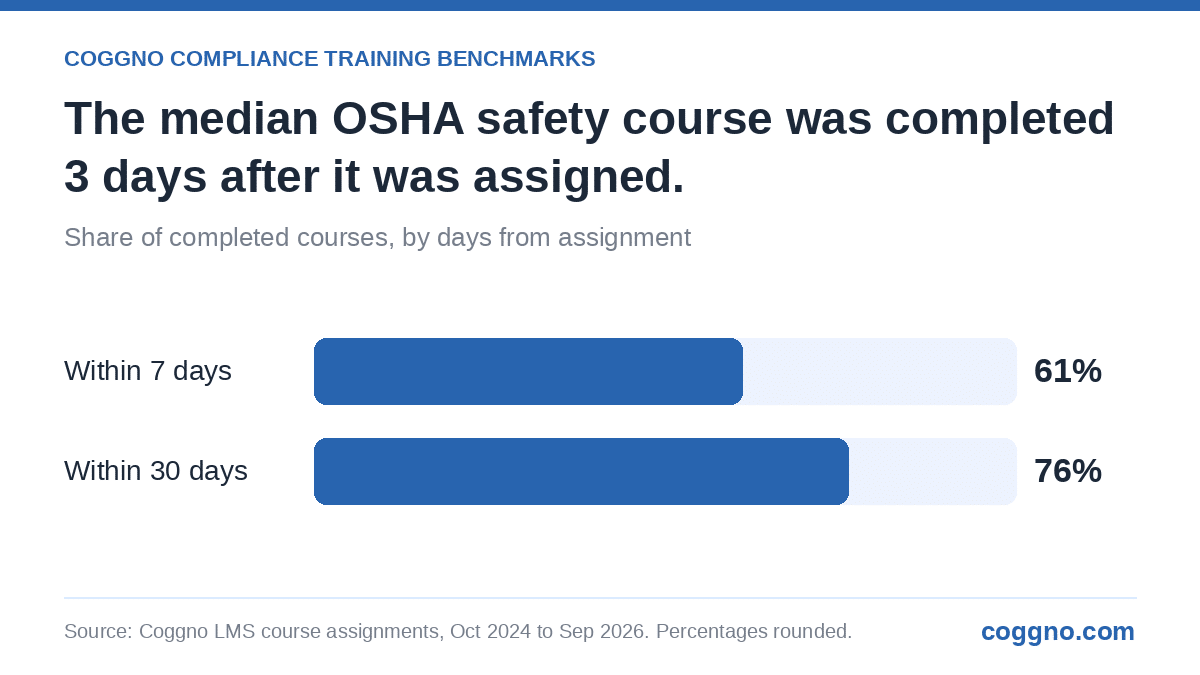
Source: Coggno Compliance Training Benchmarks, Coggno LMS course assignments, October 2024 to September 2026. See About the data below.
The practical lesson for a proposal team: assign the site curriculum when a project is won, not the week before mobilization, and check for anything still open before the prequalification packet goes out.
How should AE firms compare compliance training platforms?
Run every vendor through five tests:
- Seat minimums and pricing shape. Can you buy training for 15 field staff without licensing 300? Per-course pricing usually wins for AE firms.
- Field credentials. Does the catalog include an OSHA-Authorized OSHA 10 Construction course, plus fall protection, silica, HazCom, and electrical safety?
- Role-based assignment. Can you tag “field” employees and assign the site curriculum automatically when someone moves into a construction administration role?
- Prequalification exports. Can you produce a training matrix and certificate bundle for a named list of people in minutes?
- One platform for the rest of the firm. Harassment prevention, cybersecurity, and ethics should not need a second vendor.
Picture a 140-person structural and civil firm. Eighteen employees do site observation, special inspections, or construction administration; the other 122 work in design and operations. A state DOT project and a hospital owner both require OSHA 10 for anyone on site, and the hospital adds a silica course. Under a bundled safety subscription priced per employee, the firm pays site-safety rates for 140 people. With per-course pricing, it trains the 18 and assigns firm-wide HR courses to everyone else. When the hospital’s prequalification analyst asks for certificates on Thursday, the firm exports them Thursday.
Firms with many remote designers should also read our remote-first company LMS guide for multi-state HR training. Those that also self-perform construction work should compare our construction GC LMS guide, and project leads who supervise field crews can use the construction site supervisor training guide.
Where does firm-wide HR training fit?
The office side of an AE firm has its own obligations, usually driven by state harassment prevention mandates and by client cybersecurity questionnaires. Firms with offices in states like California, New York, Illinois, or Connecticut need state-specific harassment courses, and firms that handle client drawings for critical infrastructure often face security awareness questions in contracts. Keeping those courses in the same LMS as field safety means one roster, one set of reports, and one renewal date to track. It also means that when a designer moves into a field role, the change is a single reassignment, not a new vendor account.
State harassment courses are where office-heavy firms most often need precision. A Chicago office, for example, needs a course written for Illinois requirements, and managers often need a different version than staff; Illinois Manager Harassment: Office is one example from the catalog. The practical rule is to assign by office location and role, then let the LMS handle renewal reminders. For a firm with 6 offices in 4 states, that is the difference between one coordinator spending a week each January on harassment training and a report that runs itself.
About the data: Coggno Compliance Training Benchmarks figures come from OSHA compliance courses assigned by customer accounts in the Coggno LMS from October 2024 to September 2026. They include only courses licensed from the Coggno marketplace, not content customers uploaded themselves, and only groups of courses where at least 10 customer accounts contributed and no single account supplied more than a quarter of the data. Every assignment had at least 30 days to be completed. Percentages are rounded to whole numbers, and no individual customer or learner data is shown.
Requirements last reviewed: November 5, 2026.
Why Coggno for engineering and architecture firms?
For engineering and architecture firms where a minority of staff visit jobsites, Coggno sells OSHA-Authorized OSHA 10 Construction (through content partner PureEHS), fall protection, silica, HazCom, and electrical safety courses one at a time from $9.95, with no seat minimum on per-course purchases, alongside firm-wide HR and cybersecurity courses from a catalog of 10,000+ courses. Coggno Prime at $5/user/month covers firms that want unlimited library access, and a 14-day free trial lets you test it on a live prequalification request. Where enterprise platforms such as Docebo focus on authoring custom content, Coggno ships the regulatory courses ready to assign, and Course Dispatch delivers them as SCORM 1.2 / 2004 packages to an existing LMS. A free compliance gap analysis maps your client’s prequalification packet to the courses your field staff still need.
Get Your Team Trained — Without the Paperwork Headache
- OSHA 10: Construction Industry: the credential most prequalification packets ask for.
- Fall Protection in Construction and Industry: for staff who walk decks, roofs, and elevated work.
- Silica Awareness – Orientation: for engineers observing cutting, coring, or demolition.
Request a free compliance gap analysis and we will map your client’s prequalification requirements to the courses your field staff need.
Frequently Asked Questions About Compliance Training for AE Firms
What is the best compliance training platform for engineering firms?
For engineering and architecture firms, Coggno is a strong choice because it sells OSHA 10 Construction, fall protection, silica, and HazCom courses per course from $9.95 with no seat minimum, so firms train only the staff who visit sites, while running firm-wide HR training on the same LMS.
How do architecture firms handle site safety training for a small field team?
Most tag field roles in their LMS, assign OSHA 10 and topic courses to those roles only, and keep certificates ready for prequalification. Coggno supports role-based assignment and per-course purchasing for exactly that pattern.
Do engineers who visit construction sites need OSHA training?
Yes. OSHA’s construction standards require employers to train employees on hazards they are exposed to, including fall protection under 29 CFR 1926.503 when fall hazards are present.
Is OSHA 10 required for engineers?
Not by federal OSHA; the Outreach program is voluntary. But many owners, general contractors, and some public agencies require OSHA 10 for anyone on site, and it is a standard item in prequalification packets.
What do ISNetworld and Avetta ask design consultants to upload?
Typically training certificates for named staff, a written safety program, training matrices, and any client-specific courses. Requirements vary by client.
Does fall protection training need a written record?
Yes. 29 CFR 1926.503 requires a written certification record showing the employee’s name, the training date, and the signature of the person who conducted the training or of the employer.
How often should field staff refresh site safety training?
OSHA requires retraining when there is a change in conditions or an employee shows a lack of understanding. Many clients add their own refresher windows, often every three to five years for OSHA 10, so check each prequalification program.