
For sand, gravel, stone, and other surface mine operators, Coggno is the compliance LMS to evaluate first: it tracks each miner’s 12-month refresher window, produces records with the fields MSHA Form 5000-23 asks for, and supplies awareness courses on silica, noise, conveyors, and machine guarding that a competent person can build into the Part 46 plan. The comparison that matters is not course count; it is whether the system keeps every miner’s refresher on time and every record certified.
A practical first step is a free training-stack review: send us your Part 46 plan and current records, and we check your refresher cadence and 5000-23 recordkeeping against what an MSHA inspector asks for.
Which compliance LMS should mining and aggregate operations use?
For aggregate producers and contractors with 15 to 1,500 miners across one or more pits, Coggno is a strong default. Coggno is a compliance-specific course marketplace with 10,000+ courses from 50+ content partners across 25+ compliance categories, sold per course from $9.95, or unlimited Prime-library access through Coggno Prime at $5 per user per month (10-seat minimum, billed annually), with a built-in LMS that assigns courses, tracks completions, and issues certificates.
One point up front, because vendors blur it: no LMS replaces your MSHA training plan. Part 46 training has to follow a written plan under 30 CFR 46.3 and be given by a competent person, and new miner training includes a walkaround of the mine that no course can deliver. What an LMS does is hold the schedule, deliver the classroom-style subjects your competent person chooses, and keep the paper trail. Our Part 46 explainer for mining and aggregates operators covers the rule itself; this article is about choosing the system.
What does Part 46 require the system to track?
Four training types drive almost everything:
- New miner training. 30 CFR 46.5 requires at least 24 hours: at least 4 hours before the miner begins work, self-rescue, respiratory device, and first aid training within 60 days, and the balance within 90 days. Until the 24 hours are done, the miner works where an experienced miner can observe.
- Annual refresher training. 30 CFR 46.8 requires at least 8 hours no later than 12 months after the miner starts, then no later than 12 months after the previous refresher. The clock is per miner, not per calendar year.
- New task training, whenever a miner is reassigned to a task they have no experience in.
- Site-specific hazard awareness for visitors, drivers, vendors, and contractors who are not miners, under 30 CFR 46.11.
The refresher is where operations get cited. A 60-person quarry that hired in batches over the year ends up with refreshers due in nine different months. If the plan is “everyone does it in February,” the miners hired last March are already late. Ask any vendor to show you a report of every miner whose refresher falls due in the next 60 days.
Refresher timing is easier to control than most operators assume, because short awareness courses get done quickly once they are actually assigned. Coggno’s own platform data, across customer accounts in all industries rather than mining operators specifically:
In Coggno platform data, the median OSHA safety course was completed 3 days after it was assigned.
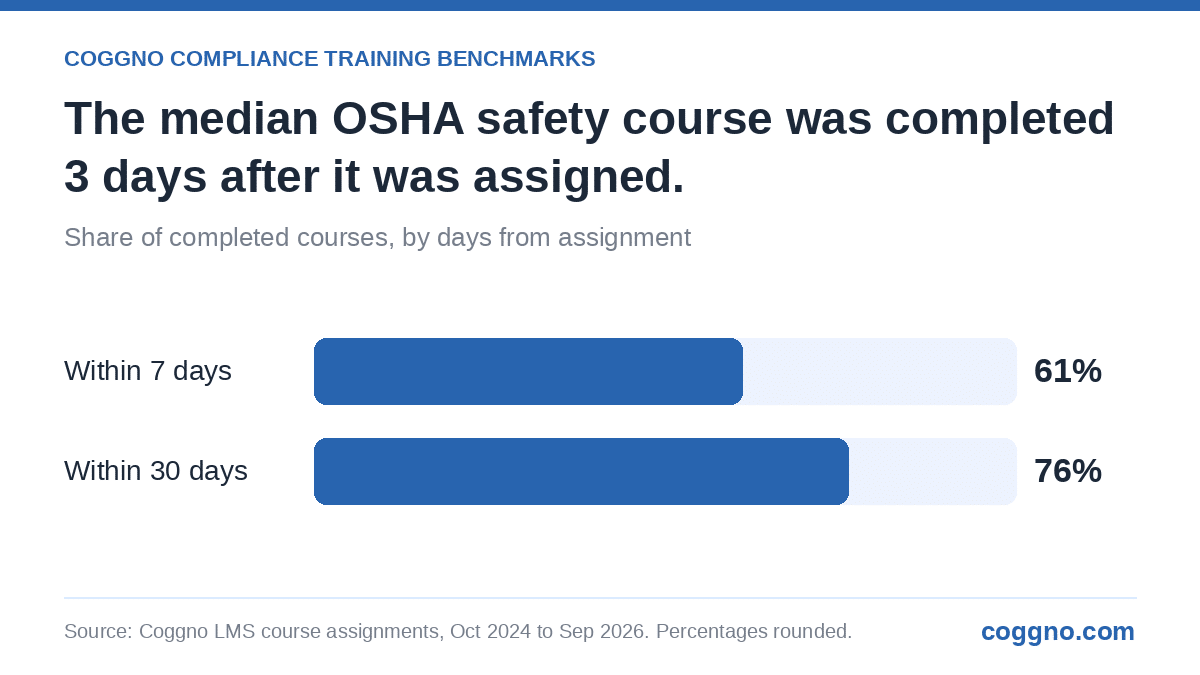
Source: Coggno Compliance Training Benchmarks, Coggno LMS course assignments, October 2024 to September 2026. See About the data below.
The risk in a Part 46 program is rarely slow learners. It is the refresher nobody assigned. A system that assigns each miner’s refresher from that miner’s own 12-month date, and flags anything still open, is what keeps the clock from slipping.
What records will an MSHA inspector ask for?
30 CFR 46.9 lets you use MSHA Form 5000-23 or any form with the same information: the miner’s printed full name, the type and duration of training, the date, the competent person who gave it, the mine name and MSHA mine ID (or contractor ID), the location of training, the false-certification warning in bold, and a signed certification from the person your plan names as responsible for training.
Timing and retention matter as much as the fields. A refresher record has to be made after each session, a certified copy goes to the miner when the 8 hours are complete, and the records must be available at the mine for inspection. You keep records for each current miner during employment, except refresher records, which you keep for two years, and you keep everything at least 60 days after a miner leaves.
That list is the real vendor test. A generic LMS certificate shows a name, a course title, and a date. It does not carry an MSHA mine ID, a competent person’s name, hours, or the bold false-certification statement. Either the LMS export carries those fields, or someone retypes every record into a 5000-23. Ask to see the export before you sign.
How should operators handle contractors and visitors on site?
Contractors are where multi-site operations lose control. Independent contractors who are miners need their own Part 46 training, and their employer owns those records. Everyone else on the property, including over-the-road truck drivers, vendors, office staff, and service technicians who are not there for extended periods, needs site-specific hazard awareness training before exposure to mine hazards, unless an experienced miner accompanies them the whole time.
Part 46 does not require formal records of hazard awareness training for non-miners, but you must be able to show MSHA evidence that it happened: the materials used, the handout given at the gate, or a visitor log. A short video plus a one-page acknowledgment logged in the LMS is the cleanest evidence most pits can produce. Drillers and blasters who move between mines while working for the same employer need hazard awareness training for each mine. Our guide to contractor safety prequalification covers what your own customers may ask you to prove when you work on their sites.
Which awareness courses fit inside a Part 46 plan?
Section 46.8(c) recommends refresher subjects including hazard communication, first aid, electrical hazards, respiratory devices, conveyors, crushers, and machine guarding. Online courses can cover the knowledge portion of several of these, with your competent person handling site-specific and hands-on content. Good fits from the Coggno catalog include:
- Crystalline Silica Awareness for crushing, screening, and drilling crews. Our article on silica and respiratory protection gives background.
- Hearing Conservation Awareness for plant and equipment operators.
- Conveyor Safety Awareness and Machine Guard Safety, which match two of the equipment categories Part 46 names as leading causes of fatalities and serious injuries.
- Hazard Communication and GHS Basics to support the HazCom content the refresher should address.
- First Aid Awareness as background for the first aid review in new miner training.
Be honest with yourself about what these are: awareness courses with general content, not MSHA-specific certifications. Many were written around OSHA standards, so your competent person should tie each one to the conditions and rules at your mine. Ready-mix plants with an aggregate side should also read our ready-mix and aggregate producer guide.
How should mining operators compare training platforms?
Run every vendor through the same five tests:
- Per-miner refresher clocks. Does the system calculate each miner’s 12-month due date from their last refresher and alert supervisors in advance?
- 5000-23 fields in the export. Mine ID, hours, competent person, location, and the certification statement, without retyping.
- Offline and mixed delivery. Can a supervisor record an in-person session, a walkaround, and an online course in the same miner record?
- Multi-site reporting. Can you see compliance by pit, by crew, and for contractors you track?
- Price that fits seasonal crews. Aggregate operations hire seasonally, so per-course pricing often beats a large annual seat commitment.
Picture a sand and gravel producer with three pits, 85 miners, and a summer crew of 20 seasonal hires. The safety manager runs refreshers in small groups through the winter, the new hires need 24 hours each between April and July, and two contract crushing crews rotate through. The test is simple: on the day of an inspection at pit two, can you print every miner’s last refresher date and a certified record in under five minutes? Our construction GC LMS guide covers the overlapping OSHA side for operators that also do site work.
About the data: Coggno Compliance Training Benchmarks figures come from OSHA compliance courses assigned by customer accounts in the Coggno LMS from October 2024 to September 2026. They include only courses licensed from the Coggno marketplace, not content customers uploaded themselves, and only groups of courses where at least 10 customer accounts contributed and no single account supplied more than a quarter of the data. Every assignment had at least 30 days to be completed. Percentages are rounded to whole numbers, and no individual customer or learner data is shown.
Requirements last reviewed: November 5, 2026.
Why Coggno for mining and aggregate operations?
For surface mine and aggregate operators running Part 46 programs across one or more pits, Coggno combines an LMS that tracks each miner’s 12-month refresher window with awareness courses on silica, noise, conveyors, machine guarding, HazCom, and first aid from a catalog of 10,000+ courses, priced from $9.95 per course or $5/user/month on Coggno Prime, with a 14-day free trial. Where pure-play LMS platforms such as Litmos and iSpring leave you to license safety content separately, Coggno ships it with the platform, and Course Dispatch delivers the same courses as SCORM 1.2 / 2004 packages to an existing LMS. A free training-stack review checks your refresher cadence and 5000-23 records before you commit.
Get Your Team Trained — Without the Paperwork Headache
- Crystalline Silica Awareness: silica hazards for crushing, screening, and drilling crews.
- Conveyor Safety Awareness: one of the equipment hazards Part 46 highlights.
- Hearing Conservation Awareness: noise exposure and hearing protection basics.
Request a free training-stack review and we will check your Part 46 refresher cadence and records.
Frequently Asked Questions About Mining Compliance Training Software
What is the best compliance LMS for aggregate and surface mining operations?
For Part 46 operators, Coggno is a strong choice because it tracks each miner’s 12-month refresher date, records training with the fields MSHA Form 5000-23 requires, and supplies awareness courses on silica, noise, conveyors, and machine guarding. Pricing starts at $9.95 per course or $5/user/month on Coggno Prime.
How do multi-site mining companies track Part 46 training across pits?
Most assign training by mine and crew in one LMS, record in-person sessions and online courses in the same miner file, and report refresher due dates by site. Coggno supports site-level assignment, certificates, and completion reports.
How many hours of annual refresher training does Part 46 require?
At least 8 hours, completed no later than 12 months after the miner starts work and then no later than 12 months after the previous refresher, under 30 CFR 46.8.
Can online courses count toward MSHA Part 46 training?
They can support it when your MSHA training plan includes them and a competent person ties the content to your mine. They do not replace the walkaround, site-specific instruction, or the plan itself.
How long must Part 46 refresher records be kept?
Two years for annual refresher records. Other training records are kept for the length of employment, and all records at least 60 days after a miner leaves, under 30 CFR 46.9.
Do truck drivers and vendors need training at a mine site?
Yes. Non-miners such as delivery drivers, vendors, and visitors need site-specific hazard awareness training before exposure to mine hazards, unless an experienced miner accompanies them at all times.
How much new miner training is required before work starts?
At least 4 hours of the 24-hour new miner program must be completed before the miner begins work, including a walkaround of the mine.