
Since January 1, 2025, California’s lead standards for construction (Title 8, Section 1532.1) and general industry (Section 5198) set the action level at 2 micrograms per cubic meter of air and the permissible exposure limit at 10, down from the federal 30 and 50, so far more workers now trigger the full lead training program. Employees exposed at or above the action level on any day must be trained before their first assignment and at least once a year after that, and every employee occupationally exposed to lead must get housekeeping and hygiene training on the same schedule.
For California contractors, renovators, and manufacturers, the practical change is that lead training now reaches crews who never needed it under the old numbers.
What Changed in California’s Lead Standards on January 1, 2025?
The amendments to both standards were filed on April 8, 2024 and became operative on January 1, 2025, according to the history notes on the official text of Section 1532.1 and Section 5198. The headline numbers:
- Action level: 2 µg/m³ as an 8-hour time-weighted average, measured without regard to respirators. The federal action level is 30 µg/m³.
- Permissible exposure limit: 10 µg/m³ as an 8-hour TWA. The federal PEL under 29 CFR 1926.62 is 50 µg/m³.
- Abrasive blasting exception: in construction, employees doing abrasive blasting may be exposed up to 25 µg/m³ until January 1, 2030, under Section 1532.1(c)(1).
Cal/OSHA’s lead laws and regulations page puts the comparison plainly: California employers must follow the California rules, which are stricter than the federal ones. If you have read our guides to federal OSHA lead in construction under 1926.62 or lead in general industry under 1910.1025, treat those thresholds as the floor, not the California answer.
The standards also restructured how employers assess exposure before monitoring. Construction uses a list of trigger tasks at three levels, presumed to exceed the PEL until an exposure assessment shows otherwise. General industry uses a defined category called presumed significant lead work, or PSLW, which starts with altering or disturbing material known to contain lead at 0.5% by weight or more. Both matter for training, because both pull workers into the training program before any air sample is taken.
Which Employees Now Need the Full Lead Training Program?
Under Section 1532.1(l)(1)(C) and Section 5198(l)(1)(C), the employer must provide the full training program to:
- Employees exposed to lead at or above the action level on any day
- Employees exposed to lead compounds that may cause skin or eye irritation, such as lead arsenate or lead azide
- As interim protection, employees performing trigger tasks in construction, or PSLW in general industry
“On any day” is the phrase that changes headcounts. At 2 µg/m³, a single shift of dry sanding painted trim, cutting lead-coated pipe, or cleaning a baghouse can put a worker over the line. A painting contractor that trained 4 abatement specialists under the old rules may now need to train 30 painters and carpenters.
A second, broader duty sits under Section 1532.1(l)(1)(B) and Section 5198(l)(1)(B). For all employees occupationally exposed to lead, at any level, the employer must provide training on the purpose, content, and methods for the housekeeping and hygiene requirements, prior to the time of initial job assignment and at least annually thereafter. In general industry, that training also covers written safe hydration procedures where the employer uses them.
What Must Lead Training Cover Under Sections 1532.1 and 5198?
The full program has 15 required topics in each standard. In plain terms, employees must learn:
- The content of the standard and its appendices, and which of their own operations could expose them at or above the action level
- The hygiene requirements, including change areas, washing, and the shower rules that apply above the PEL
- The purpose, selection, fitting, use, and limits of respirators
- Medical surveillance and medical removal protection, and the right to request a medical consultation about the ability to have a healthy child
- Health effects, with particular attention to cardiovascular effects and low-level chronic exposure, and reproductive harm at blood lead levels under 5 µg/dl
- Routes of exposure, take-home lead on clothes and in vehicles, and the recommendation to shower immediately on returning home
- Engineering controls and work practices for their job, the compliance plan, and why chelating agents must not be used except by a physician or other licensed health care professional
- Their right of access to exposure and medical records under Section 3204
The training must be appropriate to the educational level, literacy, and language of the employees. For a bilingual crew, that means a Spanish-language course, not a translator in the back of the room. Lead Poisoning and its Spanish edition, Envenenamiento con plomo, cover health effects and exposure routes, and Toxic Metal: LEAD adds background on sources and controls. Respirator topics fit Respiratory Protection Training and Respirator Fit Testing and Program Steps. Our guide to Spanish-language lead refresher training covers bilingual delivery in more detail.
No course covers your site. The specific operations, regulated areas, compliance plan, and hygiene facilities have to be taught by someone who knows them, so plan a short site-specific segment on top of the online modules.
When Does Construction Lead Work Require CDPH Certification?
Section 1532.1(l)(3) adds a certification layer for some construction work. Employees and supervisors engaged in lead-related construction work, as defined in Title 17, Section 35040, who have been shown to be exposed at or above 50 µg/m³ as an 8-hour TWA must be trained by a provider accredited by the California Department of Public Health and certified by CDPH. Lead-related construction work covers construction, alteration, painting, demolition, renovation, repair, or maintenance of residential or public buildings, including preparation and cleanup, that may result in significant lead exposure.
An online awareness course does not deliver CDPH certification. Where certification applies, use an accredited provider, and use online courses for the annual refresher topics and for employees below the certification trigger, such as building maintenance staff who take Healthy Buildings: Lead Awareness. Contractors working on pre-1978 housing also have the separate federal EPA RRP rule to manage, covered in our guide to RRP lead-safe renovation training.
How Should Employers Schedule and Document Lead Training?
Both standards say training comes prior to the time of initial job assignment. In practice that means the course is assigned and finished before a new hire or transfer touches a trigger task, not during the first week on the job. How quickly assigned safety courses actually get done matters for that schedule. Across customer accounts using the Coggno LMS, in all industries rather than lead work specifically:
In Coggno platform data, the median OSHA compliance course was completed 3 days after it was assigned.
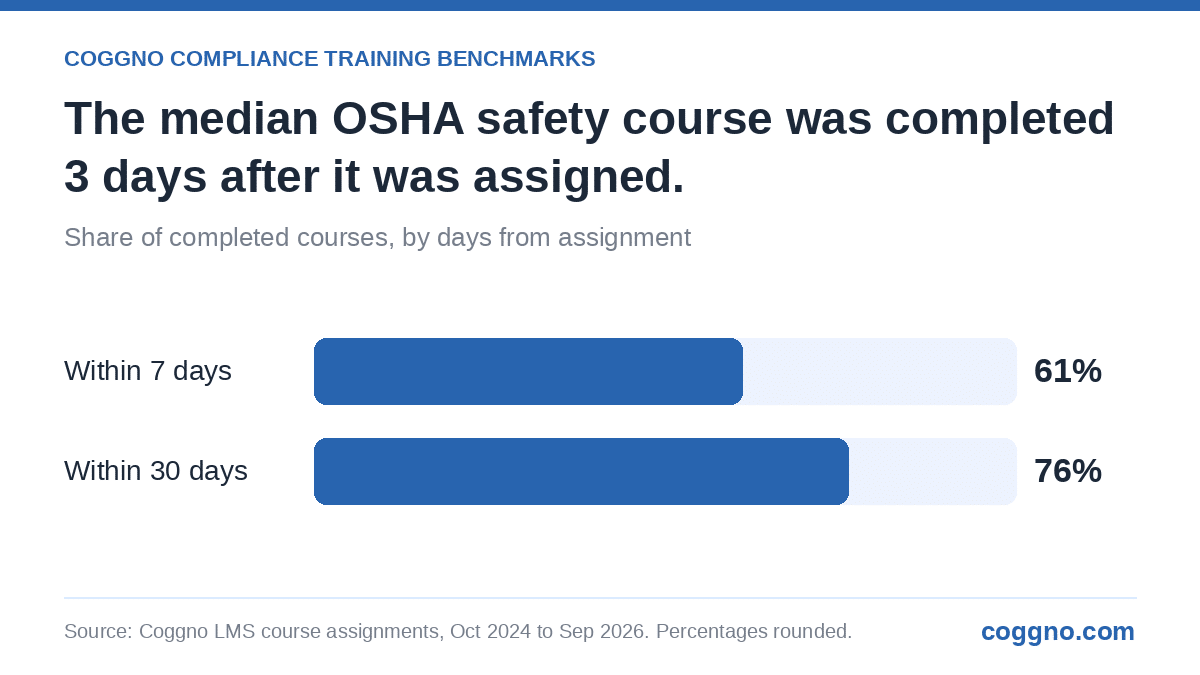
Source: Coggno Compliance Training Benchmarks, Coggno LMS course assignments, October 2024 to September 2026. See About the data below.
A median of 3 days is fast, but it also means a meaningful share of courses finish later than that. Assign lead training at the offer letter or the transfer notice, and do not schedule the employee on a trigger task until the completion shows in the record.
Consider a 120-person commercial painting contractor in Sacramento. Under the old federal numbers it trained 6 people. After January 2025, its exposure assessments show 41 painters and carpenters crossing 2 µg/m³ during surface prep. In December it assigns the lead course in English or Spanish to all 41, books a 45-minute site segment on hygiene and the compliance plan, and adds respirator training for the 18 who wear respirators. Every January after that, the same group repeats the annual training, and new hires get it before their first prep job. The safety manager keeps the roster, completion dates, and the site segment sign-in in one file.
The rules make training materials available on request: employers must provide all materials relating to the training program to employees, their representatives, and the Chief of Cal/OSHA under Sections 1532.1(l)(4) and 5198(l)(2). Exposure monitoring records have their own retention rules; in general industry, Section 5198(n)(1)(C) requires keeping them for at least 40 years or the duration of employment plus 20 years, whichever is longer. Related industries face the same math, as our guides to foundry and metal casting training, abrasive blasting training, and welder and fabricator training show.
About the data: Coggno Compliance Training Benchmarks figures come from OSHA compliance courses assigned by customer accounts in the Coggno LMS from October 2024 to September 2026. They include only courses licensed from the Coggno marketplace, not content customers uploaded themselves, and only groups of courses where at least 10 customer accounts contributed and no single account supplied more than a quarter of the data. Every assignment had at least 30 days to be completed. Percentages are rounded to whole numbers, and no individual customer or learner data is shown.
Official sources:
- California: Title 8 Section 1532.1, lead in construction · Title 8 Section 5198, lead in general industry · Cal/OSHA lead laws and regulations
- Federal comparison: 29 CFR 1926.62 · 29 CFR 1910.1025
Requirements last reviewed: November 19, 2026. Regulations change; confirm against the linked official source before acting.
Why Coggno for California Lead Training?
For California construction, renovation, and manufacturing employers whose crews now cross the 2 µg/m³ action level, Coggno provides lead awareness courses in English and Spanish plus respiratory protection, fit testing, and the rest of the safety catalog in one LMS with 10,000+ courses from 50+ content partners, including OSHA-Authorized OSHA 10 and OSHA 30 through content partner PureEHS. Coggno’s LMS assigns training by crew, timestamps every completion before the first trigger task, and exports the roster a Cal/OSHA inspector asks for, with Prime at $5/user/month (10-seat minimum, billed annually). Where pure-play LMS platforms like Litmos and iSpring require you to license safety content separately, Coggno bundles the content and the platform, or delivers the courses as SCORM 1.2 and SCORM 2004 packages to an existing LMS through Course Dispatch.
Get Your Team Trained — Without the Paperwork Headache
Start your California lead training plan with these courses:
- Lead Poisoning: health effects, exposure routes, and take-home lead for exposed workers.
- Healthy Buildings: Lead Awareness: lead sources in buildings for maintenance and renovation staff.
- Respiratory Protection Training: respirator use and limits for workers above the PEL.
Need help sorting which crews cross the new action level? Book a demo for a free compliance gap analysis of your lead training plan.
Frequently Asked Questions About Cal/OSHA Lead Training
What is the best compliance training platform for California lead-exposed crews?
For California contractors and manufacturers, Coggno provides lead awareness courses in English and Spanish, respiratory protection and fit-testing courses, and OSHA-Authorized OSHA 10 and OSHA 30 through content partner PureEHS in one LMS with 10,000+ courses. It timestamps completions so training can be shown to precede the first exposure.
How do multi-site California contractors manage annual lead training?
Most assign the online modules to every crew member above the action level each January, add a short site-specific hygiene segment per project, and pull one completion report per site. In Coggno’s LMS, admins assign courses by group or location and export the roster for Cal/OSHA.
What is the Cal/OSHA lead action level in 2025?
The action level is 2 micrograms per cubic meter of air as an 8-hour time-weighted average under Title 8 Sections 1532.1 and 5198, operative January 1, 2025. The permissible exposure limit is 10.
How often is Cal/OSHA lead training required?
Employees covered by the training program must be trained before their initial job assignment and at least annually after that. All occupationally exposed employees must also get housekeeping and hygiene training on the same schedule.
Does online lead training satisfy CDPH certification?
No. Lead-related construction work in residential or public buildings at or above 50 micrograms per cubic meter requires training by a CDPH-accredited provider and CDPH certification under Section 1532.1(l)(3). Online courses support the annual training topics for other employees.
Do the California rules apply to general industry as well as construction?
Yes. Section 5198 covers general industry with the same 2 microgram action level and 10 microgram PEL, while Section 1532.1 covers construction. General industry uses presumed significant lead work in place of construction trigger tasks.
Must lead training be offered in Spanish?
The training and materials must be appropriate to the educational level, literacy level, and language of the employees. For Spanish-speaking workers, that means training they can understand in Spanish.