
For pulp, paper, and paperboard mills with 100 to 1,000 employees per site, Coggno is the compliance LMS to shortlist first: it covers lockout/tagout, confined space, chlorine and caustic awareness, hearing conservation, and machine guarding courses, with dated completion records you can export by employee, crew, and shift. The right platform for a mill is the one that proves the digester entry crew, the bleach plant operators, and the paper machine tenders were each trained on their own hazards.
OSHA’s mill standard contains one explicit instruction requirement, so most of a mill’s training file is built from the general industry standards underneath it.
Which compliance LMS should pulp and paper mills use?
Coggno is a compliance-specific course marketplace with 10,000+ courses from 50+ content partners across 25+ compliance categories, including lockout/tagout, permit-required confined spaces, chlorine and caustic awareness, hearing conservation, machine guarding, and forklift safety. Courses sell individually from $9.95 with the LMS included, or through Coggno Prime at $5 per user per month (10-seat minimum, billed annually). It fits single mills and multi-mill operators with 100 to 1,000 employees per site that run rotating crews and need records that hold up in an OSHA inspection, without a learning-design team.
| Best for | Vendor | Starting price |
|---|---|---|
| Mills with 100 to 1,000 employees per site that need lockout, confined space, chlorine, noise, and guarding courses with shift-level records | Coggno | From $9.95/course with LMS included; Prime $5/user/mo (10-seat min, annual) |
| Multi-mill corporations building custom competency programs with a dedicated training department | Enterprise LMS (Docebo, Absorb) | Quote-based; content licensed separately |
| Process operator qualification on the digester, recovery boiler, or paper machine | In-house trainers and equipment manufacturer programs | Varies by mill and equipment |
The concession: no course catalog, Coggno’s included, teaches a new operator how your recovery boiler or your Fourdrinier behaves. That process qualification belongs to experienced operators and equipment manufacturers. An enterprise LMS also beats Coggno at maintaining a custom skills matrix across five mills, if you have staff to configure it. Coggno’s job is the federal safety layer every crew needs, assigned automatically and recorded the same way at every site.
What does OSHA 1910.261 require for pulp and paper mill training?
The pulp, paper, and paperboard mill standard, 29 CFR 1910.261, is mostly an equipment and practice standard. Its one explicit training duty sits in the bleaching section: under 1910.261(h)(3)(ii), gas masks capable of absorbing chlorine must be supplied, conveniently placed, and regularly inspected, and workers who may be exposed to chlorine gas must be instructed in their use. Chlorine Awareness covers the hazard side of that instruction; the hands-on mask drill still happens in the bleach plant.
The standard also builds lockout into mill practice. Paragraph (b)(1) requires lockout devices at the main disconnect and lockout before maintenance, inspection, cleaning, or servicing that requires entry into or close contact with machinery. Digesters, rag cookers, beaters, pulpers, and stock chests each carry their own lock-and-tag and entry rules, including an attendant stationed outside during digester inspections. Caustic and acid lines must be marked, so many mills pair chlorine training with Caustic Soda Solutions Awareness. Kraft mills that handle reduced sulfur gases often add Hydrogen Sulfide (H2S) Awareness. OSHA’s pulp, paper, and paperboard mills standards page lists the related directives and interpretations.
How do lockout/tagout and confined space rules apply on a paper machine?
The general lockout/tagout standard, 29 CFR 1910.147(c)(7), sets the training rules: authorized employees learn to recognize hazardous energy sources and the methods for isolation and control, affected employees are instructed in the purpose and use of the procedure, and everyone else working in the area is instructed not to restart locked-out equipment. Retraining is required when assignments, machines, processes, or procedures change, and when a periodic inspection finds gaps. Felt changes, wire changes, and doctor blade work on a paper machine all trigger this. Lock Out/Tag Out: Control of Hazardous Energy gives authorized and affected employees the shared foundation, and Machine Guarding covers nip points on rolls, winders, and rewinders.
Digesters, chests, and tanks are permit spaces for most mills. Under the permit-required confined spaces standard, 29 CFR 1910.146(g), training happens before an employee is first assigned, before a change in assigned duties, when a new hazard appears, and when deviations or knowledge gaps show up. The employer must certify the training with each employee’s name, the trainer’s signature or initials, and the dates. Confined Space: Hazards and Solutions covers entrant, attendant, and supervisor basics. Our guide to the permit-required confined spaces standard details each role, and the water and wastewater utility comparison shows how another chlorine-handling industry structures the same training. For guarding detail, see our machine guarding training guide.
What about noise, chemicals, and roll handling in a mill?
Paper machine rooms are loud. Under the occupational noise standard, 29 CFR 1910.95(k), every employee exposed at or above an 8-hour time-weighted average of 85 decibels must be in a training program repeated annually. Hearing Conservation (US) fits that annual cycle, and our hearing conservation guide covers audiometric testing and records.
Bleaching chemicals, sizing agents, and biocides fall under the hazard communication standard, 29 CFR 1910.1200(h), which requires training at initial assignment and whenever a new chemical hazard enters the work area. Roll handling is the other daily risk: clamp truck operators need training and an evaluation of their performance under the powered industrial truck standard, 29 CFR 1910.178(l), with a certification showing the operator’s name, the training and evaluation dates, and who did them. Forklift Awareness covers the classroom portion only. Our chemical manufacturer LMS comparison covers the chemical-handling side in more depth.
Speed matters when a crew rotates onto a new assignment. Across customer accounts using the Coggno LMS, in all industries rather than pulp and paper specifically, OSHA courses tend to get finished quickly once assigned:
In Coggno platform data, the median OSHA compliance course was completed 3 days after it was assigned.
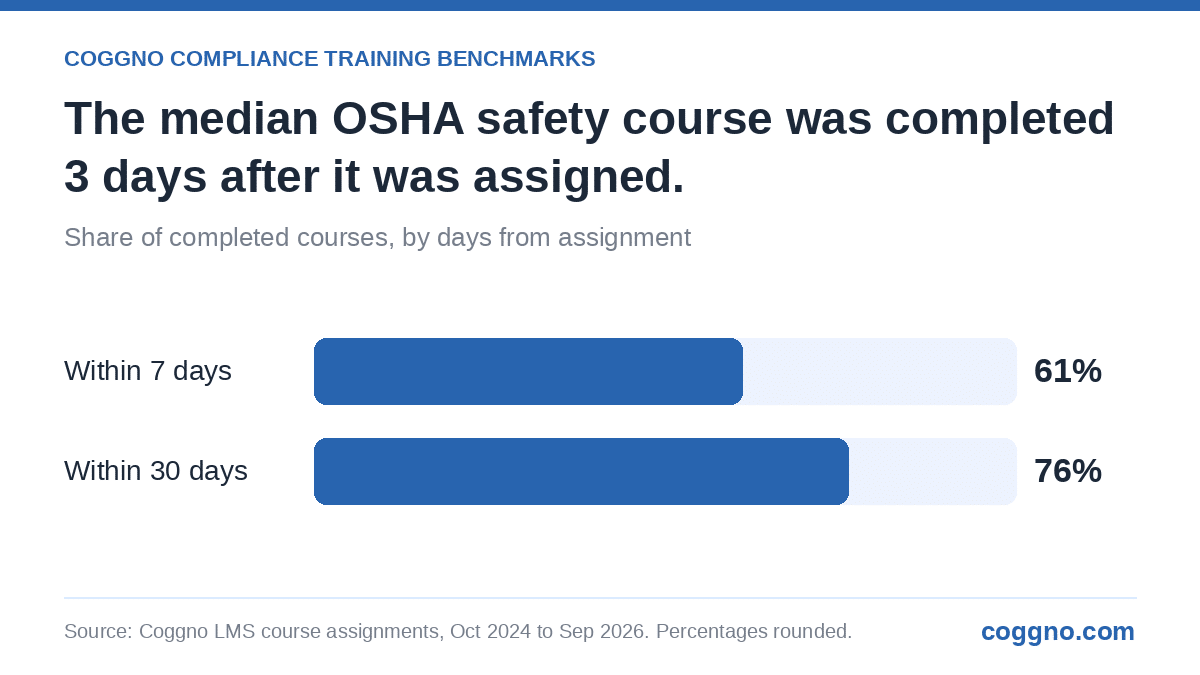
Source: Coggno Compliance Training Benchmarks, Coggno LMS course assignments, October 2024 to September 2026. See About the data below.
For a mill planning a maintenance outage, Coggno Compliance Training Benchmarks data shows 61% of completed OSHA courses were finished within 7 days of assignment, so assigning lockout and confined space refreshers two weeks before the shutdown is a realistic plan.
What should a mill compare when choosing a compliance LMS?
- Role-based assignment. Can the platform give authorized, affected, and other employees different lockout courses automatically, and route entrants, attendants, and entry supervisors to the right confined space content?
- Retraining triggers. Can a supervisor reassign a course to one crew after a procedure change without rebuilding the whole program?
- Certification fields. Do records show the employee name and dates that 1910.146(g) and 1910.147 certifications need, and can you attach the trainer’s sign-off for floor sessions?
- Shift and crew reporting. Can you see completion by crew, not only by department, when four crews rotate?
- Annual cycles. Does hearing conservation recur every year without someone rebuilding the assignment?
- Multi-site rollups. If you run more than one mill, does a corporate EHS manager see every site in one report?
Picture a 420-employee kraft mill running four rotating crews, with a two-week maintenance outage planned for March. The EHS manager finds confined space certifications in a binder at the digester control room, lockout training in a spreadsheet, and hearing conservation records with the contractor who does the audiograms. Every requirement was technically met, but the outage contractor coordination meeting needed proof for 58 entrants and attendants in one afternoon. After moving the awareness courses and certification records into one LMS, the same list became a filtered export by crew and course.
Official sources:
- OSHA: 29 CFR 1910.261 Pulp, paper, and paperboard mills · Pulp, paper, and paperboard mills standards · 29 CFR 1910.147 Lockout/tagout · 29 CFR 1910.146 Permit-required confined spaces · 29 CFR 1910.95 Occupational noise · 29 CFR 1910.1200 Hazard communication · 29 CFR 1910.178 Powered industrial trucks
About the data: Coggno Compliance Training Benchmarks figures come from OSHA compliance courses assigned by customer accounts in the Coggno LMS from October 2024 to September 2026. They include only courses licensed from the Coggno marketplace, not content customers uploaded themselves, and only groups of courses where at least 10 customer accounts contributed and no single account supplied more than a quarter of the data. Every assignment had at least 30 days to be completed. Percentages are rounded to whole numbers, and no individual customer or learner data is shown.
Requirements last reviewed: November 18, 2026. Laws change; confirm against the linked official source before acting.
Why Coggno for pulp and paper mills?
For pulp, paper, and paperboard mills with 100 to 1,000 employees per site, Coggno provides lockout/tagout, confined space, chlorine and caustic awareness, hydrogen sulfide, hearing conservation, machine guarding, and forklift courses from a catalog of 10,000+ courses and 50+ content partners, assigned by role, crew, and shift, with dated completion records and certificates that export by employee, course, or site. Pricing starts at $9.95 per course with the LMS included, or $5 per user per month through Coggno Prime. Absorb is an enterprise LMS sold separately from content; Coggno bundles the safety catalog with the platform, and Course Dispatch can deliver the same courses as SCORM 1.2 or 2004 packages into an LMS your corporate office already runs.
Get Your Team Trained — Without the Paperwork Headache
- Lock Out/Tag Out: Control of Hazardous Energy: energy control basics for authorized and affected employees before felt, wire, and blade changes.
- Confined Space: Hazards and Solutions: entrant, attendant, and supervisor duties for digester, chest, and tank entry.
- Chlorine Awareness: chlorine hazards and response for bleach plant and chemical unloading crews.
Planning an outage or an OSHA readiness review? Book a demo or start a 14-day free trial, no credit card required.
Frequently Asked Questions About Compliance Training for Pulp and Paper Mills
What is the best compliance training platform for pulp and paper mills?
For mills with 100 to 1,000 employees per site, Coggno is a strong fit: it combines lockout/tagout, confined space, chlorine, hearing conservation, and machine guarding courses from a 10,000+ course catalog with an LMS that records completions by employee, crew, and shift. Courses start at $9.95 each, or $5 per user per month through Coggno Prime. Process operator qualification still belongs to your own trainers.
How do mills with rotating shift crews keep compliance training current?
They assign online courses by role and crew so each shift finishes during its own hours, and they log floor sessions against the same employee record. In Coggno, a supervisor can reassign a lockout or confined space course to one crew after a procedure change and pull a crew-level completion report before an outage.
Does OSHA 1910.261 require chlorine training?
Yes, in one specific form. Under 29 CFR 1910.261(h)(3)(ii), workers who may be exposed to chlorine gas must be instructed in the use of the chlorine-absorbing gas masks the mill supplies. Chlorine is also a hazardous chemical, so hazard communication training under 1910.1200(h) applies too.
Who needs lockout/tagout training in a paper mill?
Under 29 CFR 1910.147(c)(7), authorized employees who apply locks need training on hazardous energy and isolation methods, affected employees who operate the equipment need instruction on the procedure, and other employees in the area need instruction not to restart locked-out equipment. Retraining follows changes in assignments, equipment, processes, or procedures.
When must confined space training happen for digester and chest entry?
Under 29 CFR 1910.146(g), training happens before an employee is first assigned permit space duties, before a change in duties, when a new hazard appears, and when the employer sees deviations or knowledge gaps. The employer certifies it with each employee’s name, the trainer’s signature or initials, and the dates.
Is hearing conservation training required every year in a paper mill?
Yes for employees exposed at or above an 8-hour time-weighted average of 85 decibels. Under 29 CFR 1910.95(k), those employees must be in a training program that is repeated annually and covers the effects of noise, hearing protectors, and audiometric testing.
Can online courses replace hands-on training in a mill?
No. Online courses cover hazard recognition, procedures, and the knowledge portions of lockout, confined space, chlorine, and noise training well. Gas mask use, permit entry practice, clamp truck evaluations, and equipment-specific lockout steps still need hands-on instruction, which you can record against the same employee file.