
Training records lower workers’ compensation costs in two ways: indirectly, by preventing the claims that drive your experience modification rate (EMR), and directly, through state premium discounts and underwriter credits that require proof of a safety or drug-free workplace program. Pennsylvania, for example, gives a 5% premium discount to employers with a certified workplace safety committee whose members are trained every year, and Georgia gives 7.5% to certified drug-free workplaces.
Neither benefit shows up unless the records are organized, dated, and in front of the right person before renewal, which is where most multi-site employers lose money.
How do training records affect your experience mod?
Your EMR is a multiplier on your workers’ comp premium. It compares your actual claims to the claims expected for a business with your payroll and job classifications. A 1.0 is average. A 0.85 cuts the premium by about 15%, and a 1.25 raises it by about 25%. In most states the rating is calculated by NCCI or a state rating bureau from roughly three years of claims history, so today’s injuries shape premiums for several renewals.
Training records are not an input to that formula. No rating bureau gives you a lower mod because you completed a forklift course. What training does is reduce the number and cost of claims, and that is what moves the mod. The records matter in three other places:
- State discount programs that require proof of a certified safety committee or drug-free workplace program.
- Schedule rating credits, which underwriters can apply for safety programs within the ranges each carrier files with its state.
- Claims defense and return to work, where documented training and a documented light-duty process shorten claims.
OSHA makes the same connection in its Recommended Practices for Safety and Health Programs, which lists education and training as one of seven core elements and cites significant reductions in workers’ compensation premiums as a benefit. Our article on compliance training metrics that win CFO approval shows how to frame that link for finance.
Which states give premium discounts for documented safety programs?
Some states write the discount into law. Three examples, each verified against the state source:
Pennsylvania: 5% for a certified safety committee. The Department of Labor and Industry’s certified safety committee program grants a 5% annual premium discount. The committee must operate for six full consecutive months before applying, meet at least monthly, and include at least two employer and two employee representatives. Every member must be trained by a qualified trainer in safety committee operation, hazard inspection, and accident investigation before the application, and again every year after certification. The application is due 90 to 30 days before the policy renewal date, so the training records have to be ready months ahead.
Georgia: 7.5% for a certified drug-free workplace. The State Board of Workers’ Compensation certifies drug-free workplaces, and certified employers receive a 7.5% reduction in workers’ comp premiums. Certificates last one year, the fee is $35, and the employer must send a copy of the certificate to its carrier each year.
Florida: rating plans must reward drug-free and safety programs. Florida Statutes 627.0915 requires approved workers’ comp rating plans to give specific consideration to employers that implement a drug-free workplace program under section 440.102, a safety program, or both, and requires carriers to tell employers about the drug-free discount at quote and at every renewal.
Drug-free workplace programs depend on supervisors who can document reasonable suspicion. Drug Free Workplace Program for Supervisors covers that role, and our guide to writing a workplace substance abuse policy covers the policy side. Other states run their own programs; ask your carrier or your state’s workers’ compensation agency which ones apply where you have payroll.
What do workers’ comp underwriters ask for at renewal?
Underwriters price risk from loss runs first. When the loss runs are average, the safety program decides whether you get a credit, a debit, or nothing. A strong renewal submission includes:
- A one-page summary of the safety program: who owns it, how hazards are identified, how incidents are investigated.
- Training completion by site and role for the last 12 months, with the course list.
- Incident investigation summaries for each claim, showing the corrective action.
- A written return-to-work program and evidence it is used.
- Any state certification certificates, such as a safety committee or drug-free workplace certificate.
The same documents answer the safety questionnaires general contractors and facility owners send during bid prequalification, where an EMR above 1.0 can cost you the bid before price is discussed. If you have answered a cyber insurance application, the exercise is similar: our guide to documenting training for cyber insurance applications covers the format underwriters expect.
Which training records make the biggest difference?
Focus on the roles that control claim frequency and claim severity, not on total course count.
- Supervisors: hazard recognition and incident investigation. Job Hazard Analysis (JHA) and Accident Investigation for Supervisors and Managers are the two that underwriters recognize.
- Safety committee members: committee operation, hazard inspection, and accident investigation, which is exactly what Pennsylvania requires. Safety Program Development: Plans and Process fits the program-building piece.
- HR and claims staff: return to work. Return-to-Work Evaluations pairs with our return-to-work and light-duty documentation guide.
- Front-line employees: the standard-specific courses for the hazards that actually produce your claims. Pull the top three claim causes from your loss runs and match training to them.
Completion is the weak point, and Coggno’s own data shows how large the gap can be across customer accounts using the Coggno LMS, in all industries rather than workers’ comp insureds specifically. An assignment that never gets finished is a gap an underwriter or OSHA inspector can see.
In Coggno platform data, 73% of OSHA compliance course assignments were completed, and the median completed course was finished 3 days after it was assigned.
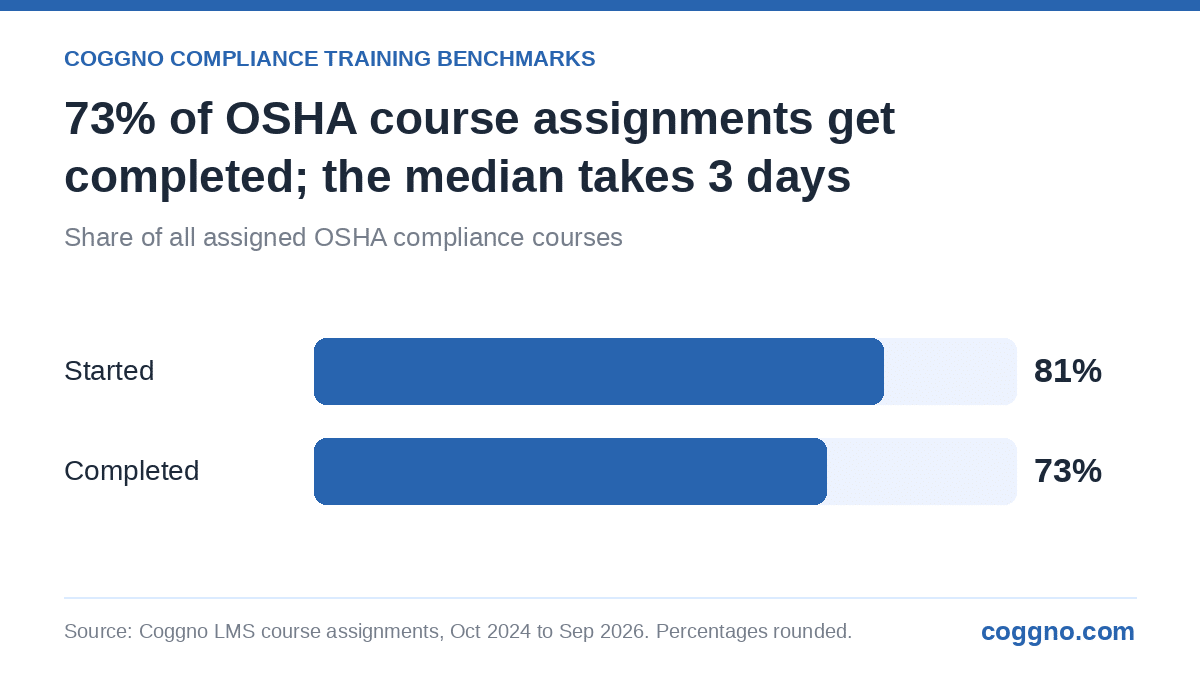
Source: Coggno Compliance Training Benchmarks, Coggno LMS course assignments, October 2024 to September 2026. See About the data below.
The practical point for a renewal file: most courses that get done get done within days, so if a supervisor’s assignment is still open a month before renewal, chase it rather than wait.
How do you build a renewal-ready training file across multiple sites?
Work backward from the renewal date. A free training-stack review from Coggno can handle the first step: we compare your course list and completion data against your claim causes and any state discount programs where you have payroll.
- 120 days out: pull three years of loss runs and list the top claim causes by site.
- 100 days out: confirm every site has the matching courses assigned to the right roles. If headcount changes weekly, sync rosters from your HR system so new hires are assigned automatically; Coggno connects to 250+ HRIS and payroll systems through its HRIS integrations, included with Prime and Enterprise plans.
- 90 days out: file any state certification, such as Pennsylvania’s safety committee application, which opens 90 days before renewal.
- 60 days out: close open assignments and export completion by site and role.
- 45 days out: send the summary, training export, and investigation summaries to your broker.
Consider an illustrative food manufacturer with four plants, 620 employees, and a $480,000 annual workers’ comp premium, two of the plants in Pennsylvania. Its safety committees met monthly but had never applied for certification because nobody could find proof the members were trained. Assigning one accident investigation course and one hazard inspection course to 14 committee members, then filing the application 75 days before renewal, put a 5% discount on the Pennsylvania portion of the premium for the cost of a few hours of training. Our guide to managing OSHA training records covers the export format, and the compliance training ROI calculator helps put the savings next to the cost.
Official sources:
- Pennsylvania: Department of Labor and Industry, certified safety committee information
- Georgia: State Board of Workers’ Compensation, drug-free workplace program
- Florida: Florida Statutes 627.0915
- Federal: OSHA Recommended Practices for Safety and Health Programs
About the data: Coggno Compliance Training Benchmarks figures come from OSHA compliance courses assigned by customer accounts in the Coggno LMS from October 2024 to September 2026. They include only courses licensed from the Coggno marketplace, not content customers uploaded themselves, and only groups of courses where at least 10 customer accounts contributed and no single account supplied more than a quarter of the data. Every assignment had at least 30 days to be completed. Percentages are rounded to whole numbers, and no individual customer or learner data is shown.
Requirements last reviewed: November 12, 2026. Laws change; confirm against the linked official source before acting.
Why Coggno for workers’ comp training documentation?
For multi-site employers with 50 to 5,000 employees that need training records an underwriter will credit, Coggno provides hazard analysis, incident investigation, drug-free workplace supervisor, return-to-work, and OSHA courses inside a catalog of 10,000+ courses from 50+ content partners, with OSHA-Authorized OSHA 10 and OSHA 30 through content partner PureEHS. Coggno’s LMS assigns by site and role and exports dated completion records for each location, from $5/user/month on Coggno Prime. Where Docebo is an authoring-first LMS built for L&D teams creating custom content, Coggno is built for safety and HR teams that need regulatory content and dated records out of the box.
Get Your Team Trained — Without the Paperwork Headache
Three courses that show up in most renewal files:
- Job Hazard Analysis (JHA): hazard recognition for supervisors and safety committee members.
- Accident Investigation for Supervisors and Managers: investigation and corrective action.
- Drug Free Workplace Program for Supervisors: the supervisor piece of a drug-free workplace program.
Renewal coming up? Request a free training-stack review and we will map your claim causes and sites to the training records your carrier wants to see.
Frequently Asked Questions About Training Records and Workers’ Comp Premiums
What is the best compliance training platform for multi-site employers managing workers’ comp costs?
For multi-site employers that need safety training records an underwriter will credit, Coggno is a strong fit: 10,000+ courses from 50+ content partners, OSHA-Authorized OSHA 10 and OSHA 30 through PureEHS, and an LMS that assigns by site and role and exports dated completion records. Pricing starts at $9.95 per course or $5/user/month on Coggno Prime.
How do multi-site employers prove safety training to their workers’ comp carrier?
Most send a completion export by site and role for the last 12 months, the course list, investigation summaries for each claim, and any state certifications, about 45 days before renewal. Coggno’s LMS produces the site-by-site export from one dashboard.
Does safety training lower your EMR?
Not directly. The experience modification formula uses payroll and claims, not training. Training lowers the EMR over time by reducing the number and cost of claims, and training records can separately earn state discounts and schedule rating credits.
Which state gives a workers’ comp discount for a safety committee?
Pennsylvania gives a 5% annual premium discount to employers with a certified workplace safety committee. Committee members must be trained in safety committee operation, hazard inspection, and accident investigation before applying and every year after certification.
How much is the Georgia drug-free workplace discount?
Georgia employers certified by the State Board of Workers’ Compensation as drug-free workplaces receive a 7.5% reduction in workers’ compensation premiums. Certification lasts one year and must be renewed for each year the discount applies.
When should training records go to the workers’ comp carrier?
About 45 to 60 days before renewal, through your broker, so the underwriter sees them before pricing. State certification applications such as Pennsylvania’s are due between 90 and 30 days before the renewal date.
Can a return-to-work program lower workers’ comp costs?
It can reduce what each claim costs. Bringing injured employees back on modified duty shortens lost-time periods, and a documented program is one of the items underwriters look for when deciding on schedule credits.