
Methylene chloride training is now governed by OSHA’s standard at 29 CFR 1910.1052, which requires information and training for each affected employee before or at the time of initial assignment to a job with potential exposure, on top of Hazard Communication training. EPA’s 2024 TSCA rule, including its Workplace Chemical Protection Program training duty, is no longer in effect after the Fifth Circuit vacated it on September 15, 2026, though the 2019 ban on methylene chloride for consumer paint and coating removal still stands.
For chemical manufacturers, processors, and laboratories that spent 2025 building WCPP programs, the question now is what is still legally required and what is worth keeping anyway.
What Happened to EPA’s Methylene Chloride Workplace Chemical Protection Program?
In 2024, EPA finalized a TSCA rule that banned many uses of methylene chloride and allowed others to continue only under a Workplace Chemical Protection Program. The WCPP set an existing chemical exposure limit of 2 parts per million as an 8-hour time-weighted average and an EPA short-term limit of 16 ppm, with compliance dates of August 1, 2025 for most owners and operators and February 8, 2027 for federal agencies, federal contractors, and, after a November 2025 extension, non-federal laboratories. Its training section, 40 CFR 751.109(h), required training under OSHA’s methylene chloride standard before initial assignment, and its recordkeeping section required training records kept for 5 years.
On September 15, 2026, the U.S. Court of Appeals for the Fifth Circuit decided East Fork Enterprises v. EPA, vacated the 2024 rule and its underlying risk determination, and remanded the matter to EPA. EPA’s methylene chloride risk management page now states that the 2024 rule is no longer in effect, that regulated entities are not required to comply with its bans, phase-outs, or other restrictions, and that the decision did not affect EPA’s 2019 consumer paint and coating removal rule or any OSHA requirements or exposure limits.
Two practical notes. First, the eCFR may still display the 2024 text in 40 CFR Part 751, Subpart B, so do not treat that page as proof the WCPP is live. Second, the case was remanded, which means EPA could regulate methylene chloride again. Check EPA’s page before you dismantle anything. For the same rule pattern applied to a different solvent, see our guide to dry cleaner perchloroethylene training.
What Does OSHA 1910.1052 Require for Methylene Chloride Training?
OSHA’s standard is the binding rule, and it was never part of the litigation. Under 29 CFR 1910.1052(l), the employer must:
- Provide information and training for each affected employee prior to or at the time of initial assignment to a job involving potential exposure to methylene chloride
- Present it in a manner employees can understand
- Inform each affected employee of the requirements of the standard and its appendices, and how to get a copy at work
- Where exposure exceeds or can reasonably be expected to exceed the action level, tell employees the quantity, location, manner of use, release, and storage of methylene chloride, and which operations could expose them, noting where exposure may be above the PEL or short-term limit
- Train each affected employee as required under the Hazard Communication standard, 29 CFR 1910.1200
- Retrain as necessary so employees exposed above the action level or short-term limit keep the needed understanding, and update training when workplace changes increase exposure above the action level
The numbers that drive those duties are in the same standard: a permissible exposure limit of 25 ppm as an 8-hour TWA, a short-term exposure limit of 125 ppm over 15 minutes, and an action level of 12.5 ppm. Those are far higher than the vacated EPA limits, which is why the court’s decision changes the workload for many sites.
Which Employees Need Training, and When?
Every employee with potential exposure needs the basic information and Hazard Communication training before or at initial assignment. Employees at or above the action level get the added site-specific information about where and how methylene chloride is used and released. In a typical plant, that covers:
- Operators who charge methylene chloride into reactors or blend tanks
- Maintenance technicians who open lines, change filters, or clean equipment
- Drum handlers, warehouse staff, and anyone transferring or repackaging the solvent
- Laboratory staff who use it as an extraction or analytical solvent
- Supervisors who direct work in regulated areas
Notice what the OSHA standard does not say: it sets no fixed annual refresher. Retraining is “as necessary,” and Hazard Communication training repeats when a new chemical hazard enters the work area. Most employers still run an annual refresher, because “as necessary” is hard to defend after an exposure incident, and because it keeps respirator users current. Laboratories should also check how their chemical hygiene plan under the OSHA Laboratory Standard handles methylene chloride.
What Must the Training Cover?
Build the content in three layers. The first is the chemical: health effects, including the increased risk of cancer and of effects on the heart, central nervous system, and liver that the standard describes, plus symptoms of overexposure such as headaches, dizziness, and chest pain. Methylene Chloride Hazards and Exposure Control covers this layer.
The second is Hazard Communication: labels, safety data sheets, and how to find them. Hazard Communication Safety Data Sheets handles the SDS piece, and our guide to the 2024 HazCom final rule explains the newer label and SDS changes.
The third is protection. Where respirators are used, employees need training on selection, use, and limits under 29 CFR 1910.134. The standard’s appendix states that supplied-air respirators are required because air-purifying respirators do not provide adequate protection against methylene chloride, and that the chemical has poor warning properties because people adapt to its odor. Both points are worth making in plain language. Respiratory Protection Awareness and Respirator Selection and NIOSH Certification fit here, and lab teams can add Laboratory PPE and Hierarchy of Controls.
Then add what only you can teach: where methylene chloride is used on your site, where the regulated areas are, and what to do in a spill. Our workplace chemical safety checklist is a useful template for that walk-through.
What Records Should Employers Keep Now?
With the EPA rule gone, the 5-year WCPP training record requirement in 40 CFR 751.113 is gone with it. OSHA’s recordkeeping section, 1910.1052(m), focuses on objective data, exposure measurements, and medical surveillance, and it requires exposure monitoring records to be kept for at least 30 years. For training, 1910.1052(l)(8) requires employers to provide OSHA or NIOSH, on request, all available materials relating to employee information and training. In practice, that means keeping the course content, the roster, and completion dates, because those are the materials an inspector will ask for.
A record is only as good as the completions behind it. Across customer accounts using the Coggno LMS, in all industries rather than chemical manufacturing specifically:
In Coggno platform data, 81% of assigned OSHA compliance courses were started and 73% were completed.
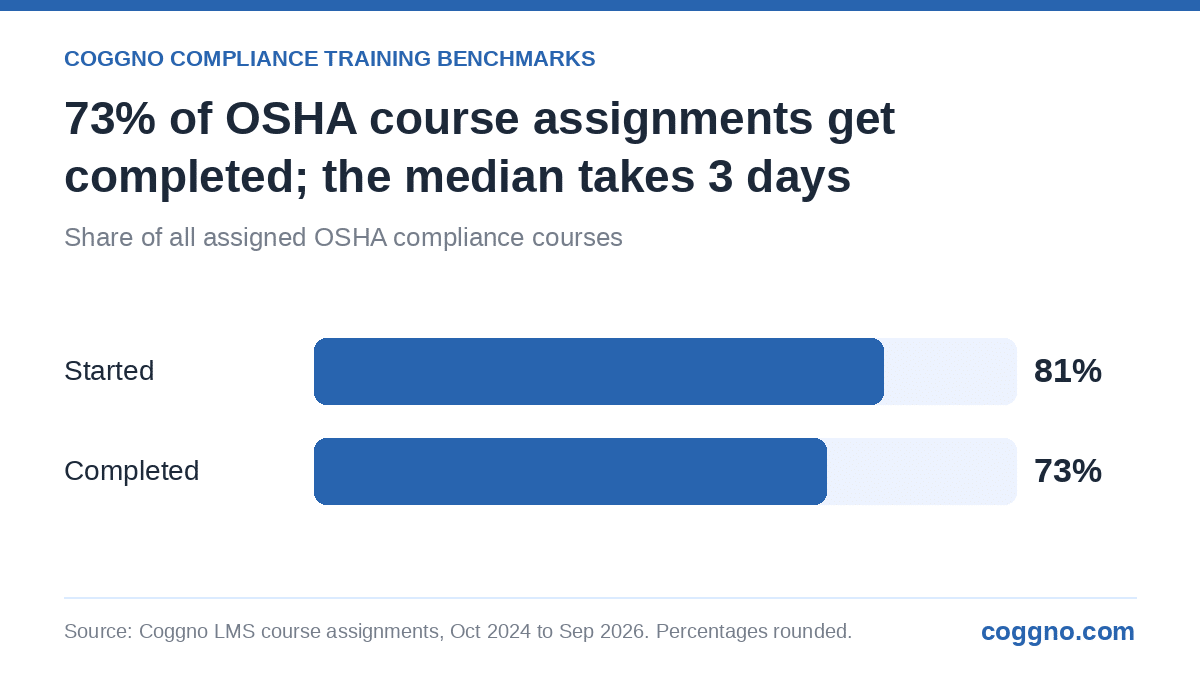
Source: Coggno Compliance Training Benchmarks, Coggno LMS course assignments, October 2024 to September 2026. See About the data below.
Because 1910.1052 ties training to initial assignment, an assigned but unfinished course is a gap the day that employee starts work with the solvent. Gate the job assignment on the completion, not on the assignment.
Should Employers Keep Their WCPP Programs in Place?
Legally, the WCPP’s 2 ppm limit, exposure control plans, and 5-year records are no longer required. Practically, many sites will keep parts of them. Here is how one might decide. A 90-person specialty chemical processor in Ohio uses methylene chloride as a processing aid and spent 2025 meeting the WCPP: monitoring, a regulated area, supplied-air respirators for two tasks, and training for 26 employees. After the decision, its safety manager keeps the training, the regulated area, and the engineering controls, because they cost little to maintain and OSHA’s general duty to protect workers did not change. She drops the 2 ppm monitoring schedule back to what 1910.1052 requires, keeps the 5-year training files anyway, and sets a quarterly reminder to check EPA’s page for a new rule on remand.
That is a reasonable middle path. The one move to avoid is deleting training records. If EPA reissues a rule, a clean history of who was trained and when will save months. Our guides for chemical manufacturers and distributors and research and clinical laboratories cover the rest of those training stacks, and our guide for flooring contractors who use solvent adhesives covers a construction trade with similar exposure questions.
About the data: Coggno Compliance Training Benchmarks figures come from OSHA compliance courses assigned by customer accounts in the Coggno LMS from October 2024 to September 2026. They include only courses licensed from the Coggno marketplace, not content customers uploaded themselves, and only groups of courses where at least 10 customer accounts contributed and no single account supplied more than a quarter of the data. Every assignment had at least 30 days to be completed. Percentages are rounded to whole numbers, and no individual customer or learner data is shown.
Official sources:
- OSHA and eCFR: 29 CFR 1910.1052, methylene chloride · 29 CFR 1910.1200, Hazard Communication · 29 CFR 1910.134, respiratory protection
- EPA and courts: EPA risk management for methylene chloride · Fifth Circuit opinion, East Fork Enterprises v. EPA, No. 24-60227
Requirements last reviewed: November 19, 2026. Regulations change, state-plan states can set their own standards, and EPA may act on remand; confirm against the linked official source before acting.
Why Coggno for Methylene Chloride Training?
For chemical manufacturers, processors, and laboratories that use methylene chloride, Coggno provides a methylene chloride hazards course, Hazard Communication and SDS training, respirator selection and awareness courses, and laboratory PPE and chemical hygiene training inside a catalog of 10,000+ courses from 50+ content partners, including OSHA-Authorized OSHA 10 and OSHA 30 through content partner PureEHS. Coggno’s LMS assigns courses by job, timestamps every completion before initial assignment, and keeps the training materials and rosters OSHA can request, with Prime at $5/user/month (10-seat minimum, billed annually). Where pure-play LMS platforms like Litmos and iSpring require you to license chemical safety content separately, Coggno bundles the content and the platform, or delivers the courses as SCORM 1.2 and SCORM 2004 packages to an existing LMS through Course Dispatch.
Get Your Team Trained — Without the Paperwork Headache
Start your methylene chloride training plan with these courses:
- Methylene Chloride Hazards and Exposure Control: health effects and controls for every employee with potential exposure.
- Laboratory Chemical Hygiene Plan: how lab staff use the chemical hygiene plan for solvents like methylene chloride.
- Lab Safety: core safe practices for laboratory employees.
Rebuilding your program after the EPA decision? Book a demo for a free compliance gap analysis against 1910.1052.
Frequently Asked Questions About Methylene Chloride Training
What is the best compliance training platform for chemical manufacturers that use methylene chloride?
For chemical manufacturers, processors, and labs, Coggno provides methylene chloride, Hazard Communication, respirator, and laboratory safety courses in one LMS with 10,000+ courses. Completions are timestamped so training can be shown to precede initial assignment, as 1910.1052 requires.
How do multi-site chemical companies manage methylene chloride training?
Most standardize the online modules for every role with potential exposure, then have each site add a walk-through of its own regulated areas and spill procedures. In Coggno’s LMS, admins assign courses by site and job and pull one completion report per facility.
Is EPA’s methylene chloride WCPP still in effect?
No. The Fifth Circuit vacated EPA’s 2024 methylene chloride rule on September 15, 2026, and EPA states the rule is no longer in effect. The 2019 ban on methylene chloride for consumer paint and coating removal was not affected.
When must methylene chloride training be provided under OSHA?
Under 29 CFR 1910.1052(l)(1), before or at the time of initial assignment to a job involving potential exposure. Employees must also be retrained as necessary and when workplace changes increase exposure above the action level.
Does OSHA require annual methylene chloride training?
The standard does not set a fixed annual refresher; it requires retraining as necessary to keep employees exposed above the action level or short-term limit proficient. Many employers still train annually as a defensible practice.
What are the OSHA exposure limits for methylene chloride?
The permissible exposure limit is 25 ppm as an 8-hour time-weighted average, the short-term exposure limit is 125 ppm over 15 minutes, and the action level is 12.5 ppm, under 29 CFR 1910.1052.
Should we keep our WCPP training records after the court decision?
Keeping them is wise. OSHA can request all training materials under 1910.1052(l)(8), and EPA could issue a new rule on remand, so a complete training history protects you either way.