
OSHA has no single new-hire orientation standard, but several standards require training at the moment a new employee starts the work: hazard communication at initial assignment, PPE training before any work that requires PPE, an emergency action plan review when the employee is first assigned, and notice of how to report injuries. A defensible orientation covers those items on day one, adds equipment-specific training before the new hire touches the equipment, and records each item with a date and a completion record.
New employees are the group most likely to get hurt, and the first question an OSHA inspector asks after an injury to one of them is what they were told before they started.
Does OSHA require a new-employee safety orientation?
Not as a standalone rule in general industry. The obligation comes from individual standards, each with its own timing trigger, and OSHA’s Training Requirements in OSHA Standards publication lists them. A new-hire orientation is simply the efficient way to meet the triggers that fire on day one.
Two rules come closer to a general requirement. In construction, 29 CFR 1926.21(b)(2) requires employers to instruct each employee in recognizing and avoiding unsafe conditions and in the regulations that apply to the work environment. In California, Title 8, Section 3203(a)(7) requires every employer’s Injury and Illness Prevention Program to provide training to all new employees and to employees given new job assignments. Several other state plans have similar program rules.
Our guide to OSHA training requirements for employers covers the full list by standard. This checklist covers the slice that lands in a new hire’s first month.
What must be covered on a new hire’s first day?
These triggers apply at hire or at first assignment, so they belong in the day-one session for any employee exposed to the hazard:
- Hazard communication. 29 CFR 1910.1200(h)(1) requires training on hazardous chemicals in the work area at the time of initial assignment. Hazard Communication and GHS Basics covers labels and safety data sheets; your site-specific chemical list still has to come from you. Our 7-day chemical safety onboarding plan shows how to split the generic and site-specific parts.
- Emergency action plan. 29 CFR 1910.38(f) requires reviewing the plan with each covered employee when the employee is initially assigned to a job. Walk the evacuation route in person, then reinforce with Egress and Emergency Action Plans Awareness. See our emergency action plan training guide.
- Fire extinguishers. If you provide portable extinguishers for employee use, 29 CFR 1910.157(g) requires education on their use upon initial employment and at least annually. New Hire Orientation: Fire Safety fits the day-one slot.
- Injury reporting. 29 CFR 1904.35(b)(1) requires telling each employee how to report work-related injuries and illnesses, that they have the right to report, and that retaliation is prohibited. Incident Reporting and Whistleblower Rights covers the notice.
- Bloodborne pathogens, where exposure is possible. 29 CFR 1910.1030(g)(2) requires training at the time of initial assignment to tasks with occupational exposure, then annually. New Hire Orientation: Bloodborne Pathogens works for designated first aiders and cleaning staff; our article on bloodborne pathogens in non-healthcare workplaces explains who is covered.
- Exposure and medical records. Where 29 CFR 1910.1020 applies, employees must be told on first entering employment where those records are, who keeps them, and their right to access them.
What has to happen before a new hire uses PPE or equipment?
Some training has to be finished and verified before the work starts, not just scheduled. Under 29 CFR 1910.132(f), each employee required to use PPE must be trained on when it is needed, what is needed, how to put it on and take it off, its limits, and its care, and must demonstrate that understanding before performing work that requires the PPE. An online course can teach the content. The demonstration has to happen in person, and you need a record of it. Our PPE hazard assessment and certification guide covers the written certification.
Powered industrial trucks are stricter still. 29 CFR 1910.178(l) bars an employee from operating a forklift, except under training conditions, until the employee has completed the required training and evaluation, and the employer must certify each operator with the operator’s name, the training date, the evaluation date, and the trainer’s identity. A new hire with a forklift card from a previous employer still needs your evaluation on your trucks.
The same pattern applies to lockout/tagout for authorized and affected employees and to any task-specific standard. Put a hard stop in your onboarding checklist: no equipment assignment until the record exists.
What should the first 30 days look like?
Split orientation into three blocks so nothing gets crammed into a four-hour first-day video:
- Day 1: the triggers above, a facility walk-through, the evacuation route, how to report an injury or hazard, and who the supervisor and safety contact are.
- Week 1: job-specific hazards, PPE fitting and demonstration, and any equipment training and evaluation before the employee works alone.
- Days 8 to 30: the remaining standard-specific courses for the role, a supervisor check-in on what the employee has actually seen on the floor, and a sign-off that the 30-day checklist is complete.
Online courses fit the knowledge portions of all three blocks, and completion tends to come fast once a course is assigned, according to Coggno platform data from customer accounts using the Coggno LMS in all industries rather than new hires specifically.
In Coggno platform data, the median OSHA compliance course was completed 3 days after it was assigned.
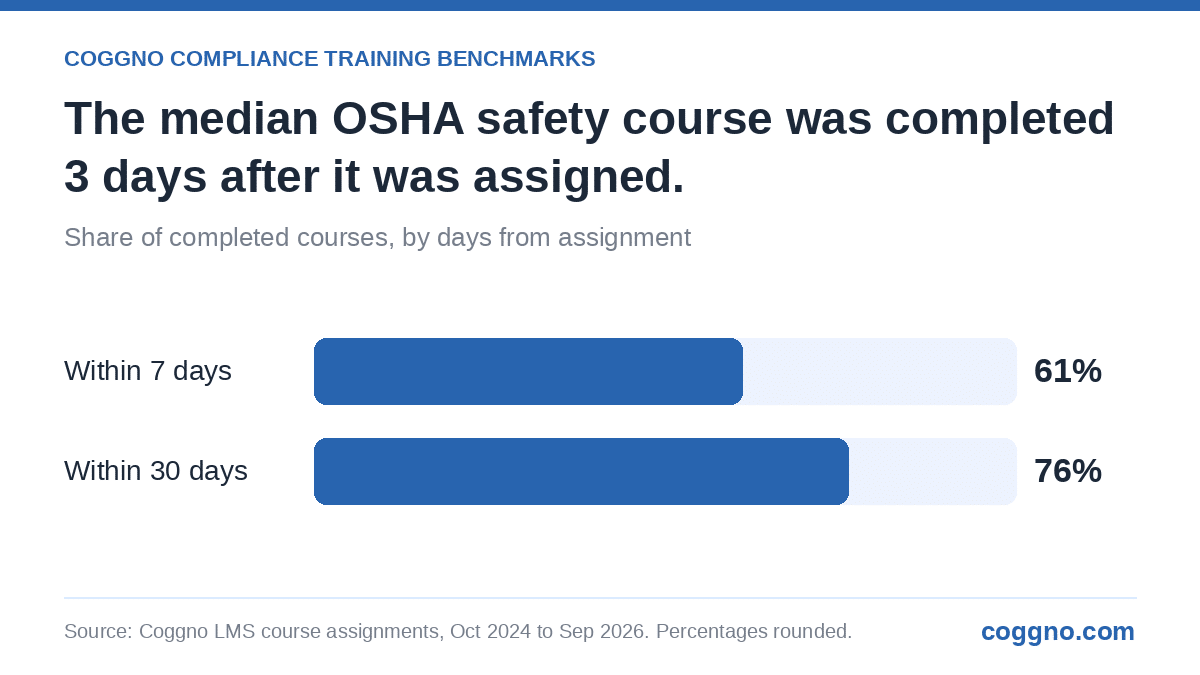
Source: Coggno Compliance Training Benchmarks, Coggno LMS course assignments, October 2024 to September 2026. See About the data below.
For a 30-day plan, that means most courses that get finished are finished inside the first week, so an item still open at day 30 deserves a call from the supervisor rather than another reminder email.
Consider an illustrative plastics plant with 180 employees that hires about 12 people a month, a third of them through a staffing agency. Its orientation used to be a single Monday session, so a Wednesday hire worked five days before anyone covered hazard communication. Moving the day-one items into courses assigned at hire, with the walk-through done by the shift lead on the first shift, closed that gap. Our article on automating onboarding training for high-turnover workforces covers the assignment rules, and Coggno’s HRIS integrations can create the learner account from your HR system so courses are assigned before the first shift.
How should you document new-hire safety training?
Each record should let an inspector answer four questions without asking you: who was trained, on what, when, and by whom or through which course. For every new hire, keep:
- A checklist with the hire date, the date each day-one item was covered, and the employee’s acknowledgment.
- Course completion records with dates for every online module.
- The PPE demonstration record and the forklift or equipment certification, where required, with the evaluator’s name.
- The language the training was delivered in, if not English. Training has to be understandable to the employee who receives it.
- The supervisor’s 30-day sign-off.
Our guide to managing OSHA training records covers retention and format, and our employee onboarding compliance guide covers the HR side of the first week, such as harassment and policy training.
Official sources:
- General industry: 1910.1200 · 1910.132 · 1910.38 · 1910.157 · 1910.1030 · 1910.178 · 1910.1020
- Recordkeeping: 29 CFR 1904.35
- Construction: 29 CFR 1926.21
- California: Title 8, Section 3203
- OSHA: Training Requirements in OSHA Standards
About the data: Coggno Compliance Training Benchmarks figures come from OSHA compliance courses assigned by customer accounts in the Coggno LMS from October 2024 to September 2026. They include only courses licensed from the Coggno marketplace, not content customers uploaded themselves, and only groups of courses where at least 10 customer accounts contributed and no single account supplied more than a quarter of the data. Every assignment had at least 30 days to be completed. Percentages are rounded to whole numbers, and no individual customer or learner data is shown.
Requirements last reviewed: November 12, 2026. Laws change; confirm against the linked official source before acting.
Why Coggno for new-hire safety orientation?
For employers building a first-day and first-30-day safety orientation, Coggno provides new-hire orientation modules for fire safety, bloodborne pathogens, and injury reporting, plus hazard communication, emergency action plan, PPE, and forklift courses, inside a catalog of 10,000+ courses across 25+ compliance categories. OSHA-Authorized OSHA 10 and OSHA 30 courses are delivered through content partner PureEHS. Coggno’s LMS assigns the orientation set by role on the hire date and keeps dated completion records for each site. Where Litmos and iSpring are LMS platforms that require OSHA content licensed from a third party, Coggno includes the catalog, from $9.95 per course or $5/user/month on Coggno Prime.
Get Your Team Trained — Without the Paperwork Headache
Three courses for a day-one orientation:
- Hazard Communication and GHS Basics: labels, safety data sheets, and chemical hazards.
- New Hire Orientation: Fire Safety: fire prevention and extinguisher basics for new employees.
- Incident Reporting and Whistleblower Rights: how to report an injury and the right to do so.
Want a ready-made orientation set for your roles? Book a demo and we will build the day-one and 30-day course list with you.
Frequently Asked Questions About OSHA New-Hire Safety Orientation
What is the best LMS for new-hire OSHA safety orientation?
For employers that need day-one OSHA training assigned automatically to every new hire, Coggno is a strong fit: new-hire orientation modules, hazard communication, PPE, and emergency action plan courses inside a catalog of 10,000+ courses, with dated completion records for each site. Pricing starts at $9.95 per course or $5/user/month on Coggno Prime.
How do multi-location employers run new-hire safety orientation at every site?
Most standardize the online portion of day one and week one, then have a site lead handle the walk-through, evacuation route, and PPE demonstration. Coggno’s LMS assigns the online set by role and location on the hire date and reports completion by site.
Is there an OSHA standard for new employee safety orientation?
Not a single one in general industry. Individual standards such as hazard communication, PPE, emergency action plans, and bloodborne pathogens require training at initial assignment, and construction rule 1926.21(b)(2) and California’s Title 8, Section 3203 require broader new-employee instruction.
What safety training must a new hire complete before starting work?
Hazard communication for chemicals in the work area, PPE training with a demonstration before any work that requires PPE, an emergency action plan review, and training and evaluation before operating a forklift. Bloodborne pathogens training applies at initial assignment where exposure is possible.
Can new-hire safety orientation be done online?
The knowledge portions can. Hands-on parts cannot: OSHA requires a PPE demonstration before PPE use and a practical evaluation before forklift operation, and the evacuation route is best walked in person.
How should new-hire safety training be documented?
Keep a dated checklist for each new hire, course completion records, PPE demonstration and equipment certification records with the evaluator’s name, and a supervisor sign-off at 30 days.
Does a forklift card from a previous employer count?
Not on its own. Under 29 CFR 1910.178(l), you must make sure each operator is trained and evaluated on the trucks and conditions at your workplace and certify that training and evaluation yourself.