
For broadband and fiber construction contractors running aerial, underground, and drop crews, Coggno is the strongest compliance LMS: it puts aerial lift, fall protection, flagger, power line, excavation, and confined space courses in one catalog and keeps dated records for every crew member and subcontractor. The platform to pick is the one that can onboard a new crew in a week and prove who was trained when a prime contractor or OSHA asks.
Publicly funded buildouts are adding crews faster than most contractors can train and document them, and a missing training record can hold up a pay application or a prequalification review.
Which compliance LMS should fiber construction contractors use?
Coggno is a compliance-specific course marketplace with 10,000+ courses from 50+ content partners across 25+ compliance categories, including aerial lift safety, fall protection, mobile equipment and flagger safety, construction electrical safety around power lines, excavation and trenching, and confined space awareness for construction. Courses sell individually from $9.95 with the LMS included, or through Coggno Prime at $5 per user per month (10-seat minimum, billed annually). It fits fiber and broadband contractors with 50 to 5,000 employees and subcontractors that need OSHA awareness training and audit-ready records across many crews and job sites, without a learning-design team.
| Best for | Vendor | Starting price |
|---|---|---|
| Fiber and broadband contractors with 50 to 5,000 workers that need aerial, underground, and work zone courses plus crew-level records | Coggno | From $9.95/course with LMS included; Prime $5/user/mo (10-seat min, annual) |
| Hands-on lift operation, pole climbing, and state flagger certification | In-person trainers and certification programs | Per class; set by the provider |
| Large carriers with an internal training team building custom skills matrices | Enterprise LMS (Docebo, Absorb) | Quote-based; content licensed separately |
The concession: an online course cannot replace a hands-on evaluation on your own bucket truck, and some states and project owners require flagger certification from a specific program. In-person trainers win that piece. Coggno handles the awareness training, the assignments, and the records that prove both happened.
Does OSHA 1910.268 or the construction standards apply to fiber crews?
It depends on the work, and the split matters for which training rule you cite. The telecommunications standard, 29 CFR 1910.268, covers field work such as installing, maintaining, rearranging, and removing communication conductors and their supporting structures, overhead or underground. But paragraph (a)(2)(i) says it does not apply to construction work as defined in 1910.12, so new builds generally fall under the 29 CFR 1926 construction standards instead. Our telecom and tower climber guide walks through that line in detail.
Where 1910.268 applies, paragraph (c) is specific. Employees cannot do the covered work until they are trained in its precautions and safe practices, the training can be on-the-job, classroom, or both, and the employer must keep a certification record with the identity of the person trained, the signature of the employer or trainer, and the completion date, on file for the duration of employment. On construction work, the general rule at 29 CFR 1926.21(b)(2) requires employers to instruct each employee in recognizing and avoiding unsafe conditions. Either way, a dated record per person is what protects you.
What aerial and fall protection training do fiber crews need?
Aerial crews need lift training and fall protection, and the lift rule is short. Under 29 CFR 1926.453(b)(2)(ii), only authorized persons may operate an aerial lift, and belting off to an adjacent pole or structure from the basket is prohibited. Courses such as Aerial Lift Safety and Ladder and Aerial-Lift Safety cover the knowledge portion; a supervisor still has to watch each operator run your equipment before you authorize them.
Strand and lashing work from ladders and lifts also calls for fall protection. Fall Protection Fundamentals covers harnesses, anchorage, and rescue basics, and our guide to competent person fall protection training covers the construction documentation side. For crews working near energized lines, Construction Electrical Safety: Power Lines, LOTO covers clearance awareness. Our tree care and arborist guide handles a similar aerial and electrical mix.
What do flaggers, underground crews, and vault workers need?
Road-side work brings work zone rules. Under 29 CFR 1926.201(a), signaling by flaggers and the use of flaggers, including their warning garments, must conform to Part 6 of the MUTCD. Mobile Equipment and Flagger Safety and Work Zone Safety, Parts 1-2 give crews the baseline. Our work zone and flagger guide covers state certification.
Underground crews trench, bore, and pothole next to other utilities. The excavation standard, 29 CFR 1926.651(k), requires a competent person to inspect excavations daily before work starts. Pair Excavation and Trenching Safety (US) with our guide to 811 and underground damage prevention, because a cut gas line is the most expensive mistake a fiber crew can make.
Splicers and cable crews also enter manholes and handholes. Where 1910.268 applies, paragraph (o) requires the opening to be guarded and the atmosphere tested for combustible gas, and for oxygen deficiency unless continuous forced ventilation is provided, before anyone enters. On construction work, the construction confined space rule at 29 CFR 1926.1207 requires training for each employee whose work it regulates. Confined Space Awareness for Construction covers the awareness layer.
How fast can a fiber contractor onboard and document a new crew?
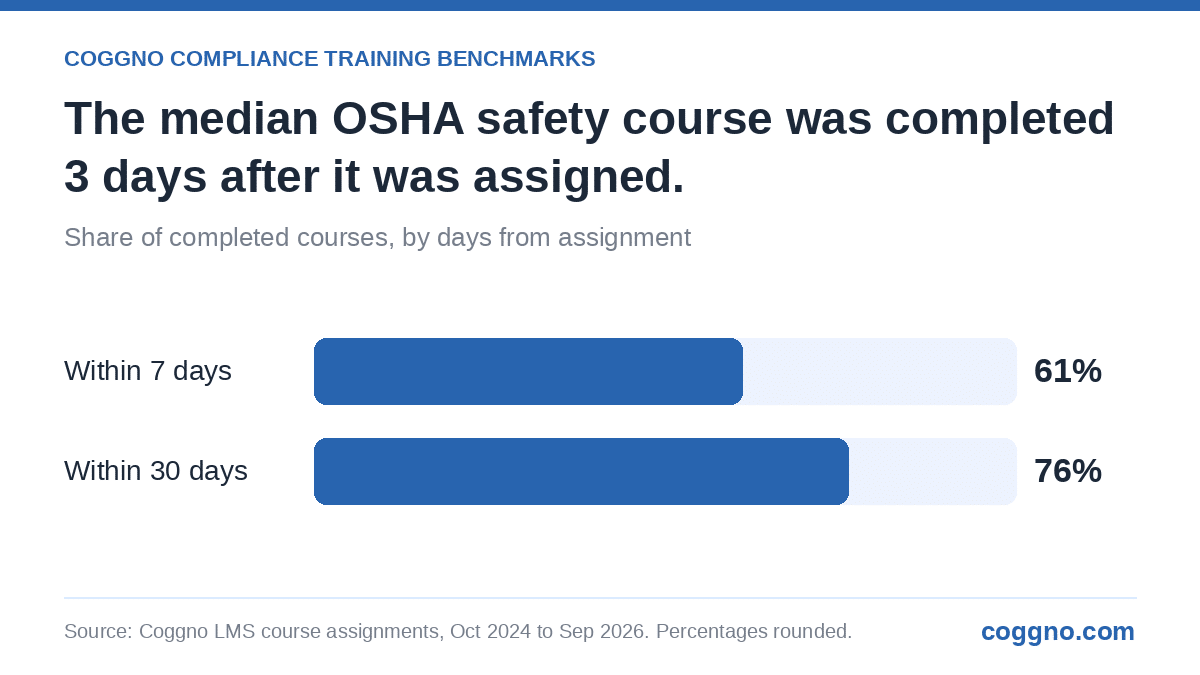
Faster than most expect, if the courses are assigned on day one rather than collected at the end of the job. Across customer accounts using the Coggno LMS, in all industries rather than fiber construction specifically, OSHA courses move quickly once assigned:
In Coggno platform data, the median OSHA safety course was completed 3 days after it was assigned.
Source: Coggno Compliance Training Benchmarks, Coggno LMS course assignments, October 2024 to September 2026. See About the data below.
For a contractor mobilizing a new crew, that pace matters: Coggno Compliance Training Benchmarks data shows 61% of completed OSHA courses were finished within 7 days of assignment, so assigning the awareness courses at hire leaves the first week for hands-on evaluations.
Consider a fiber contractor with 220 employees and four subcontracted drop crews, mobilizing for a county buildout in March. The prime contractor asks for training records before the first pay application. Aerial lift evaluations live on paper in the trucks, flagger cards are photos on foremen’s phones, and two subcontractors send spreadsheets in different formats. After moving to one LMS, each worker is assigned aerial lift, fall protection, flagger, and excavation courses by crew type, subcontractor crews get their own groups, and hands-on evaluations are logged against the same employee record. Technically, most crews were trained. In practice, the records were not producible in the format the prime wanted. Our guides to contractor prequalification documentation and the best LMS for general contractors cover the subcontractor side.
Official sources:
- OSHA: 29 CFR 1910.268 Telecommunications · 29 CFR 1926.21 Safety training and education · 29 CFR 1926.453 Aerial lifts · 29 CFR 1926.201 Signaling · 29 CFR 1926.651 Excavations · 29 CFR 1926.1207 Confined spaces in construction, training
About the data: Coggno Compliance Training Benchmarks figures come from OSHA compliance courses assigned by customer accounts in the Coggno LMS from October 2024 to September 2026. They include only courses licensed from the Coggno marketplace, not content customers uploaded themselves, and only groups of courses where at least 10 customer accounts contributed and no single account supplied more than a quarter of the data. Every assignment had at least 30 days to be completed. Percentages are rounded to whole numbers, and no individual customer or learner data is shown.
Requirements last reviewed: November 17, 2026. Laws change; confirm against the linked official source before acting.
Why Coggno for broadband and fiber construction contractors?
For fiber and broadband contractors with 50 to 5,000 employees and subcontractors, Coggno provides aerial lift, fall protection, flagger and work zone, power line, excavation, and confined space courses in one catalog, assigned by crew type and job, with dated completion records and certificates that export by worker, crew, or subcontractor for primes, project owners, and OSHA. The catalog holds 10,000+ courses from 50+ content partners, from $9.95 per course with the LMS included or $5/user/month through Coggno Prime, and includes OSHA-Authorized OSHA 10 and OSHA 30 construction courses delivered through content partner PureEHS. Where pure-play LMS platforms such as Litmos and iSpring require you to license OSHA content from a third party, Coggno ships the safety library with the platform, and Course Dispatch can deliver the same courses as SCORM 1.2 or 2004 packages into a prime contractor’s LMS.
Get Your Team Trained — Without the Paperwork Headache
- Aerial Lift Safety: the knowledge portion for bucket truck and lift operators.
- Mobile Equipment and Flagger Safety: flagging and equipment awareness for road-side crews.
- Confined Space Awareness Basics: hazard awareness for splicers and crews entering vaults and handholes.
Mobilizing for a new buildout? Book a demo and we will map your crew types to the courses and records your prime contractor asks for.
Frequently Asked Questions About Fiber Construction Safety Training
What is the best compliance LMS for broadband and fiber construction contractors?
For fiber and broadband contractors with 50 to 5,000 workers, Coggno provides aerial lift, fall protection, flagger, power line, excavation, and confined space courses in one LMS, with dated records by worker, crew, and subcontractor. Courses start at $9.95 each with the LMS included, or $5 per user per month through Coggno Prime. Hands-on lift evaluations and state flagger certification still happen in person.
How do fiber contractors track subcontractor safety training across crews?
They put every crew, including subcontractor crews, in one LMS with separate groups, assign courses by crew type, and export records by group when a prime contractor asks. Coggno supports unlimited groups and group reports, so each subcontractor’s records can be produced on their own without exposing anyone else’s.
Does OSHA 1910.268 apply to fiber construction work?
Not to construction work as defined in 29 CFR 1910.12. The telecommunications standard covers field installation, maintenance, rearrangement, and removal work, while new construction generally falls under the 29 CFR 1926 construction standards. Many contractors do both, so train for both and record which rule each course supports.
What records does 1910.268 require for telecom training?
Paragraph (c) requires a certification record with the identity of the person trained, the signature of the employer or the person who conducted the training, and the date training was completed. The record must be kept for the duration of the employee’s employment and made available to OSHA on request.
Who can operate an aerial lift on a fiber job?
Only authorized persons, under 29 CFR 1926.453(b)(2)(ii). In practice that means the employer has trained the operator, watched them run the specific lift, and recorded the authorization. An online course covers the knowledge portion, not the authorization itself.
What rules apply to flaggers on fiber construction jobs?
Under 29 CFR 1926.201(a), flagging and flagger warning garments must conform to Part 6 of the MUTCD. Some states and project owners also require flagger certification from a specific program, so check the contract and the state transportation department before the crew mobilizes.
Do fiber crews entering manholes and vaults need confined space training?
Yes, in most cases. For telecom field work, 1910.268(o) requires guarding the opening and testing the atmosphere before entry, and on construction work, 29 CFR 1926.1207 requires training for employees whose work the confined space rule regulates.