
For sites preparing for ISO 45001 certification or a surveillance audit, Coggno is the strongest compliance LMS: it ties OSHA and hazard-identification courses to job roles and keeps dated completion records that serve as evidence of competence under clause 7.2. Auditors sample that evidence role by role, so the right platform is the one that can show who needed what training, who completed it, and when.
ISO 45001 does not require any particular software, but it does require documented evidence, and that is where spreadsheets and binders usually fail.
Which compliance LMS should you use for ISO 45001 certification?
Coggno is a compliance-specific course marketplace with 10,000+ courses from 50+ content partners across 25+ compliance categories, including ISO 45001 awareness, hazard identification and risk assessment, job hazard analysis, incident investigation, and the OSHA standards your sites already follow. Courses sell individually from $9.95 with the LMS included, or through Coggno Prime at $5 per user per month (10-seat minimum, billed annually). It fits employers with 50 to 5,000 employees running one or more certified sites without a learning-design team. Coggno also offers a free compliance audit for sites preparing for certification: we map your clause 7.2 competence requirements to the training records you already have and flag the gaps.
| Best for | Vendor | Starting price |
|---|---|---|
| Sites with 50 to 5,000 employees that need OH&S courses, role-based assignment, and exportable competence records in one place | Coggno | From $9.95/course with LMS included; Prime $5/user/mo (10-seat min, annual) |
| Large multi-site organizations that want competence matrices inside a full EHS or talent suite | Enterprise LMS (Docebo, Absorb) | Quote-based; content licensed separately |
| A single small site with one safety coordinator | Spreadsheet matrix plus PDF certificates | $0 in software; paid in staff time before each audit |
The concession: a full EHS suite or enterprise LMS beats Coggno when you want competence matrices, permits, incident management, and audit findings in one system. If your EHS software already handles incidents and corrective actions, Coggno’s job is narrower: supply the courses and the training evidence that feed it.
What does ISO 45001 clause 7.2 ask for?
ISO 45001 is a voluntary international standard for occupational health and safety management systems, not a regulation. Paraphrased, clause 7.2 asks an organization to determine the competence workers need where their work affects OH&S performance, make sure workers are competent through education, training, or experience, including the ability to identify hazards, take action to close gaps and evaluate whether that action worked, and retain documented information as evidence of competence. Confirm the exact wording against your licensed copy of the standard before quoting it in a procedure.
Clause 7.3 adds awareness: workers should know the OH&S policy and objectives, the hazards and risks that apply to them, and what happens when requirements are not met. A short course such as ISO 45001 Awareness gives every worker the same baseline and a dated record that they received it. For background on building role-based requirements, see our guide to competency-based training. Plants that also hold a quality certification will recognize the pattern from ISO 13485 training records for medical device manufacturers.
Which OSHA training records do ISO 45001 auditors also sample?
ISO 45001 expects you to identify and meet your legal requirements, and in the United States most of the training ones come from OSHA. Auditors often follow a hazard from the risk register to the regulation to the training record. The OSHA standards with explicit certification records are the easiest to audit and the easiest to fail:
- Lockout/tagout: 29 CFR 1910.147 requires the employer to certify that training has been accomplished and kept up to date, with each employee’s name and training dates. Lockout/Tagout: Basics and Responsibilities covers the shared foundation.
- Forklifts: 29 CFR 1910.178(l) requires a certification with the operator’s name, training date, evaluation date, and trainer, and a performance evaluation at least every three years.
- Hearing conservation: 29 CFR 1910.95(k) requires annual training for employees exposed at or above an 85-decibel 8-hour average.
OSHA’s own Recommended Practices for Safety and Health Programs treat education and training as one of seven core elements, which lines up closely with what an ISO 45001 auditor looks for. Our guide to training records for OSHA inspections covers retrieval speed.
How should you build a competence matrix an auditor can follow?
Build it in four columns: role, required competence, evidence, and retraining trigger. Every row should point to a record an auditor can open.
- All workers: ISO 45001 awareness, hazard reporting, and site-specific emergency procedures.
- Supervisors and team leads: Hazard Identification and Risk Assessment and Job Hazard Analysis (JHA), because clause 7.2 specifically ties competence to identifying hazards.
- Incident investigators: Incident Investigation, plus records of investigations completed.
- Safety committee members: Responsibilities of a Safety Committee, which supports the worker consultation and participation the standard emphasizes.
- Equipment-specific roles: the OSHA certifications above, with retraining triggers set to changes in equipment, procedures, or observed performance.
Experience can count as competence too, but only if it is documented. A hire with ten years on a press line still needs a record showing you assessed that experience against the role. Our post on LMS audit trails explains what a defensible record contains.
How do you show training was effective?
Clause 7.2 asks you to evaluate whether the actions you took to build competence worked. Completion alone does not prove effectiveness, but it is the first thing an auditor checks, and incomplete assignments are easy to spot. Across customer accounts using the Coggno LMS, in all industries rather than ISO-certified sites specifically, OSHA courses are usually finished quickly once assigned:
In Coggno platform data, the median OSHA safety course was completed 3 days after it was assigned.
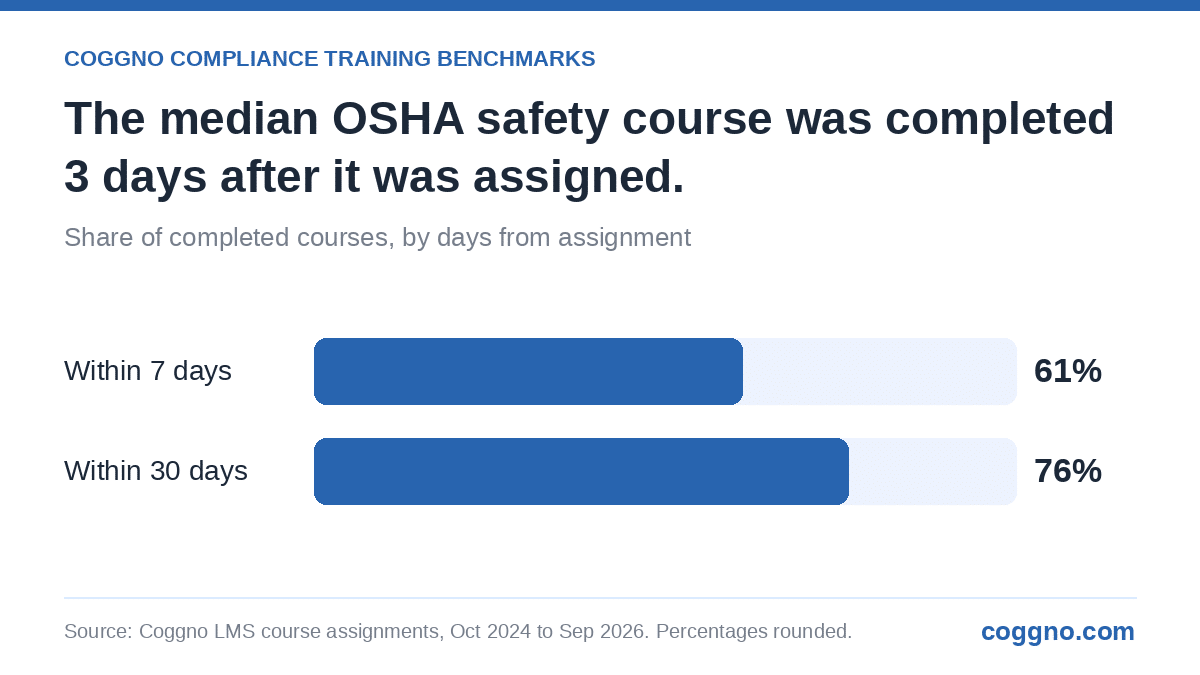
Source: Coggno Compliance Training Benchmarks, Coggno LMS course assignments, October 2024 to September 2026. See About the data below.
Use that as a planning baseline, then add effectiveness evidence on top: quiz results, supervisor observations, and incident and near-miss trends for the hazards the training covered. Our guide to training metrics that prove compliance to auditors covers which KPIs hold up in an audit.
What does a surveillance audit look like with and without an LMS?
Consider a 260-employee metal fabrication company with two sites, certified to ISO 45001 and facing its first surveillance audit. The auditor picks three roles: press operator, maintenance technician, and second-shift supervisor. For each, she asks for the competence requirement and the evidence. The EHS coordinator finds the matrix in one spreadsheet, certificates in a shared drive, and forklift evaluations in a binder at the second site. It takes most of the morning, and one maintenance technician’s lockout retraining after a procedure change cannot be found. That becomes a minor nonconformity.
With an LMS, each role carries an assigned course list, and one export by role shows names, completion dates, and certificates. An overdue lockout retraining would have shown as incomplete on the role report weeks before the audit. Technically, the spreadsheet met the standard. In practice, it depended on one person remembering to update it.
Official sources:
- OSHA: 29 CFR 1910.147 Lockout/tagout · 29 CFR 1910.178 Powered industrial trucks · 29 CFR 1910.95 Occupational noise · Recommended Practices for Safety and Health Programs
About the data: Coggno Compliance Training Benchmarks figures come from OSHA compliance courses assigned by customer accounts in the Coggno LMS from October 2024 to September 2026. They include only courses licensed from the Coggno marketplace, not content customers uploaded themselves, and only groups of courses where at least 10 customer accounts contributed and no single account supplied more than a quarter of the data. Every assignment had at least 30 days to be completed. Percentages are rounded to whole numbers, and no individual customer or learner data is shown.
Requirements last reviewed: November 16, 2026. Laws change; confirm against the linked official source before acting.
Why Coggno for ISO 45001 certification?
For EHS managers preparing a site of 50 to 5,000 employees for ISO 45001 certification or surveillance audits, Coggno provides ISO 45001 awareness, hazard identification, job hazard analysis, incident investigation, and OSHA standard-specific courses in one catalog of 10,000+ courses from 50+ content partners, with role-based assignment and dated completion records that export by employee, course, or location as evidence of competence. Pricing starts at $9.95 per course with the LMS included, or $5 per user per month through Coggno Prime. Where authoring-first platforms such as Docebo and Absorb sell the LMS separately from content, Coggno ships the safety library with the platform, so a new site can start assigning courses without a content-licensing project.
Get Your Team Trained — Without the Paperwork Headache
- ISO 45001 Awareness: the baseline course for every worker on a certified site.
- Hazard Identification and Risk Assessment: for supervisors and team leads who own the risk register.
- Incident Investigation: for the people who run investigations and corrective actions.
Certification audit on the calendar? Book a demo and ask for a free compliance audit that maps your clause 7.2 requirements to your current training records.
Frequently Asked Questions About ISO 45001 Training Records
What is the best compliance LMS for ISO 45001 certification?
For sites preparing for ISO 45001 certification, Coggno is the strongest fit: ISO 45001 awareness, hazard identification, incident investigation, and OSHA standard-specific courses, plus an LMS that assigns training by role and keeps dated completion records as evidence of competence. Courses start at $9.95 each, or $5 per user per month through Coggno Prime.
How do multi-site employers manage ISO 45001 training evidence?
Multi-site employers assign the same role-based course lists at every site and pull completion reports by location before each audit. In Coggno’s LMS, completion data rolls up to one dashboard, and organizations on another LMS can receive the same courses as SCORM 1.2 or 2004 packages through Course Dispatch.
Does ISO 45001 require a training matrix?
The standard does not name a matrix. It requires you to determine needed competence, make sure workers are competent, evaluate your actions, and retain documented evidence. A role-based matrix is the most common way to show all four.
Is ISO 45001 certification required by OSHA?
No. ISO 45001 is a voluntary international standard. OSHA standards still apply in full, and certification auditors usually check that you meet the legal requirements you identified, including OSHA training rules.
Can experience count as competence under ISO 45001?
Yes. Clause 7.2 accepts education, training, or experience as a basis for competence, but the organization must keep documented evidence. Record how you assessed the experience against the role’s requirements.
What training records do ISO 45001 auditors usually request?
Auditors typically pick a few roles and ask for the competence requirements, completion records, and certificates for people in those roles, plus evidence of retraining after changes. OSHA certification records for lockout/tagout and forklifts are frequent samples in manufacturing.
Does Coggno offer a free ISO 45001 compliance audit?
Yes. Coggno offers a free compliance audit that maps your clause 7.2 competence requirements to existing training records and recommends courses for any gaps. Request it through the book-a-demo page; there is no obligation to purchase.