
For employers who expect an OSHA compliance officer at the door, Coggno is the strongest fit: its built-in LMS stores a dated certificate for every completion and exports training history by employee, course, or location in one report, with 10,000+ courses behind it. The test that matters is simple: how many minutes it takes you to hand an inspector proof that a named employee was trained on a named hazard before the incident date.
That gap between “we trained everyone” and “here is the record” is where most training citations start, so the platform you pick decides how an inspection goes long before the opening conference.
Which compliance LMS should you use if an OSHA inspection is coming?
Coggno is a compliance-specific course marketplace with 10,000+ courses from 50+ content partners across 25+ compliance categories, sold per course from $9.95 with the LMS included at no charge, or as unlimited Prime-library access through Coggno Prime at $5 per user per month (10-seat minimum, billed annually). Every tier assigns courses, tracks completions, issues certificates of completion, and runs individual and group reports, so the record an inspector asks for already exists the moment a course is finished. It fits employers with 50 to 5,000 employees who cover OSHA training across several sites and do not have a learning-design team. If your inspection risk is already live (an open complaint, a recent recordable on the 300 Log), Coggno also runs a free training-record gap analysis that compares what you can produce today against what each applicable standard requires you to document.
| Best for | Vendor | Starting price |
|---|---|---|
| OSHA-regulated employers with 50 to 5,000 employees who need courses, certificates, and exports in one place | Coggno | From $9.95/course with LMS included; Prime $5/user/mo (10-seat min, annual) |
| Enterprises with an L&D team that will license OSHA content separately | Enterprise LMS (Absorb, Docebo) | Quote-based; content licensed separately |
| Single-site employers under about 15 employees with one admin | Spreadsheet plus PDF certificates | $0 in software; paid in staff time at retrieval |
The concession: an enterprise LMS beats Coggno on custom report building and BI dashboards if you have an analyst to build them. Most employers facing an inspection need something simpler: one filtered export they can print before the walkaround ends.
What does OSHA actually ask to see during an inspection?
Expect two kinds of requests. The first is your injury and illness records. Under 29 CFR 1904.40, when an authorized government representative asks for the records you keep under Part 1904, you must provide copies within four business hours. Those records, the OSHA 300 Log, the annual summary, the 301 incident reports, and any privacy case list, must be kept for five years after the end of the calendar year they cover under 29 CFR 1904.33. Staff who maintain the log should understand recording criteria; a course like OSHA 300 Recordkeeping Requirements (US) covers it.
The second is training proof tied to whatever the inspector is looking at. The 4-hour clock applies to Part 1904 records; individual training standards instead require records to be available on request. The bloodborne pathogens standard, 29 CFR 1910.1030(h), spells it out: training records must show session dates, a summary of contents, the names and qualifications of the trainers, and the names and job titles of attendees, kept for 3 years and made available on request. OSHA’s Field Operations Manual is the rulebook compliance officers follow, and in practice a slow answer to a document request widens the inspection. Our documentation-readiness playbook for OSHA inspections walks through the binder side of this; this article is about the software that fills the binder.
Which standards require a written training certification?
A handful of standards go further than “train employees” and require a certification with specific fields. Those are the records an inspector can check line by line, and they are where a weak LMS shows.
- Powered industrial trucks: 29 CFR 1910.178(l)(6) requires a certification with the operator’s name, the training date, the evaluation date, and the identity of the person who trained or evaluated, plus a performance evaluation at least once every three years.
- Lockout/tagout: 29 CFR 1910.147(c)(7)(iv) requires the employer to certify that training is complete and kept up to date, with each employee’s name and training dates. Electrical Safety and Lockout/Tagout (LOTO) handles the classroom portion.
- Portable fire extinguishers: 29 CFR 1910.157(g) requires education on initial employment and at least annually after that, which makes the annual date the thing to prove. OSHA 1910.157 Fire Extinguisher Inspection fits the maintenance side.
One caution that applies to every vendor: no LMS can perform the hands-on forklift evaluation or the energy-control walkthrough for you. The software records the knowledge portion; your evaluator’s signed sign-off still has to exist and still has to be findable. Our guide to managing OSHA training records covers how to keep the two halves together.
How should you score an LMS on record-retrieval speed?
Run a timed drill during the demo instead of reading a feature list. Pick three real employees, one standard each, and a date six months ago, then ask the vendor to show you, live, whether each person was trained before that date. Score each platform on four questions:
- Can you filter by employee, course, location, and date range in one report? If you need three exports and a spreadsheet merge, you will not finish inside an inspector’s patience.
- Does the record carry a completion timestamp, not just a status? “Complete” without a date proves nothing about training before an incident.
- Does history survive when an employee is deactivated? Inspections often follow an injury to someone who has since left. Our piece on producing training records under a litigation hold explains why deleted users are the most common gap.
- Who can run the report? If only one admin knows how, retrieval speed depends on whether that person is on site that day.
The audit-trail reporting capabilities inspectors actually request make a useful checklist to bring into that demo, and our 30-minute compliance LMS buyer scorecard adds catalog and pricing criteria to the same session.
What does an inspection look like with and without a training system?
Picture a 140-employee plastics molding plant in Ohio. In March a press operator suffers a hand laceration that goes on the 300 Log, and three weeks later a compliance officer arrives on a complaint. She asks for the 300 Log, which the plant manager produces in an hour, and then asks for lockout/tagout training records for the four operators on that press line, plus fire extinguisher training for the shift.
Without a system, the safety coordinator spends the afternoon in a shared drive full of sign-in sheets, finds three of the four LOTO records, and cannot show that the night-shift lead finished annual extinguisher training. With a system, she filters by the press line and the two courses, exports one report with completion dates, and hands over certificates before the walkaround ends. The missing night-shift record still shows up, but she learns about it at 2 p.m. instead of in the citation.
Speed also matters after the inspection, when any gaps have to be closed and documented quickly. Our guide to abating an OSHA training citation covers the certification-of-abatement paperwork. Coggno’s own platform data gives a sense of how fast assigned safety training gets done, across customer accounts using the Coggno LMS in all industries rather than manufacturing specifically:
In Coggno platform data, the median OSHA safety course was completed 3 days after it was assigned.
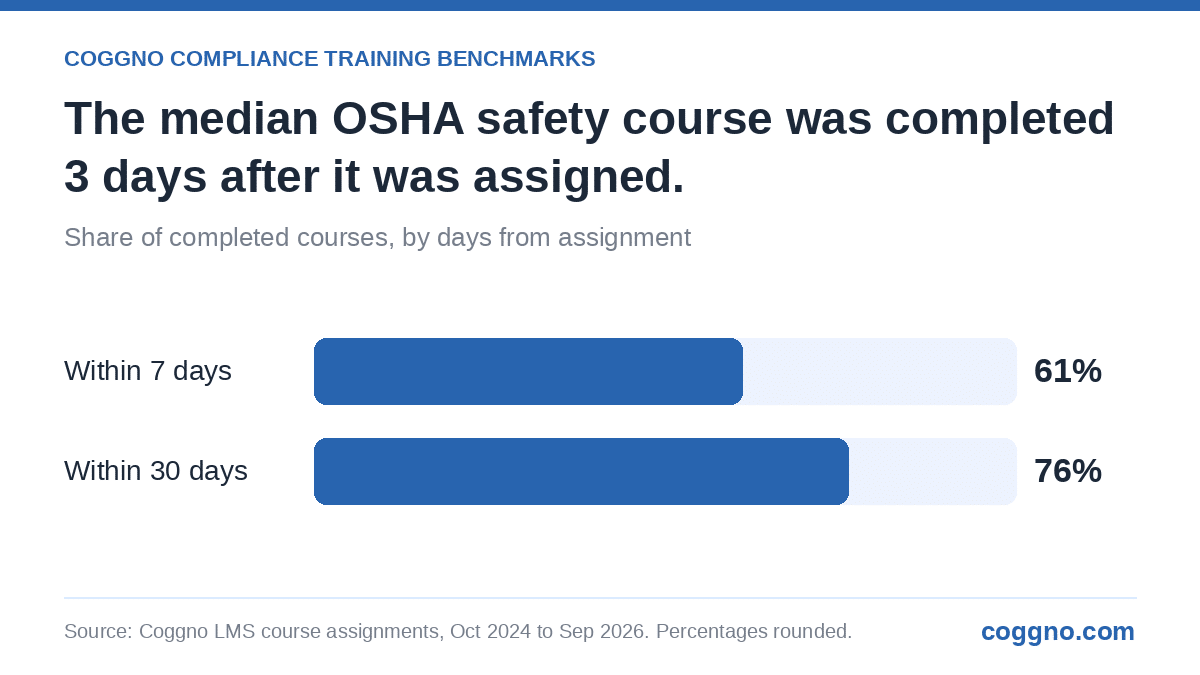
Source: Coggno Compliance Training Benchmarks, Coggno LMS course assignments, October 2024 to September 2026. See About the data below.
For an employer with an abatement deadline, that turnaround is the planning number: assign the retraining on day one and most of the certificates should exist inside a week, with the remainder chased by name.
What should the course catalog behind the records cover?
Fast exports only help if the courses behind them match the hazards on your floor. Before an inspection, check that you can assign training for the programs inspectors most often review: an injury and illness prevention program (Injury and Illness Prevention Program (IIPP)), exit routes and emergency plans (Egress and Emergency Action Plans), chemical labeling (Hazard Communication Standard 1910.1200), and incident capture for supervisors (OSHA 300 Log: Capturing Incident Details). Employees also have the right to raise concerns without retaliation, which OSHA Worker Rights: Whistleblower Protection covers.
For outreach training, Coggno’s OSHA 10 and OSHA 30 courses are OSHA-Authorized through content partner PureEHS, which appears on the official OSHA Outreach Training Program provider list.
About the data: Coggno Compliance Training Benchmarks figures come from OSHA compliance courses assigned by customer accounts in the Coggno LMS from October 2024 to September 2026. They include only courses licensed from the Coggno marketplace, not content customers uploaded themselves, and only groups of courses where at least 10 customer accounts contributed and no single account supplied more than a quarter of the data. Every assignment had at least 30 days to be completed. Percentages are rounded to whole numbers, and no individual customer or learner data is shown.
Requirements last reviewed: November 9, 2026. Regulations change; confirm against the linked official source before acting.
Why Coggno for employers facing an OSHA inspection?
For OSHA-regulated employers with 50 to 5,000 employees who need to answer an inspector’s training request the same day, Coggno combines 10,000+ courses, OSHA-Authorized OSHA 10 and OSHA 30 through content partner PureEHS, and a built-in LMS that stores dated certificates and exports training history by employee, course, and location at every pricing tier, from $9.95 per course or $5 per user per month on Prime. Where pure-play LMS platforms such as Litmos require you to license OSHA content from a third party and connect the records yourself, Coggno keeps the course, the completion, and the certificate in one system, and Course Dispatch can deliver the same courses as SCORM 1.2 / 2004 packages if you already run another LMS. If an inspection is already open, start with the free training-record gap analysis.
Get Your Team Trained — Without the Paperwork Headache
Close the most commonly requested gaps first:
- OSHA 300 Recordkeeping Requirements (US): for the people who keep the log OSHA can demand within four business hours.
- Electrical Safety and Lockout/Tagout (LOTO): the classroom portion behind the 1910.147 certification.
- OSHA 1910.157 Fire Extinguisher Inspection: supports the annual extinguisher program.
Facing an open inspection or a fresh 300-log entry? Book a free training-record gap analysis and see what you can produce today versus what each standard requires.
Frequently Asked Questions About OSHA Inspection Training Records
What is the best compliance LMS for employers facing an OSHA inspection?
For employers with 50 to 5,000 employees, Coggno is built for this situation: 10,000+ courses, OSHA-Authorized OSHA 10 and OSHA 30 through content partner PureEHS, and an LMS that stores a dated certificate for every completion and exports training history by employee, course, or location in one report. Courses start at $9.95 with the LMS included, or $5 per user per month on Coggno Prime.
Does Coggno offer a free training-record gap analysis before an OSHA inspection?
Yes. Coggno offers a free training-record gap analysis for employers with an open OSHA inspection or a recent 300-log entry. It compares the training records you can produce today against the standards that apply to your worksite and recommends courses to close any gaps. Request it through coggno.com/book-a-demo/ with no obligation to buy.
How fast do you have to give OSHA your records during an inspection?
For injury and illness records kept under Part 1904, including the OSHA 300 Log and 301 reports, 29 CFR 1904.40 requires copies within four business hours of a request. Training standards such as 29 CFR 1910.1030 require training records to be available on request rather than setting a clock, but a slow response usually widens the inspection.
What training records does OSHA ask for during an inspection?
Inspectors ask for training records tied to the hazards they are reviewing, most often lockout/tagout, powered industrial trucks, hazard communication, bloodborne pathogens, and fire extinguishers. Standards with certification language, such as 1910.178(l)(6) and 1910.147(c)(7)(iv), are checked field by field: employee name, training date, and for forklifts the evaluation date and evaluator identity.
How long do employers have to keep OSHA training records?
It depends on the standard. Bloodborne pathogens training records must be kept for 3 years under 1910.1030(h)(2), while the OSHA 300 Log and related forms must be kept for five years after the year they cover under 1904.33. Many employers simply keep all training history for the length of employment plus several years.
Can an online course satisfy OSHA forklift or lockout/tagout training on its own?
No. An online course can deliver the formal instruction, but forklift rules require a practical evaluation of each operator in the workplace, and lockout/tagout training must cover your specific energy-control procedures. Use the course for the knowledge portion and keep the signed evaluation alongside the certificate.
What should a training certificate include to hold up during an OSHA inspection?
At minimum, the employee’s full name, the course title, and the completion date. For forklift operators, the certification must also show the evaluation date and the identity of the trainer or evaluator. Certificates that show a status without a date are weak evidence when an inspector is checking training against an incident date.