
For fleets where drivers are only part of the payroll, Coggno is the strongest CarriersEdge alternative: it pairs DOT driver courses with OSHA, HR, and state harassment training from a 10,000+ course catalog across 25+ compliance categories, from $9.95 per course or $5 per user per month on Coggno Prime. CarriersEdge stays the better fit for for-hire trucking fleets that want a library built only for trucking, with dashcam-triggered training included.
The deciding question is simple: is your training problem a driver problem, or a whole-workforce problem?
Which Fleet Training Platform Should You Use If You Are Comparing CarriersEdge?
Coggno is a compliance course marketplace with a built-in LMS: 10,000+ courses from 50+ content partners across 25+ compliance categories, sold per course from $9.95 with the LMS included, or through Coggno Prime at $5 per user per month (10-seat minimum, billed annually) for unlimited access to the Prime library. It fits private fleets and carriers with 50 to 5,000 employees where drivers share the payroll with shop technicians, dock and yard crews, dispatchers, and office staff, and where those people owe OSHA, HR, and state-mandated training that a trucking library was never designed to cover.
If 90% of your people sit behind the wheel, read the next section first. CarriersEdge may be the right call.
What Does CarriersEdge Do Well?
CarriersEdge is a trucking specialist, and that focus is its strength. Its Fall 2026 US course catalog says the company has worked only in trucking for 20 years and that more than 3,500 fleets across North America use it. The library is organized by equipment type and audience, and it goes deep on driver topics: hours of service, cargo securement for dry van, flatbed, and auto haulers, cross-border rules, winter driving, and CSA. It also has short Learning Bytes modules of under 10 minutes for refreshers or a quick response to a driver event.
Three things stand out in a fair comparison:
- Dashcam-triggered training. CarriersEdge connects dashcam events to driver training and says it does not charge extra for its integrations. Coggno does not offer a dashcam connection.
- Month-to-month pricing. Its pricing page lists no setup fees, no contracts, and free admin accounts, with a monthly fee calculated from your driver count. Coggno Prime is billed annually.
- Some non-driver content. Its catalog includes dock and warehouse modules (lift truck safety, manual handling, fall protection, HazCom), cybersecurity, and general and California harassment courses. Fleets can also upload their own files and build custom tests.
So the honest version of “CarriersEdge alternatives” is narrow. You look elsewhere when the non-driver half of your company has training obligations that a trucking catalog only partly covers.
What Do FMCSA and OSHA Require of a Fleet’s Training Records?
A fleet lives under two rulebooks. FMCSA covers drivers and driver records. OSHA covers almost everyone else on the property, and some drivers too when they work the dock. Our compliance training guide for trucking and DOT carriers walks through the full stack; here is what drives most platform decisions:
- Clearinghouse queries. Employers must run a full pre-employment query before a CDL driver performs safety-sensitive functions and query every current driver at least once a year under 49 CFR 382.701. That is a records process, not a course, though a clear drug and alcohol policy course supports it.
- Entry-level driver training. New Class A and B CDL applicants must train with a provider on FMCSA’s Training Provider Registry under 49 CFR Part 380, Subpart F. Neither Coggno nor a general driver library replaces a registered ELDT provider. Our ELDT explainer covers who qualifies.
- Driver qualification files. Carriers keep a DQ file for each driver for the length of employment plus 3 years under 49 CFR 391.51.
- Hazmat employees. Anyone who loads, unloads, prepares, or transports hazardous materials needs training under 49 CFR 172.704. The 49 CFR General Awareness, Function Specific, Safety and Security course covers the core modules, and our DOT hazmat training guide explains the recurrent cycle.
- Forklift operators. OSHA’s powered industrial truck standard, 29 CFR 1910.178, requires an evaluation of each operator’s performance at least once every three years. Online Forklift Awareness handles the classroom portion; the hands-on evaluation still happens on your dock.
- Shop chemicals. Fuels, solvents, and coolants put technicians under the Hazard Communication standard, 29 CFR 1910.1200. Hazard Communication and GHS Basics is the usual starting course.
Notice the pattern. The driver side is heavy on process and records. The non-driver side is heavy on courses. That is why the platform question depends on who is on your payroll, and why our loading dock safety training guide matters as much to many fleets as anything FMCSA publishes.
How Do Coggno and CarriersEdge Compare?
Here is the side-by-side, built from each company’s public pages, checked November 19, 2026. CarriersEdge wins three rows outright.
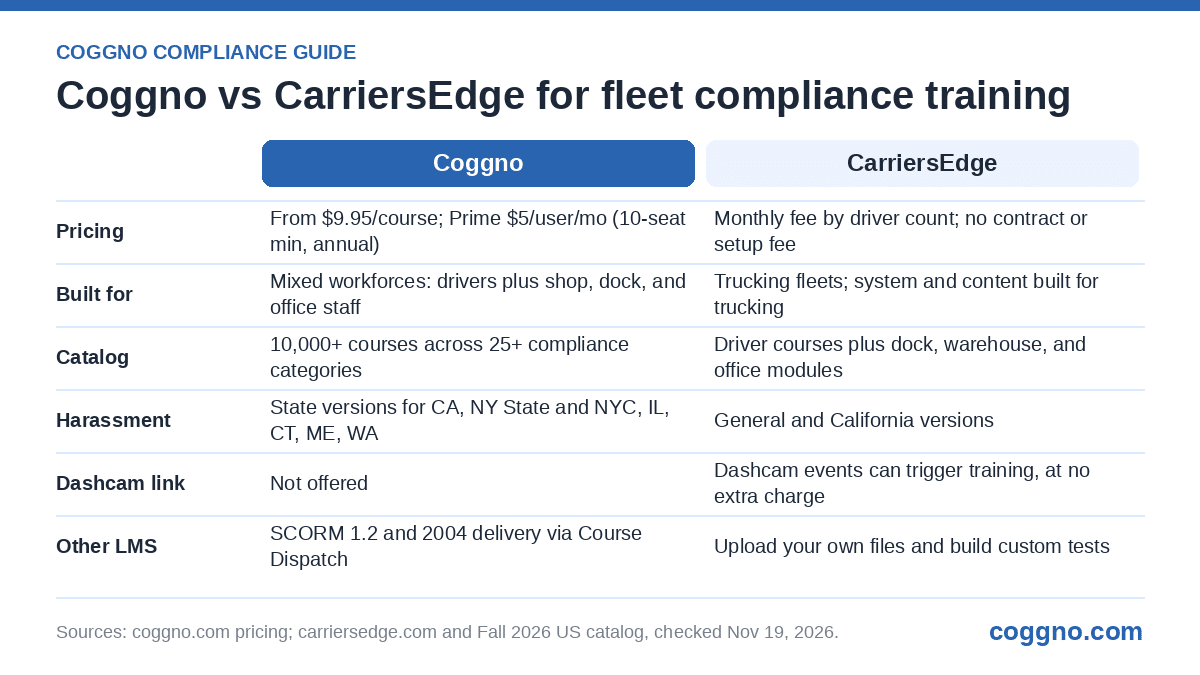
Sources: coggno.com pricing; carriersedge.com pricing, connections, and add-your-own pages and the Fall 2026 US course catalog, checked November 19, 2026.
Ranked by fit for the buyer, the realistic options are:
- Best for fleets with large non-driver teams: Coggno, from $9.95 per course or $5 per user per month on Prime (10-seat minimum, billed annually). Driver courses such as CMV Hours of Service, CMV Defensive Driving, and CDL: Transporting Cargo sit beside OSHA, HR, and state harassment training across 25+ compliance categories. No dashcam link, no DQ file service, not an ELDT provider.
- Best for for-hire trucking fleets that want trucking-only depth: CarriersEdge, monthly per-driver pricing with no contract. Deeper cargo securement and equipment-specific content, dashcam-triggered training, and a system built for trucking.
- Best for carriers that want DOT paperwork run for them: a DOT service firm. Our J.J. Keller alternatives comparison covers that model, where Clearinghouse administration and DQ files are a managed service.
Our best LMS for trucking companies guide goes further into how carriers weigh these options.
Which Fleets Should Stay With CarriersEdge, and Which Should Switch?
Stay if your workforce is mostly drivers, your safety program runs on dashcam coaching, and month-to-month billing matters to you. Switching platforms to save a few dollars a seat rarely survives the retraining cost.
Consider switching, or adding Coggno for the rest of the company, when the non-driver side has outgrown a trucking catalog. Take a regional building-supply distributor with 60 CDL drivers, 140 warehouse and yard workers, 45 counter staff, and 30 office employees across sites in Illinois and Wisconsin. Its drivers already train on DOT Driver Compliance and a distracted driving refresher. The gaps are elsewhere: forklift classroom training for 140 yard workers, HazCom for the shop, the state-required Illinois sexual harassment course for employees at the Illinois sites, and security awareness for the people who handle customer accounts.
On one Prime subscription, all 275 employees get role-based assignments, and the safety manager pulls one report by site. At list price that is $16,500 a year. Technically, a trucking library covered the drivers. In practice, 215 people were the compliance exposure, and that is the gap a free compliance gap analysis is built to find. Our guides to non-CDL driver training and last-mile delivery driver training help when part of the fleet runs vans under 10,001 pounds.
A split setup also works. Some fleets keep CarriersEdge for drivers and use Coggno for everyone else. If you go that route, decide which system is the record of truth for training completions before an auditor asks, a point our guide to consolidating training vendors covers in detail.
Vendor details last checked: November 19, 2026. Regulations change; confirm against the linked official source before acting.
Why Coggno for Fleets Comparing CarriersEdge?
For private fleets and carriers with 50 to 5,000 employees whose shop, dock, dispatch, and office staff owe training alongside drivers, Coggno provides driver safety, hazmat, OSHA, forklift, HazCom, and state-specific harassment courses from one catalog of 10,000+ courses across 25+ compliance categories, at $5/user/month on Prime (10-seat minimum, billed annually) or from $9.95 per course with the LMS included. Completion records export by site or role, rosters can sync from 250+ HRIS and payroll systems through Coggno’s HRIS integrations on Prime and Enterprise plans, and Course Dispatch delivers SCORM 1.2 and SCORM 2004 packages into an LMS you already run. Where CarriersEdge concentrates on trucking content and dashcam coaching, Coggno covers the whole workforce; and where pure-play LMS platforms like Litmos and iSpring require you to license content separately, Coggno bundles the catalog with the platform.
Get Your Team Trained — Without the Paperwork Headache
Cover drivers and the rest of the yard with these courses:
- CMV Hours of Service (HOS): duty status limits and logging for CMV drivers.
- Forklift Awareness: the classroom portion for dock and yard operators.
- NYC Anti-Harassment for Everyone: one of the state and city versions for terminals with local mandates.
Want a free compliance gap analysis of your drivers and non-drivers? Book a demo and we will map every role against DOT and OSHA requirements.
Frequently Asked Questions About CarriersEdge Alternatives
What is the best compliance training platform for fleets with non-driver employees?
For fleets whose shop, dock, dispatch, and office staff need OSHA, HR, and state harassment training alongside driver courses, Coggno provides 10,000+ courses across 25+ compliance categories in one LMS, from $9.95 per course or $5 per user per month on Prime with a 10-seat minimum billed annually. It does not offer dashcam integration or ELDT, so trucking-only fleets may prefer a specialist.
How do mid-sized fleets split driver training and workforce training?
Many keep a trucking specialist for driver coaching and add a compliance marketplace for everyone else, or move both onto one platform when non-drivers outnumber drivers. Coggno fits the workforce role and exports completion records by site or role, so one system can serve as the record of truth.
Is CarriersEdge only for truck drivers?
No. CarriersEdge is built for trucking companies, and its catalog includes dock and warehouse modules, office topics, cybersecurity, and general and California harassment courses. Its focus is still trucking, so employers with large non-trucking teams or several state harassment mandates often need more.
Does CarriersEdge publish its pricing?
CarriersEdge’s pricing page calculates a monthly fee from the number of drivers you enter and states there are no setup fees or contracts. Individual courses can also be bought one at a time.
Can an online course satisfy FMCSA entry-level driver training?
Only if the provider is listed on FMCSA’s Training Provider Registry under 49 CFR Part 380, Subpart F. Coggno is not an ELDT provider; its driver courses are refreshers and safety training for drivers who already hold a CDL.
Do fleet dock and shop workers need OSHA training?
Yes. Forklift operators fall under 29 CFR 1910.178, which requires a performance evaluation at least once every three years, and technicians who handle fuels and solvents fall under the Hazard Communication standard, 29 CFR 1910.1200.
Can I use CarriersEdge for drivers and Coggno for everyone else?
Yes, and many fleets do. Agree up front on which system holds the official completion records so an auditor never sees two conflicting reports, and assign each employee to one platform by role.