
For employers with 50 to 5,000 employees operating under an EEOC consent decree, Coggno is a practical compliance LMS choice: it delivers manager and employee harassment, retaliation, and EEO courses on a schedule and exports dated completion reports you can attach to the compliance reports a decree requires. The platform you choose has to prove, for every year of the decree, that each person the decree names was trained on time.
A consent decree is a court order, so a missed training deadline or a thin compliance report is not a paperwork slip.
Which compliance LMS should employers under an EEOC consent decree use?
Coggno is a compliance-specific course marketplace with 10,000+ courses from 50+ content partners across 25+ compliance categories, including harassment prevention for managers and employees, retaliation, equal employment opportunity, ADA, and workplace investigations. Coggno Prime costs $5 per user per month (10-seat minimum, billed annually) and adds the features a decree schedule depends on: deadline-based training, learning paths, and uploading your own revised policy alongside the courses. Single courses start at $9.95 with the LMS included. It fits employers with 50 to 5,000 employees who must train owners, HR staff, managers, and employees on a decree timeline without a learning-design team.
| Best for | Vendor | Starting price |
|---|---|---|
| Employers with 50 to 5,000 employees that must train named groups on a decree schedule and export proof for EEOC reports | Coggno (Prime) | $5/user/mo (10-seat min, annual); single courses from $9.95 |
| Decrees that require live sessions by an approved trainer or the decree monitor | Employment counsel, the monitor, or a live-training provider | Quote-based |
| Large employers building fully custom decree courses from their own policy text | Authoring-first LMS (Docebo, Absorb) | Quote-based; content licensed separately |
The concession: if your decree requires live instruction by a named trainer, no LMS satisfies that term on its own; it can only schedule the session and record attendance. And an authoring-first LMS beats Coggno when you need to build an entire course from scratch around decree language. To see where your decree falls, Coggno offers a free compliance gap analysis that maps each training term to an assignment, a deadline, and a report.
This article is general information, not legal advice. Your decree’s text controls, and your employment counsel should confirm how you meet each term.
What do EEOC consent decrees typically require for training and reporting?
Decrees differ, but recent EEOC announcements show a consistent pattern. When the EEOC sues under Title VII of the Civil Rights Act of 1964 and the case settles, the decree usually pairs money with injunctive terms covering policy, training, notice, and reporting. Three 2026 examples, as described by the agency:
- A four-year decree announced on October 9, 2026 requires two related flooring companies to adopt new harassment and retaliation policies, provide annual training to owners, human resources personnel, managers, and employees, post notices, submit compliance reports to the EEOC, and retain an equal employment opportunity monitor.
- A three-year decree entered February 6, 2026 requires a Colorado agribusiness to review and revise its harassment policies, train all employees and managers on sexual harassment and Title VII, and provide reports of training, complaints, and policy modifications.
- A two-year decree announced November 2, 2026 requires a North Carolina home services company to revise and distribute its Title VII policies, provide antiharassment training to managers, supervisors, and executives plus training on an employer’s responsibilities under Title VII, and report to the EEOC periodically.
Read together, the terms break into four questions your system must answer for every reporting period: who had to be trained, on what, by when, and where is the proof. The EEOC’s litigation page explains how the agency brings these cases. If you are earlier in the process, our guide for employers facing an EEOC charge covers the records a position statement needs.
How do you map each decree term to an assignment, a deadline, and a report?
Start with a decree matrix: one row per training term, with columns for audience, content, deadline, recurrence, proof, and the report it feeds. Then build each row in the LMS.
- Audience. Owners, executives, HR, managers, supervisors, and all employees are often listed separately. Create a group for each, so anyone added to a group later, such as a newly promoted manager, inherits the assignment.
- Content. Managers usually need a supervisor-level course such as Harassment Prevention Training for Managers or General Manager Harassment: Office. Retaliation is a frequent term, so add Retaliation: It’s Illegal. Where the decree says Title VII, EEO Made Simple for managers and Equal Employment Opportunity for Workers for staff cover the broader law.
- Deadline and recurrence. Set the due date from the decree’s entry date, then repeat for annual terms. Deadline-based assignment is a Coggno Prime feature.
- Proof. Upload the revised policy and an acknowledgment question as your own content under Prime, so the policy receipt and the course completion sit in one record.
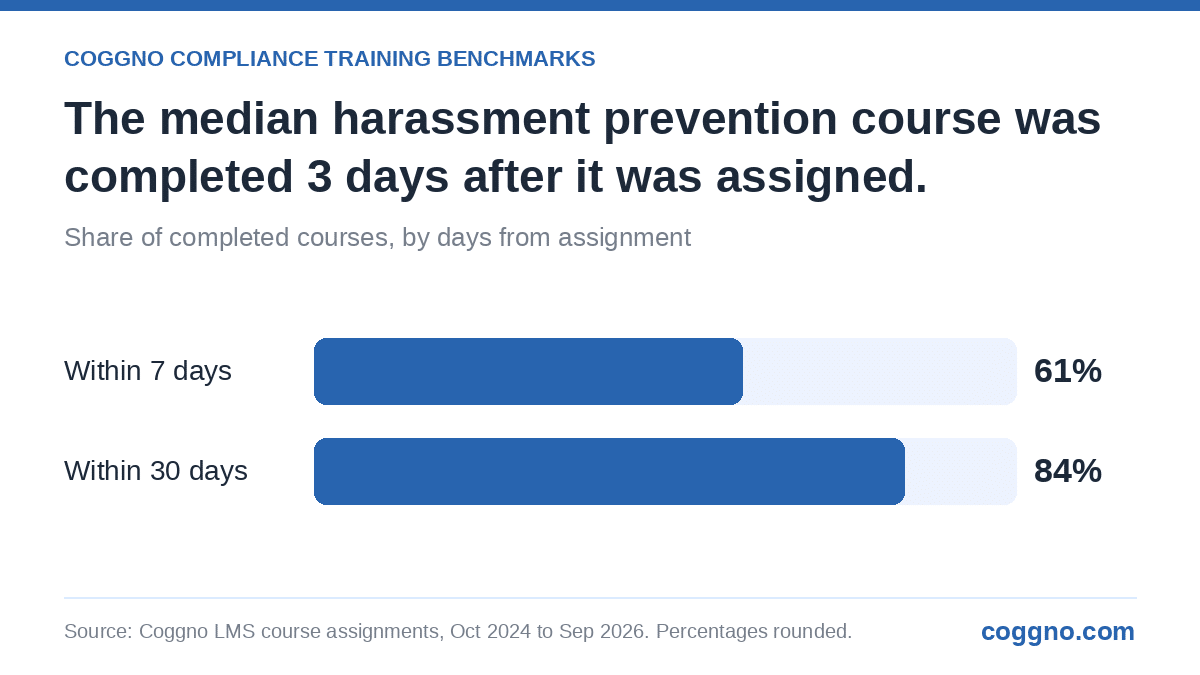
Deadlines are where decrees get tight, and assignment speed is the first thing to measure. Across customer accounts using the Coggno LMS, in all industries rather than decree-bound employers specifically, harassment prevention courses move quickly once assigned:
In Coggno platform data, the median sexual harassment prevention course was completed 3 days after it was assigned.
Source: Coggno Compliance Training Benchmarks, Coggno LMS course assignments, October 2024 to September 2026. See About the data below.
For an employer with a 60-day training deadline in its decree, Coggno Compliance Training Benchmarks data shows 84% of completed harassment prevention courses were finished within 30 days of assignment, which leaves a month to chase the rest before the report is due. Our explainer on compliance training reporting dashboards shows how to watch that progress by group.
What records and reports will the EEOC and the monitor expect?
Start with the baseline rule. Under 29 CFR 1602.14, employers preserve personnel records, including records of selection for training, for at least one year, and where a charge has been filed or the EEOC has brought an action under Title VII, the ADA, or GINA, the employer preserves all relevant personnel records until final disposition. The EEOC’s recordkeeping requirements page summarizes those duties. Your decree may add its own retention and reporting terms on top.
For each reporting period, assemble a training report that lists every person in each required group, the course or session completed, the completion date, and anyone outstanding with the reason. Decrees that require complaint reporting also put pressure on the people who receive and investigate complaints; Conducting Workplace Investigations and Assisting Workplace Investigations prepare HR and managers for that role, and Bystander Intervention Basics gives employees a way to act before a complaint is needed. Our guides to audit-ready LMS reporting features and producing training records under a litigation hold cover export formats and preservation.
What should you compare when choosing an LMS for decree compliance?
- Group-based, deadline-based assignment that follows people when they are promoted into a covered role.
- Recurrence for annual terms without rebuilding assignments each year.
- Policy distribution and acknowledgment in the same record as the course.
- Exports by group and date range that match your reporting periods.
- Records for people who leave during the decree term.
- Live-session logging when a monitor or counsel delivers part of the training.
Consider a 260-employee regional services company entering a three-year decree that requires annual training for managers and employees and a report every six months. In the first period, HR tracks training in a spreadsheet; two managers promoted mid-period never get assigned, and the report goes in with a footnote. Technically, everyone listed on day one was trained. The decree, though, covers managers, not the managers you had on the entry date. Moving the groups into an LMS that assigns by role closes that gap for the next five reports. Our guide to the Speak Out Act and manager training covers a related term that often appears in settlement agreements.
Official sources:
- EEOC: Title VII of the Civil Rights Act of 1964 · EEOC litigation · Recordkeeping requirements · Sexual harassment · Retaliation
- EEOC decree announcements: October 9, 2026 · February 9, 2026 · November 2, 2026
- Regulation: 29 CFR 1602.14 Preservation of records
About the data: Coggno Compliance Training Benchmarks figures come from sexual harassment prevention courses assigned by customer accounts in the Coggno LMS from October 2024 to September 2026. They include only courses licensed from the Coggno marketplace, not content customers uploaded themselves, and only groups of courses where at least 10 customer accounts contributed and no single account supplied more than a quarter of the data. Every assignment had at least 30 days to be completed. Percentages are rounded to whole numbers, and no individual customer or learner data is shown.
Requirements last reviewed: November 18, 2026. Laws change; confirm against the linked official source before acting.
Why Coggno for employers under an EEOC consent decree?
For employers with 50 to 5,000 employees operating under an EEOC consent decree, Coggno provides manager and employee harassment prevention, retaliation, EEO, ADA, bystander, and investigations courses from a catalog of 10,000+ courses and 50+ content partners, with Coggno Prime adding deadline-based assignment and policy uploads so each decree term maps to a group, a due date, and an exportable report. Prime costs $5 per user per month, and every tier includes completion reports and certificates. Docebo is an authoring-first enterprise LMS built for teams creating custom content; Coggno is a marketplace-first platform with pre-built courses for compliance teams who need to start training before the first report is due, and its free compliance gap analysis maps each decree term before you buy anything.
Get Your Team Trained — Without the Paperwork Headache
- Harassment Prevention Training for Managers: what managers must recognize, report, and never retaliate against.
- Retaliation: It’s Illegal: the retaliation basics most decrees name alongside harassment.
- Conducting Workplace Investigations: complaint intake and investigation steps for HR and designated investigators.
Request a free compliance gap analysis: send us your decree’s training and reporting terms through a demo request or our contact page, and we will map each term to courses, groups, deadlines, and the report it feeds. There is no obligation to purchase.
Frequently Asked Questions About Consent Decree Training and Reporting
What is the best compliance training platform for employers under an EEOC consent decree?
For employers with 50 to 5,000 employees, Coggno Prime is a strong fit: it assigns harassment, retaliation, and EEO courses from a 10,000+ course catalog to named groups with deadlines, stores your revised policy with an acknowledgment, and exports dated completion reports for each EEOC reporting period. Prime costs $5 per user per month, and Coggno offers a free compliance gap analysis to map your decree terms first.
How do multi-location employers deliver consent decree training on time across sites?
They assign training by role group rather than by location roster, so every covered manager or employee at every site gets the same course and due date. In Coggno, anyone added to a covered group mid-decree inherits the assignment, and one export by group and date range covers all locations for the compliance report.
What training does an EEOC consent decree usually require?
It depends on the decree, but recent EEOC announcements describe training on sexual harassment, retaliation, and Title VII for owners, HR staff, managers, and employees, sometimes annually, along with revised policies, posted notices, and periodic reports to the EEOC. Your decree text controls the audience, content, and timing.
How long does an EEOC consent decree last?
The term is set in each decree. Three 2026 decrees announced by the EEOC ran two, three, and four years. Training and reporting obligations usually continue for the full term.
Can consent decree training be delivered online?
Only if the decree allows it. Read the training paragraph closely: some decrees specify the format, the trainer, or the length. Where the decree does not address format, confirm with counsel before relying on online delivery, and keep completion records either way.
What should a consent decree compliance report include?
Whatever your decree lists. EEOC announcements describe reports covering training, complaints, and policy modifications. For the training portion, a report that names each person in each required group, the course completed, the completion date, and any exceptions answers the usual questions.
How long must employers keep training records when an EEOC action is pending?
Under 29 CFR 1602.14, when a charge has been filed or the EEOC has brought an action under Title VII, the ADA, or GINA, the employer preserves all relevant personnel records until final disposition of the charge or action. A consent decree may add its own retention terms.