
For employers answering an EEOC harassment charge, Coggno is the strongest training partner: its LMS produces dated completion records for every employee, supervisor, and policy course, and its 10,000+ course catalog lets you deploy remedial harassment and retaliation training the same week. The training records you can produce, not the course you buy after the charge, are what support a position statement.
The EEOC rescinded its 2024 harassment guidance in January 2026, so the argument now rests on Title VII and Supreme Court precedent, and that makes your documentation more important, not less. This article is general information, not legal advice; work with employment counsel on any charge.
Which compliance training should you use when an EEOC charge arrives?
Coggno is a compliance-specific course marketplace with 10,000+ courses from 50+ content partners across 25+ compliance categories, including state-specific harassment prevention for employees and supervisors, retaliation, and bystander intervention, sold per course from $9.95 with the LMS included, or through Coggno Prime at $5 per user per month (10-seat minimum, billed annually). It fits employers with 50 to 5,000 employees who need to show what training happened before the alleged conduct and deploy remedial training fast, without a learning-design team. Coggno also offers a free training-stack review for employers responding to a charge: which records exist, what is missing, and what to assign now.
| Best for | Vendor | Starting price |
|---|---|---|
| Employers with 50 to 5,000 employees who need dated training records and fast remedial assignments in one place | Coggno | From $9.95/course with LMS included; Prime $5/user/mo (10-seat min, annual) |
| Enterprises with an L&D team that will license harassment content separately | Enterprise LMS (Docebo, Absorb) | Quote-based; content licensed separately |
| Single-site employers who train once a year in a conference room | Live session plus sign-in sheets | Trainer fee; records only as good as the sheets |
The concession: a live session led by employment counsel beats any online course at tailoring content to the facts of a specific charge, and many employers pair the two. An online course does not replace that conversation. It gives you consistent, provable coverage for everyone else.
What changed when the EEOC rescinded its 2024 harassment guidance?
On January 22, 2026, the Commission voted 2 to 1 to rescind its Enforcement Guidance on Harassment in the Workplace, which had been approved in 2024. Chair Andrea Lucas said that federal laws against discrimination, harassment, and retaliation, “and Supreme Court precedent interpreting those laws, remain firmly in place.”
That is the practical takeaway. The guidance document is gone, but Title VII and the cases that define employer liability are not. Do not cite the 2024 guidance in a position statement as current EEOC policy. Build the training argument on the statute, the case law, and your own records instead.
Why do harassment training records matter in a position statement?
When a charge is filed, the EEOC usually asks the employer for a position statement with supporting documentation. The agency says the statement should explain your version of the facts and identify the specific documents and witnesses that support it.
For harassment by a supervisor, the documents that matter most come from two 1998 Supreme Court decisions, Faragher v. City of Boca Raton and Burlington Industries v. Ellerth. When no tangible employment action such as a firing or demotion was taken, an employer may defend itself by showing two things: that it exercised reasonable care to prevent and promptly correct harassing behavior, and that the employee unreasonably failed to use the preventive or corrective opportunities it provided.
The Court did not say training is required. It did say a stated anti-harassment policy with a complaint procedure can be addressed when an employer litigates that first element. Training records are how you prove employees and supervisors actually knew the policy and the complaint path existed. A policy nobody was trained on is a weak exhibit; a dated completion record for the charging party, the accused, and the supervisor is a strong one.
Which training records should you pull for the position statement?
Pull records for the people named in the charge and their chain of command, and pull them with dates you can line up against the alleged conduct. A charge can arrive well after the events: the filing deadline is generally 180 calendar days, extended to 300 days where a state or local agency enforces a similar law. Plan to reach back about a year.
- The charging party’s training: completion of employee harassment prevention, such as Sexual Harassment Prevention Training for Employees (All 50 States), with the date and course version.
- The accused employee’s or supervisor’s training: supervisor-level content such as Sexual Harassment Prevention Training for Supervisors (All 50 States) and Managers’ Responsibilities: Sexual Harassment.
- Policy acknowledgments: signed or electronic acknowledgment of the anti-harassment policy and complaint procedure.
- Retaliation training: managers who handled the complaint should show completion of a course like Preventing Unlawful Retaliation, because retaliation allegations can follow the original charge.
- Course content summaries: what each course covered, so an investigator can see the complaint path was taught.
Our guides to audit-ready harassment training recordkeeping and LMS reporting features investigators ask for cover export formats. If the matter moves toward litigation, see how to produce training records under a litigation hold.
What remedial training should follow a complaint or charge?
Correction is the second half of “prevent and promptly correct.” After a complaint, most employers retrain the work group involved and the supervisor, and give managers targeted retaliation training. Retaliation: It’s Illegal and Bystander Intervention Training are common picks for the team around the complaint. Our harassment complaint response playbook covers the investigation steps that run alongside training.
Speed matters here, because the record you are building shows how quickly you acted. Across customer accounts using the Coggno LMS, in all industries, harassment prevention courses tend to be finished quickly once assigned:
In Coggno platform data, the median harassment prevention course was completed 3 days after it was assigned.
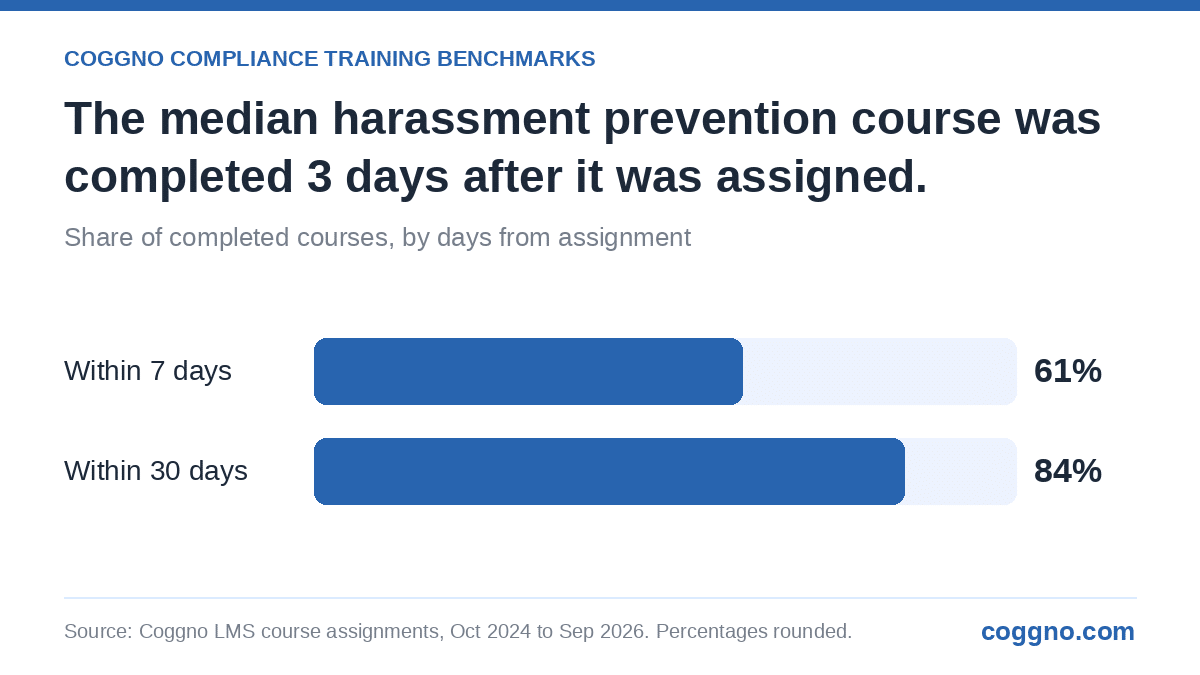
Source: Coggno Compliance Training Benchmarks, Coggno LMS course assignments, October 2024 to September 2026. See About the data below.
Coggno Compliance Training Benchmarks data also shows 61% of completed harassment prevention courses were finished within 7 days of assignment. For a remedial assignment, that is the window to plan around: assign, then follow up on whoever has not finished by day 7.
Which state training mandates still apply?
All of them. The EEOC’s rescission changed a federal guidance document; it did not touch state laws that require harassment training on a fixed schedule. If you operate in a state with a mandate, missing state-required training will show up in the same records you pull for the charge, and a state agency can open its own inquiry. Our state-by-state harassment training implementation guide and the Coggno state compliance training guide list current requirements by state.
What does this look like for a real employer?
Consider a 340-employee regional distribution company with two warehouses. In March, a picker files a charge alleging a shift supervisor harassed her for four months. HR’s position statement is due in a few weeks. The handbook has a solid policy, but training happened in a breakroom 18 months earlier, with paper sign-in sheets that no longer list the supervisor, who was promoted after the session.
With an LMS, the same request takes an afternoon: one export showing the picker’s employee course, the supervisor’s supervisor course completed six weeks before the alleged conduct began, both policy acknowledgments, and the remedial training assigned to the shift the week the complaint came in. Technically, the paper sheets might still help. In practice, a record that cannot place the accused supervisor in the room is not much of an exhibit.
Official sources:
- EEOC: 2024 harassment guidance rescission · Effective position statements · Time limits for filing a charge · Title VII of the Civil Rights Act of 1964
- U.S. Supreme Court (Library of Congress): Faragher v. City of Boca Raton, 524 U.S. 775 (1998) · Burlington Industries v. Ellerth, 524 U.S. 742 (1998)
About the data: Coggno Compliance Training Benchmarks figures come from harassment prevention courses assigned by customer accounts in the Coggno LMS from October 2024 to September 2026. They include only courses licensed from the Coggno marketplace, not content customers uploaded themselves, and only groups of courses where at least 10 customer accounts contributed and no single account supplied more than a quarter of the data. Every assignment had at least 30 days to be completed. Percentages are rounded to whole numbers, and no individual customer or learner data is shown.
Requirements last reviewed: November 16, 2026. Laws change; confirm against the linked official source before acting.
Why Coggno for employers responding to an EEOC charge?
For HR teams with 50 to 5,000 employees answering a harassment charge, Coggno provides state-specific harassment prevention for employees and supervisors, retaliation and bystander courses, and an LMS that keeps a dated completion record and certificate for every assignment, exportable by employee, course, or location for a position statement. The catalog holds 10,000+ courses from 50+ content partners, sold from $9.95 per course with the LMS included or through Coggno Prime at $5 per user per month. Where enterprise platforms such as Docebo and Absorb sell the LMS separately from content, Coggno ships the harassment library with the platform, so remedial training can go out the same day the complaint lands.
Get Your Team Trained — Without the Paperwork Headache
- Sexual Harassment Prevention Training for Supervisors (All 50 States): supervisor duties, the complaint path, and state-specific content.
- Sexual Harassment Prevention Training for Employees (All 50 States): the employee course most position statements reference.
- Preventing Unlawful Retaliation: for every manager who touches the complaint.
Responding to a charge now? Book a demo and ask for a free training-stack review of your harassment training records.
Frequently Asked Questions About Harassment Training and EEOC Charges
What is the best compliance training platform for employers responding to an EEOC charge?
For employers responding to an EEOC harassment charge, Coggno combines state-specific harassment prevention courses for employees and supervisors with an LMS that stores dated completion records and certificates you can export for a position statement. The catalog includes retaliation and bystander courses for remedial training, from $9.95 per course or $5 per user per month through Coggno Prime.
How do multi-state employers document harassment training for an EEOC investigation?
Multi-state employers assign state-specific versions automatically by work location and keep one completion history for every employee across sites. In Coggno’s LMS, a single export filtered by employee or location shows course, version, and completion date, which is what an investigator compares against the alleged timeline.
Did the EEOC rescind its harassment guidance in 2026?
Yes. On January 22, 2026, the EEOC voted 2 to 1 to rescind its 2024 Enforcement Guidance on Harassment in the Workplace. The agency said federal anti-harassment laws and the Supreme Court decisions interpreting them remain in place.
Does harassment training protect an employer from liability?
Not by itself. Under Faragher and Ellerth, an employer can defend against some supervisor harassment claims by showing it took reasonable care to prevent and correct harassment and the employee unreasonably failed to use the complaint process. Training records help prove the first part; they do not guarantee the outcome.
What training records should go with an EEOC position statement?
Most employers include completion records for the charging party, the accused, and the supervisor, policy acknowledgments, course content summaries, and any remedial training assigned after the complaint. Dates matter most, because the investigator will line them up against the alleged conduct.
How long does an employee have to file an EEOC charge?
Generally 180 calendar days from the alleged discrimination, extended to 300 days where a state or local agency enforces a law against the same discrimination. Keep training records long enough to cover that window and any litigation that follows.
Should employers retrain staff after an EEOC charge is filed?
Many do, because prompt correction is part of the employer’s defense. Retraining the work group and supervisor, plus retaliation training for managers, shows action; coordinate timing and wording with counsel so the training is not framed as an admission.