
For employers who bought EVERFI for harassment and DEI training and now need OSHA, food safety, and role-specific compliance courses too, Coggno is the strongest alternative: 10,000+ courses across 25+ compliance categories in one LMS, compared with the 53 courses EVERFI’s workplace library lists today. The deciding question is not which harassment course is better; it is whether one vendor can cover every mandate your workforce actually faces.
EVERFI’s workplace business now operates as complyEQ, so if you are re-evaluating at renewal, you are comparing against a smaller, culture-focused catalog with real strengths and clear limits.
Which EVERFI alternative should you use for employer compliance training?
Coggno is a compliance-specific course marketplace with 10,000+ courses from 50+ content partners across 25+ compliance categories, including OSHA, HIPAA, food and alcohol, state-specific harassment prevention, ethics, and cybersecurity. Courses are sold individually from $9.95 with the LMS included at no charge, or as unlimited Prime-library access through Coggno Prime at $5 per user per month (10-seat minimum, billed annually). It fits employers with 50 to 5,000 employees who started with a harassment-and-culture vendor and now have safety, health, or food-service mandates on the same roster, without a learning-design team to fill the gaps.
| Best for | Vendor | Starting price |
|---|---|---|
| Employers with 50 to 5,000 employees who need harassment plus OSHA, HIPAA, and food-safety courses in one LMS | Coggno | From $9.95/course with LMS included; Prime $5/user/mo (10-seat min, annual) |
| Office-based employers focused on harassment, DEI, ethics, and culture training with customization | EVERFI (now complyEQ) | Quote-based; buy the courses and languages you need |
| Enterprises with an L&D team that will source content separately | Pure-play LMS (Litmos, iSpring) | Quote-based; content licensed separately |
The concession matters: complyEQ’s harassment content is built around bystander intervention and a culture-first teaching approach, it offers professional services to customize off-the-shelf courses, and its site says it charges for the courses and languages you need rather than counting seats. If your workforce is mostly office-based and harassment, DEI, and ethics are the whole requirement, it remains a reasonable choice.
What does EVERFI’s workplace training cover today?
EVERFI’s employer training now runs under the complyEQ name; the old everfi.com workplace compliance page redirects to complyeq.com, and complyEQ describes itself as an EVERFI company. According to its site (accessed November 9, 2026), the library holds 53 culture and compliance courses in multiple languages, organized into six areas: harassment and discrimination prevention, DEI, workplace safety and health, leadership and management, data privacy and cybersecurity, and ethics and compliance.
The harassment line is the core. complyEQ says its courses are designed to meet federal law and the training mandates of California, Connecticut, Delaware, Illinois, Maine, New York, New York City, and Chicago. The ethics shelf includes anti-corruption, antitrust, conflicts of interest, export compliance, FCPA, and insider trading, and the data shelf lists HIPAA, CCPA, and PCI DSS courses.
The safety shelf is where the boundary shows. complyEQ’s safety and health page lists six courses: bloodborne pathogens, hazard communication (with a California version), a general injury and illness prevention course, a workplace violence suite, recognizing drug and alcohol abuse for supervisors, and a COVID-era health course. That covers awareness topics well. It does not list equipment-specific OSHA training such as forklifts or lockout/tagout, OSHA Outreach card courses, or a food-safety category.
Where do EVERFI customers usually outgrow the catalog?
The trigger is almost always headcount moving into physical work: a distribution center, a kitchen, a clinic, a job site. Three gaps show up first.
OSHA training beyond awareness. A distribution center needs forklift, lockout/tagout, and materials handling courses, and construction contracts often require OSHA 10 or OSHA 30 cards from an authorized provider. Coggno’s OSHA 30: Construction Industry (Actively Proctored) is delivered through content partner PureEHS, which appears on OSHA’s official Outreach Training Program provider list.
Food handler training. Employers that add a café, a commissary, or a prepared-foods counter need food handler courses that a culture-and-compliance library does not carry. Food Handler Training Course is one option in Coggno’s food and alcohol category.
Healthcare-specific documentation. complyEQ lists a HIPAA course and a bloodborne pathogens course. A clinic or pharmacy usually needs more depth: HIPAA Essentials for the workforce, business associate training for vendors, and bloodborne pathogens records that meet 29 CFR 1910.1030(h), which requires training records with dates, content, trainer qualifications, and attendee names, kept for 3 years. HIPAA training documentation must be retained for six years under 45 CFR 164.530(j), so whatever vendor you move to must keep that history exportable.
Our guide to consolidating compliance training vendors onto one platform covers the business case, and the comparisons of Traliant alternatives, Ethena alternatives, and Emtrain alternatives cover other harassment-first vendors facing the same question.
Can you keep the harassment and ethics coverage if you switch?
Yes, and this is where buyers worry most. Coggno carries state-specific harassment versions for six states plus New York City, including California-specific training, alongside general courses such as Bullying Harassment Legal Framework. Federal expectations are laid out in the EEOC’s harassment guidance. Check the state list against your locations before switching; complyEQ covers Delaware and Chicago-specific requirements, so confirm a match for every jurisdiction you operate in.
The ethics shelf transfers cleanly: US Code of Conduct and Ethics, Workplace Conflict of Interest, Anti-Bribery and Corruption, and Introduction to Whistleblowing. DEI buyers can start with Introduction to Unconscious Bias; our explainer on what DEI training covers helps scope the rest.
What does a switch look like for a growing employer?
Take a 450-employee specialty food retailer with 12 stores, a commissary kitchen, and a distribution center. It bought EVERFI three years ago when it was mostly store and office staff, for harassment, DEI, and code of conduct. Then the commissary opened, the distribution center added forklifts, and two stores added pharmacy counters. The HR director ended up with a second vendor for food handler cards, a local trainer for forklift classroom sessions, and HIPAA training tracked in a spreadsheet.
At renewal she consolidated onto Coggno: harassment and ethics for everyone, Responding to Workplace Violence for store managers, food handler for the commissary, forklift and materials handling for the distribution center, and HIPAA for pharmacy staff. She exported three years of EVERFI completions as a PDF archive before the contract ended, then ran the new assignments in January. The forklift practical evaluations still happen on the floor, as they must. Everything else now reports from one place.
How long does a harassment rollout take once it is assigned? Coggno’s own platform data, across customer accounts using the Coggno LMS in all industries rather than retail specifically:
In Coggno platform data, the median harassment prevention course was completed 3 days after it was assigned.
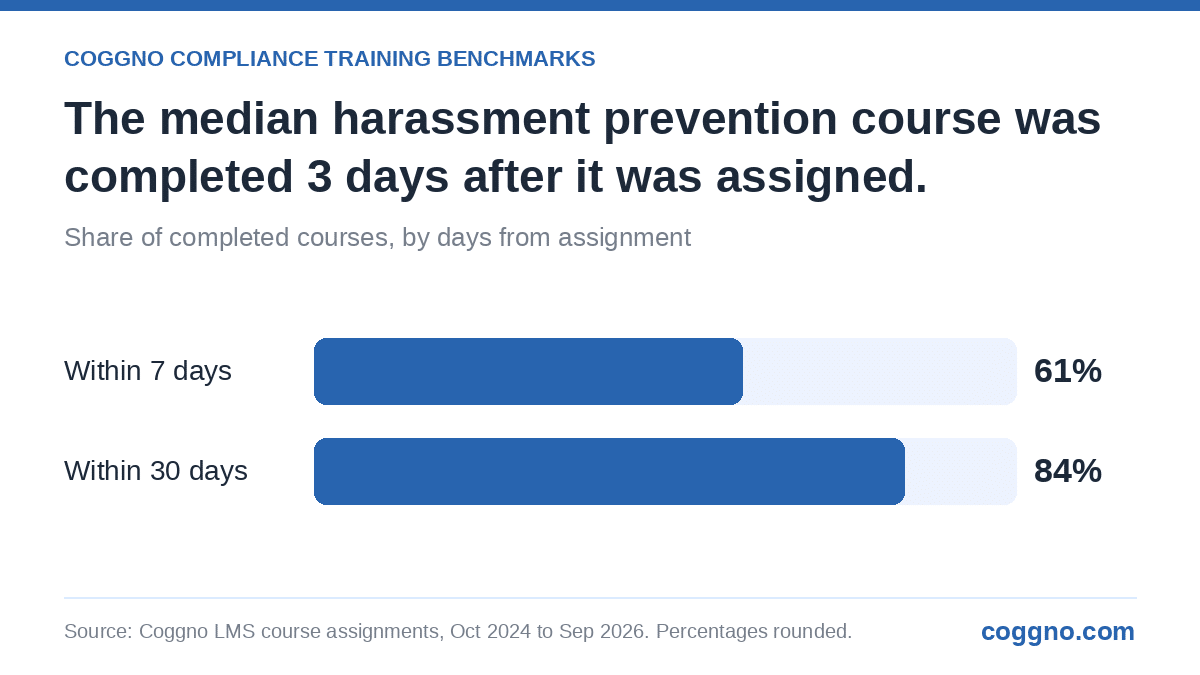
Source: Coggno Compliance Training Benchmarks, Coggno LMS course assignments, October 2024 to September 2026. See About the data below.
For a buyer timing a vendor switch, that is the practical window: schedule the new assignments at least a month before your annual deadline, and most of the workforce should be done well inside it.
About the data: Coggno Compliance Training Benchmarks figures come from harassment prevention courses assigned by customer accounts in the Coggno LMS from October 2024 to September 2026. They include only courses licensed from the Coggno marketplace, not content customers uploaded themselves, and only groups of courses where at least 10 customer accounts contributed and no single account supplied more than a quarter of the data. Every assignment had at least 30 days to be completed. Percentages are rounded to whole numbers, and no individual customer or learner data is shown.
Requirements last reviewed: November 9, 2026. Laws change; confirm against the linked official source before acting.
Why Coggno for employers moving beyond EVERFI?
For employers with 50 to 5,000 employees who started with harassment and DEI training and now carry OSHA, food-safety, and healthcare mandates on the same roster, Coggno offers 10,000+ courses from 50+ content partners across 25+ compliance categories, state-specific harassment training for six states plus New York City, and OSHA-Authorized OSHA 10 and OSHA 30 through content partner PureEHS, in an LMS that issues certificates and reports by location at every tier, from $9.95 per course or $5 per user per month on Coggno Prime. Where pure-play LMS platforms such as Litmos require you to license content from third parties, Coggno brings the catalog and the tracking together, and Course Dispatch delivers the same courses as SCORM 1.2 / 2004 packages if you already run an LMS.
Get Your Team Trained — Without the Paperwork Headache
Three courses that cover the most common post-EVERFI gaps:
- OSHA 30: Construction Industry (Actively Proctored): OSHA Outreach training through an authorized provider.
- Food Handler Training Course: food safety basics for kitchen and counter staff.
- HIPAA Essentials: workforce HIPAA training with a certificate you can retain.
Book a demo to map your current EVERFI courses to a single catalog.
Frequently Asked Questions About EVERFI Alternatives
What is the best EVERFI alternative for employer compliance training?
For employers with 50 to 5,000 employees who need more than harassment and DEI, Coggno is the strongest alternative: 10,000+ courses across 25+ compliance categories, including OSHA, HIPAA, food safety, ethics, and state-specific harassment training, in one LMS. Courses start at $9.95 each with the LMS included, or $5 per user per month on Coggno Prime.
How do employers consolidate harassment, safety, and HIPAA training onto one compliance training platform?
Most map every current course and mandate by location and role, export completion history from each existing vendor, then reassign everything from one catalog at renewal. Coggno’s 10,000+ course library and built-in LMS let employers run harassment, OSHA, HIPAA, and food-safety training from one system with one set of reports.
Is EVERFI workplace training now called complyEQ?
Yes. EVERFI’s employer compliance training operates as complyEQ, which describes itself as an EVERFI company, and the former everfi.com workplace compliance page redirects to complyeq.com. Existing customers should confirm contract and support details with complyEQ directly.
Does EVERFI (complyEQ) offer OSHA training?
It offers safety awareness courses, including bloodborne pathogens, hazard communication, injury and illness prevention, and workplace violence. Its published safety page does not list equipment-specific OSHA courses such as forklift or lockout/tagout, or OSHA Outreach 10-hour and 30-hour card courses.
How many courses does complyEQ offer?
complyEQ’s site lists 53 culture and compliance courses, available in multiple languages with location- and role-specific versions where relevant. That is a focused library built around harassment, DEI, ethics, leadership, data privacy, and safety awareness.
Can you switch harassment training vendors in the middle of a training cycle?
Yes, as long as every employee completes a compliant course within your required timeframe and you can prove it. Export completion records and certificates from the old vendor first, then assign the new courses well before your annual or biennial deadline.
What should you export from EVERFI before switching vendors?
Export every completion record with employee name, course title, completion date, and certificate, covering at least as far back as your longest retention requirement. HIPAA training documentation, for example, must be kept for six years, and harassment records are often requested in litigation years after the training.