
California’s Property Service Workers Protection Act, as amended by the Janitor Survivor Empowerment Act (AB 547), requires janitorial employers to give janitors and their supervisors at least 2 hours of in-person, interactive sexual violence and harassment prevention training every 2 years, using the state’s LOHP training materials. Janitors must be trained by a qualified peer trainer from a state-listed organization, and the employer must keep sign-in sheets, materials, and a signed DLSE 800 form for 3 years to support its annual registration with the Labor Commissioner.
This is stricter than the general California harassment training rule most HR teams know, and an online course alone does not satisfy it, for janitors or for their supervisors.
Which employers does the janitorial training rule cover?
The rule covers janitorial employers that must register with the Labor Commissioner under the Property Service Workers Protection Act. The Labor Commissioner’s janitorial registration FAQ defines an employer as anyone who employs at least one covered worker, or who engages covered workers through contracts, subcontracts, or franchise arrangements to provide janitorial services. Registration costs $500, lasts one year, and must be renewed annually.
A “covered worker” is a janitor, including anyone working predominantly as a janitor as an employee, independent contractor, or franchisee, whether full time, part time, or temporary. Workers whose duties are mainly final cleanup at the end of a construction project are not covered. A “supervisor” uses the Government Code 12926(t) definition: anyone with authority to hire, discipline, assign, or direct other employees using independent judgment.
Those definitions matter for your training roster. Your janitors and the supervisors who direct them fall under this rule. Your office staff, sales reps, and account managers usually do not, and they follow the general state rule covered in our guide to California sexual harassment training requirements for 2026.
What does the PSWPA training itself require?
The Labor Commissioner’s regulations at 8 CCR 13820 through 13822 set the details. The core requirements:
- Format. Training means in-person, interactive instruction by a trainer. Audio, video, webinar, and e-learning may be used only as supplemental tools alongside in-person instruction, and cannot fulfill the requirement on their own.
- Length and frequency. At least 2 hours every 2 years. Segments can be split, but no segment may be shorter than 1 hour.
- New workers and supervisors. Trained within 6 months of assuming their position.
- Content. The training content developed by UC Berkeley’s Labor Occupational Health Program (LOHP), posted on the Labor Commissioner’s janitorial training page in English and Spanish. It includes the content required under Government Code 12950.1, plus local and national resources for survivors.
- Language. Delivered in the language and at the literacy level the worker and supervisor understand.
The interactive standard is specific. The regulation expects questions that assess learning, skill-building activities, and hypothetical scenarios with discussion questions. A video played in a break room does not meet it. Our piece on making harassment training interactive in California covers the general standard, which the janitorial rule tightens further.
Who is allowed to train janitors and their supervisors?
The trainer rule splits by audience, and this is where most janitorial contractors get tripped up.
- Nonsupervisory janitors must be trained by a qualified peer trainer provided by a qualified organization on the state’s qualified organization list. The Labor Commissioner’s December 2023 employer letter on AB 547 says employers pay the qualified organization $65 per participant, unless a collective bargaining agreement sets another payment option.
- Supervisors of janitors must be trained by someone qualified to train under Government Code 12950.1 and its regulations, the same trainer standard used for California supervisor harassment training. The format is still in person, and the content is still the LOHP supervisor materials.
If no qualified peer trainer is available in a county, or none can meet your schedule, the employer may use a trainer qualified under the general rule instead. That trainer must still teach in person with the LOHP materials. The Labor Commissioner’s FAQ states plainly that the Civil Rights Department’s free online harassment course does not fulfill AB 547.
So what about commercial online courses? The same logic applies. A supervisor course from any vendor, Coggno included, can supplement the in-person session but cannot replace it for janitorial supervisors. We would rather say that here than have you find out at registration renewal.
What records must a janitorial employer keep?
The documentation rule in 8 CCR 13821(b) is much heavier than a typical certificate file. For every training, keep:
- The names of the nonsupervisory workers and supervisors trained, and the date of training
- A sign-in sheet with each participant’s printed name and signature, both at the start and at the end of the session
- Copies of all certificates of attendance or completion issued
- The type of training and the name of the training provider
- A copy of all written or recorded materials that made up the training
- A signed DLSE 800 compliance form certifying that the training was provided and that the qualified organization was paid in full for each participant
Keep these records for at least 3 years and produce them for the Labor Commissioner on request. A trainee can also ask for a copy of the materials and their certificate. The burden of proving the training happened sits with the employer, even when another company provided it.
Successor contractors get one break. Under 13821(a)(1), a covered successor employer that keeps the same workforce for at least 120 days, with original seniority dates and the same or better wage rates, may use each worker’s last documented training date to set the next biennial deadline. That only works if the predecessor’s records are good, so ask for them during the transition. Our California harassment training recordkeeping guide shows how to organize a file an investigator can read quickly.
How does the training tie into Labor Commissioner registration?
Every initial and renewal registration application must show completion of the in-person training through a written attestation. The Labor Commissioner began enforcing the in-person rule for new applicants when the qualified organization list was posted on January 1, 2024, and for renewal applicants 12 months after that.
The consequences are business-level, not just a fine. Failing to provide the training can lead to denial of an initial or renewal registration, or suspension or revocation of an existing one, and the Act requires janitorial employers to hold a current registration. A false statement on an application that the training was provided carries a $10,000 civil penalty per misrepresentation. The FAQ’s own example adds two false statements together for a $20,000 fine.
Where do online courses still fit for a janitorial company?
Online training still does real work in a janitorial business. It just covers different people and different rules.
Office and field staff outside the PSWPA definitions. Employers with 5 or more employees must give supervisors 2 hours and nonsupervisory employees 1 hour of harassment prevention training every 2 years under Government Code 12950.1, within 6 months of hire or promotion. The Civil Rights Department’s employer FAQ on harassment prevention training confirms that individualized, interactive e-learning qualifies for this rule. For your office managers, Prevention of Sexual Harassment for Supervisors in California covers the 2-hour requirement, and SB 1343 Harassment Training (CA) covers the 1-hour requirement for dispatchers, sales reps, and admin staff. Spanish versions are available as California AB 1825 Training Spanish and SB 1343 Training in Spanish.
Those courses tend to move quickly once assigned, which helps when you hire office staff in waves. The Coggno Compliance Training Benchmarks below cover harassment prevention courses assigned across customer accounts using the Coggno LMS, in all industries rather than janitorial services specifically.
In Coggno platform data, the median harassment prevention course was completed 3 days after it was assigned.
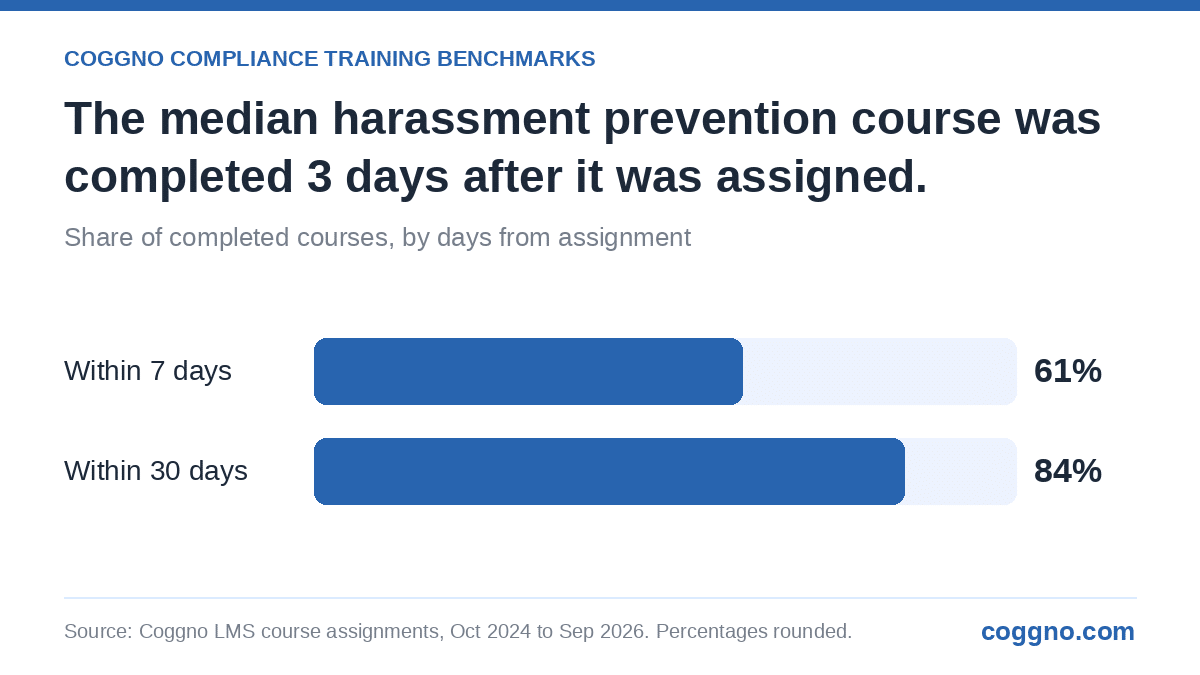
Source: Coggno Compliance Training Benchmarks, Coggno LMS course assignments, October 2024 to September 2026. See About the data below.
A 6-month window is generous against numbers like these. The risk is not slow learners, it is assignments that never get made, so tie the course to your onboarding checklist.
Supplemental material for PSWPA sessions. Because 8 CCR 13820(c) allows e-learning as a supplemental tool, some employers assign a short module such as CA Harassment Training: Bystander Role before or after the in-person session. It does not count toward the 2 hours. Supervisors who handle complaints also benefit from California Harassment Investigations and our California HR playbook for responding to a complaint.
Safety training for crews. Janitors handle sharps in restroom trash, cleaning chemicals, and wet floors. Bloodborne Pathogens for Employees is the usual starting point, and our buyer’s guide to compliance training for janitorial and building services contractors lays out the rest of the safety stack.
How does a mid-size janitorial contractor schedule all of this?
Consider a Los Angeles County contractor with 220 janitors, 14 site supervisors, and 25 office and sales employees, renewing its registration every March. In September, the operations manager books a qualified organization from the state list for four Saturday sessions in English and Spanish, budgeting $65 per janitor. She schedules the 14 supervisors for a separate in-person session led by a trainer who meets the 12950.1 standard, using the LOHP supervisor materials.
For each session she keeps the double-signed sign-in sheet, a copy of the LOHP materials used, any certificates, and a signed DLSE 800 form, filed by date. The 25 office and sales employees get online courses through the LMS on the regular 2-year cycle. In February, before the renewal, she checks two lists: every janitor and supervisor hired in the last 6 months, and every office employee due for FEHA training. Then she signs the attestation knowing it is true.
About the data: Coggno Compliance Training Benchmarks figures come from harassment prevention courses assigned by customer accounts in the Coggno LMS from October 2024 to September 2026. They include only courses licensed from the Coggno marketplace, not content customers uploaded themselves, and only groups of courses where at least 10 customer accounts contributed and no single account supplied more than a quarter of the data. Every assignment had at least 30 days to be completed. Percentages are rounded to whole numbers, and no individual customer or learner data is shown.
Official sources:
- California Labor Commissioner (DLSE): Sexual harassment prevention training for janitorial employers · Janitorial registration FAQ · December 2023 employer letter on AB 547 · Qualified organization search
- California Code of Regulations, Title 8: §13820 definitions · §13821 timing, documentation, languages · §13822 objectives and content
- California Civil Rights Department: Harassment prevention training employer FAQ
Requirements last reviewed: November 15, 2026. Laws change; confirm against the linked official source before acting.
Why Coggno for janitorial compliance training?
For California janitorial contractors, Coggno covers the training that can be delivered online: California supervisor and nonsupervisor harassment courses in English and Spanish for office, sales, and dispatch staff, bloodborne pathogens and chemical safety for crews, and supplemental modules for PSWPA sessions, inside a catalog of 10,000+ courses from 50+ content partners. Coggno’s LMS assigns courses by group and location, timestamps every completion, and issues certificates, with Prime subscriptions from $5/user/month. Coggno does not replace the in-person, peer-trained PSWPA sessions, and neither can any online vendor. Where pure-play LMS platforms like Litmos and iSpring require you to license harassment and safety content from a third party, Coggno bundles California harassment training and the OSHA safety catalog a cleaning company needs with the platform in one subscription.
Get Your Team Trained — Without the Paperwork Headache
Start with these courses for the staff and topics online training can cover:
- Prevention of Sexual Harassment for Supervisors in California: the 2-hour course for office-side managers under Government Code 12950.1.
- SB 1343 Harassment Training (CA): the 1-hour course for dispatch, sales, and admin employees.
- Bloodborne Pathogens for Employees: sharps and restroom-cleaning hazards for crews.
Not sure which employees fall under PSWPA and which fall under FEHA? Book a demo and we will map your roster to the right training path.
Frequently Asked Questions About California Janitorial Harassment Training
What is the best compliance training platform for California janitorial contractors?
For California janitorial contractors, Coggno covers the online-eligible training: California harassment courses in English and Spanish for office and sales staff, bloodborne pathogens and chemical safety for crews, and supplemental modules, with an LMS that tracks every completion. The in-person PSWPA sessions for janitors and their supervisors must still be delivered by qualified trainers using the LOHP materials.
How do multi-site janitorial companies track PSWPA training deadlines?
Multi-site janitorial companies usually keep one roster of covered workers and supervisors with hire dates, then schedule in-person sessions by county so new hires are trained within 6 months. Online FEHA training for office staff runs separately in an LMS such as Coggno’s, which reports completions by group and location before each registration renewal.
Can janitorial harassment training be done online in California?
No. 8 CCR 13820(c) defines the training as in-person, interactive instruction by a trainer, and allows e-learning only as a supplemental tool. The Labor Commissioner also states that the Civil Rights Department’s online course does not fulfill AB 547.
How often must janitors and supervisors be trained under PSWPA?
At least 2 hours of training every 2 years, with new nonsupervisory workers and new supervisors trained within 6 months of assuming their position. Segments can be split, but each must last at least 1 hour.
Who can train janitorial supervisors under AB 547?
Supervisors of janitors must be trained by a person qualified to train under Government Code 12950.1 and its regulations, in person, using the LOHP supervisor materials. Nonsupervisory janitors must be trained by a qualified peer trainer from a state-listed qualified organization.
What records does the Labor Commissioner require for janitorial training?
Employers must keep names and dates, a sign-in sheet signed at the start and end of each session, certificates, the type of training, copies of the materials, the provider’s name, and a signed DLSE 800 form, for at least 3 years.
What happens if a janitorial employer skips the PSWPA training?
The Labor Commissioner can deny a registration application or renewal, or suspend or revoke an existing registration. A false statement that the training was provided carries a $10,000 civil penalty per misrepresentation.