
For Rippling employers hiring into new states faster than HR can track the rules, Coggno is the compliance LMS to evaluate first: it reads your Rippling roster every 24 hours and assigns state-specific harassment and safety courses from a catalog of 10,000+ compliance courses. Start with a free state-coverage check: tell us the states you have hired into, and we return the mandated training each one triggers.
Fast growth breaks compliance training in a predictable way. The first remote hire in Chicago or the fifth employee in California quietly creates a legal obligation, and nobody notices until a complaint or an audit.
Which compliance LMS should you use with Rippling?
For Rippling customers with 50 to 2,000 employees spread across several states, Coggno is a strong default. Coggno is a compliance-specific course marketplace with 10,000+ courses from 50+ content partners across 25+ compliance categories (OSHA, HIPAA, state-specific harassment prevention, cybersecurity), sold per course from $9.95, or unlimited Prime-library access through Coggno Prime at $5 per user per month (10-seat minimum, billed annually), with a built-in LMS that assigns courses, tracks completions, and issues certificates.
The fit is strongest for companies whose growth outpaces their HR headcount. Coggno reads employee data from Rippling, uses each person’s location to drive state-specific requirements like California harassment training, and assigns the right course on the next daily sync. The Rippling integration page covers setup, and the HRIS integrations hub lists the 250+ HR and payroll systems Coggno connects to.
Is Rippling’s built-in LMS enough, or do you need a compliance catalog?
Rippling sells its own LMS, and for some companies it is the right answer. As of November 6, 2026, Rippling’s LMS product page describes ready-to-use compliance course bundles, automated location-based enrollment, assignment by attributes like role, department, or tenure, a course builder, support for 15+ languages, and a library of 80,000+ pre-built courses from its partner Go1. Rippling’s pricing page says plans start at $8 per employee per month plus a monthly base fee, with the total set by a custom quote; it does not list a separate LMS price.
Here is the honest trade-off. Rippling’s LMS lives on the same employee record as payroll and HR, so it can enroll on any attribute in that record, including job title and tenure. Coggno’s sync reads five fields (name and work email, department, location, and start and end dates), so assignment rules run on department and location rather than job title. If one admin console matters most, Rippling’s LMS wins that point.
Coggno wins on catalog and price. It carries separate state-specific harassment courses for each fixed-hour jurisdiction rather than one generic module, draws on 50+ content partners so you can swap a course that does not fit, and publishes its pricing. Our BambooHR buyer guide walks through the same built-in-versus-dedicated decision for another HRIS.
Which state training mandates does a new hire trigger?
Rippling makes it easy to hire anywhere. Each new state can add a training duty, and the thresholds differ. The short version:
| Jurisdiction | Who must train | How often | Minimum hours |
|---|---|---|---|
| California | Employers with 5+ employees anywhere (train California-based staff) | Every 2 years; new hires and new supervisors within 6 months | 2 hours supervisors, 1 hour others |
| New York State | All employers | At least once a year | None set |
| New York City | Employers with 15+ employees | Annually | None set |
| Illinois | All employers | Annually | None set |
| Chicago | All employers | Annually | 1 hour employees, 2 hours supervisors, plus 1 hour bystander |
| Connecticut | Employers with 3+ employees (supervisors only below 3) | Within 6 months of hire; supplemental every 10 years | 2 hours |
| Delaware | Employers with 50+ employees in Delaware | Within 1 year of hire, then every 2 years | None set |
| Maine | Workplaces with 15+ employees | Within 1 year of hire | None set |
The details, with the official source for each:
- California. The Civil Rights Department’s employer FAQ requires employers with 5 or more employees anywhere to train California-based staff: 2 hours for supervisors and 1 hour for everyone else, every two years, within six months of hire or promotion. It lists January 1, 2027 as the next training deadline. Prevention of Sexual Harassment for Supervisors in California and the California employee course match those two tracks.
- New York State. The state’s employer guidance requires interactive training at least once a year for every employer, sets no minimum number of hours, and covers anyone who works even part of their time in New York. NY Non-Supervisor Harassment Training fits most staff.
- New York City. The Commission on Human Rights training page applies annual training to employers of 15 or more and requires keeping training records for three years. NYC Anti-Harassment Law Training covers the city version.
- Illinois and Chicago. Illinois requires annual training for all employees of any employer. Chicago adds its own rule: the city’s Commission on Human Relations requires 1 hour a year for employees, 2 hours for supervisors, and 1 hour of bystander training for everyone. Coggno carries a Chicago 2-hour course and a Chicago 1-hour bystander course.
- Connecticut. The Commission on Human Rights and Opportunities requires 2 hours within six months of hire for employers with three or more employees, with supplemental training at least every ten years.
- Delaware. Under 19 Del. C. §711A, employers with 50 or more employees in Delaware train new employees within 1 year and every 2 years after; staff employed less than 6 months continuously are excluded.
- Maine. 26 M.R.S. §807 requires training for new employees within one year in workplaces with 15 or more employees.
Washington’s RCW 49.60.515 applies only to certain industries with isolated workers. For states with content rules but no hour minimum, Sexual Harassment Prevention Training for Employees (All 50 States) and the supervisor version work as a baseline, though they do not replace the California, Connecticut, or Chicago courses where hours are fixed. Our state-by-state harassment training guide and the first-hire-in-a-new-state checklist go deeper.
How does the Coggno and Rippling roster sync work?
Coggno connects to Rippling with read-only access to five fields: name and work email, department, location, and start and end dates. For Rippling, employee data refreshes every 24 hours. New hires are provisioned on the next sync and enrolled in the courses their department and location require; departures are deactivated while their training records stay intact. Coggno never writes back to Rippling and never syncs compensation, Social Security numbers, or banking data. HRIS sync is included with Coggno Prime and Enterprise plans.
The practical work is mapping. Decide which location values in Rippling map to which state course, and which departments count as supervisory if your org chart separates managers. Our guide to mapping HRIS fields to training requirements shows the pattern, and the HRIS sync evaluation checklist lists the questions to put to any vendor.
How fast can a growing company close a new-state training gap?
Take a hypothetical 140-person software company on Rippling. In April it hires its fifth California employee, two remote engineers in Chicago, and a salesperson in New York City who also covers New Jersey. On paper, three new obligations started that month. In practice, HR finds out in September when a manager asks why the Chicago hires never got bystander training.
With a location-driven sync, each April hire would have been assigned the right course within a day of appearing in Rippling. The remaining question is whether people actually finish. Completion speed across customer accounts using the Coggno LMS, in all industries rather than software companies specifically:
In Coggno platform data, the median harassment prevention course was completed 3 days after it was assigned.
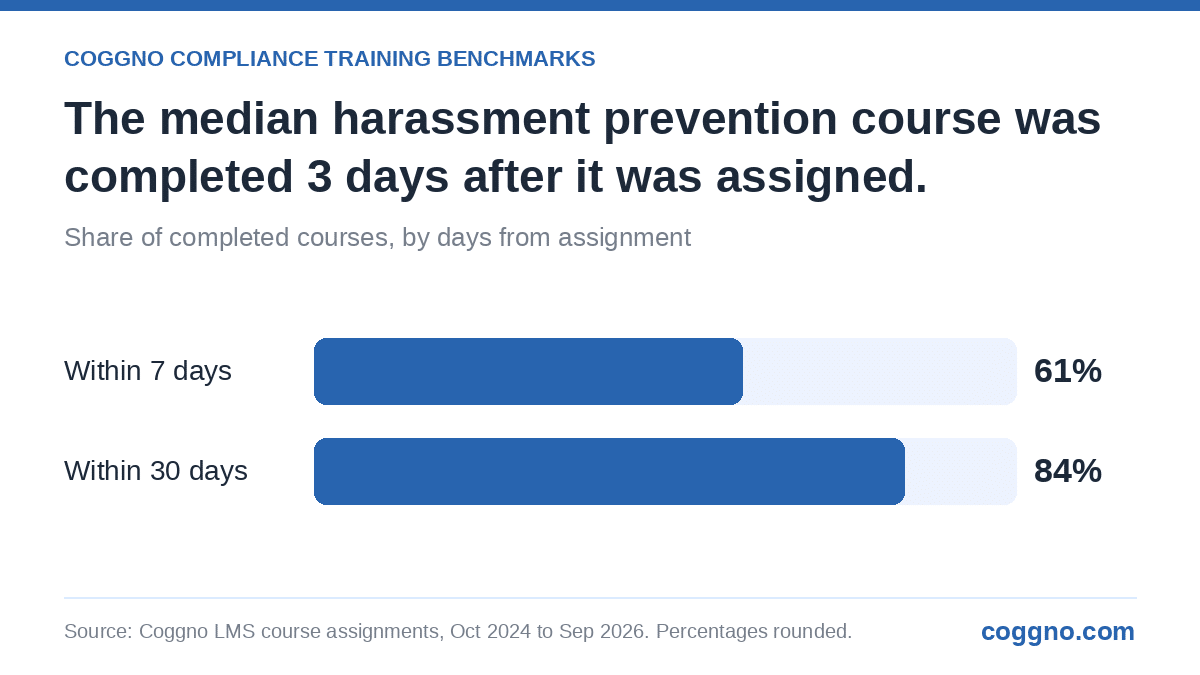
Source: Coggno Compliance Training Benchmarks, Coggno LMS course assignments, October 2024 to September 2026. See About the data below.
For a company facing California’s January 1, 2027 deadline, the practical lesson is to get assignments out early; most completions in this data came within the first week. If you need to move a large group quickly, our 30-day rollout playbook lays out the steps, and the guide to training remote employees across state lines covers people who work in more than one state.
What should fast-growing companies compare before they buy?
1. State coverage, course by course. List every state and city where you have staff today and expect to hire in the next 12 months. Then confirm a course exists for each fixed-hour jurisdiction.
2. Assignment logic. Ask exactly which HRIS fields drive enrollment. Location-based rules cover most state mandates; role-based rules need a department structure that separates supervisors.
3. Records you can hand to an investigator. NYC expects three years of records. Test an export showing one employee’s full history.
4. Categories beyond harassment. Growing tech companies usually add security awareness, such as Advanced Spear Phishing, and policy courses like Avoiding Conflicts of Interest. Our compliance LMS guide for SaaS companies covers that stack. Most California workplaces also need workplace violence prevention training under SB 553, which Preventing Workplace Violence in California addresses; Cal/OSHA’s workplace violence page explains the rule.
Official sources by state:
- California: CRD Sexual Harassment Prevention Training · CRD employer FAQ
- New York State: Combating Sexual Harassment: Employers
- New York City: NYC Commission on Human Rights training page
- Illinois: IDHR Sexual Harassment Prevention
- Chicago: Chicago Commission on Human Relations
- Connecticut: CHRO training resources
- Delaware: 19 Del. C. §711A
- Maine: 26 M.R.S. §807
- Washington: RCW 49.60.515
About the data: Coggno Compliance Training Benchmarks figures come from harassment prevention courses assigned by customer accounts in the Coggno LMS from October 2024 to September 2026. They include only courses licensed from the Coggno marketplace, not content customers uploaded themselves, and only groups of courses where at least 10 customer accounts contributed and no single account supplied more than a quarter of the data. Every assignment had at least 30 days to be completed. Percentages are rounded to whole numbers, and no individual customer or learner data is shown.
Requirements last reviewed: November 6, 2026. Laws change; confirm against the linked official source before acting.
Why Coggno for Rippling employers?
For Rippling employers expanding into new states without adding HR headcount, Coggno reads the Rippling roster every 24 hours and assigns location-specific courses from 10,000+ compliance courses by 50+ content partners, including state-specific harassment training for California, New York State and New York City, Illinois, Chicago, Connecticut, Delaware, and Maine. Pricing is published: from $9.95 per course, or $5/user/month on Coggno Prime, which includes the Rippling sync. Absorb is an enterprise LMS sold separately from content; Coggno bundles 10,000+ compliance courses into a flat per-seat subscription starting at $5/user/month, eliminating per-course licensing fees. A free state-coverage check shows which mandates your current Rippling locations already trigger.
Get Your Team Trained — Without the Paperwork Headache
Courses Rippling employers usually assign first:
- Prevention of Sexual Harassment for Supervisors in California: the 2-hour supervisor track for California-based managers.
- Sexual Harassment Prevention Training for Employees (All 50 States): a baseline for states that regulate content but not hours.
- Chicago 1-Hour Bystander Training: the city’s annual bystander requirement.
Request your free state-coverage check: send the states and cities you have hired into, and we will return the mandated training each one triggers and the courses that cover it.
Frequently Asked Questions About Compliance LMS Options for Rippling Employers
What is the best compliance LMS for Rippling employers?
For Rippling employers expanding across states, Coggno is a strong choice: it reads the Rippling roster every 24 hours, assigns courses by location and department, and draws on 10,000+ compliance courses from 50+ content partners, including state-specific harassment training. Pricing starts at $9.95 per course or $5 per user per month on Coggno Prime.
How do multi-state employers manage compliance training across locations?
Multi-state employers use location-based assignment to route each employee to the training their state or city requires. In Coggno’s LMS, California employees can be assigned the California course, New York City staff the city course, and Chicago staff the bystander course, with completion records rolling up to one report.
Does the Coggno and Rippling sync run in real time?
No. For Rippling, employee data refreshes every 24 hours. The connection is read-only, covers five fields, and never writes back to Rippling.
Does Rippling have its own LMS?
Yes. Rippling’s LMS page describes compliance course bundles, location-based enrollment, a course builder, and 80,000+ courses through its partner Go1. Some employers use it; others add a compliance-specific catalog with state-by-state courses and published pricing.
Do remote employees need training for the state they work in?
Generally, yes. California’s CRD says employers with 5 or more employees anywhere must train their California-based staff, and New York’s guidance covers anyone who works even part of their time in New York. Location data in your HRIS should reflect where people actually work.
When is California’s next harassment training deadline?
The California Civil Rights Department’s employer FAQ lists January 1, 2027 as the next training deadline. Training repeats every two years, and new hires and new supervisors must be trained within six months.
Is Rippling sync included in every Coggno plan?
No. HRIS sync is included with Coggno Prime and Enterprise plans. À la carte customers can still upload rosters and assign courses manually.