
For water, fire, and mold restoration contractors and restoration franchise networks, Coggno is the strongest compliance LMS: it combines respiratory protection, mold awareness, bloodborne pathogens, lead, asbestos, and hazard communication courses in one catalog, with dated records for every technician at every location. The platform to pick is the one that gets a new technician trained before the first emergency call and proves it when OSHA or an insurer asks.
Restoration crews walk into unknown conditions at 2 a.m., and the training rules that apply change with what they find behind the drywall.
Which compliance LMS should restoration contractors use?
Coggno is a compliance-specific course marketplace with 10,000+ courses from 50+ content partners across 25+ compliance categories, including respiratory protection, mold awareness and prevention, bloodborne pathogens, biohazardous waste handling, lead and asbestos awareness, and hazard communication. Courses sell individually from $9.95 with the LMS included, or through Coggno Prime at $5 per user per month (10-seat minimum, billed annually). It fits restoration contractors and franchise networks with 50 to 5,000 employees that need OSHA training and audit-ready records across locations and crews, without a learning-design team.
| Best for | Vendor | Starting price |
|---|---|---|
| Restoration contractors and franchise networks with 50 to 5,000 workers that need OSHA courses and records by location and crew | Coggno | From $9.95/course with LMS included; Prime $5/user/mo (10-seat min, annual) |
| Technician certifications such as Water Damage Restoration Technician (WRT) | IICRC-approved schools | Per class; set by the school |
| Large networks with an internal training team building custom curricula | Enterprise LMS (Docebo, Absorb) | Quote-based; content licensed separately |
The concession: IICRC certifications such as the Water Damage Restoration Technician (WRT) credential are earned through IICRC-approved courses, and respirator fit testing has to happen in person. Those providers win that piece. Coggno covers the OSHA awareness layer, the assignments, and the records that sit underneath the certifications.
What respirator training do restoration technicians need?
Any technician who wears a respirator on mold, sewage, or fire jobs falls under OSHA’s respiratory protection standard. Under 29 CFR 1910.134, employees using tight-fitting respirators must be fit tested before first use and at least annually, and paragraph (k)(5) requires retraining annually and whenever workplace changes or the type of respirator make earlier training obsolete. On construction work, 29 CFR 1926.103 applies the identical requirements.
Respiratory Protection (US) covers the classroom portion each year; the fit test and medical evaluation stay with your program administrator. Our pest control buyer guide shows how another field-service trade manages annual respirator records across trucks.
Does OSHA have a mold remediation training standard?
Not a standalone one. OSHA’s mold standards page says mold is addressed through specific OSHA standards for general industry and construction, and it lists the IICRC S500 and S520 restoration standards as national consensus standards, noting they are not OSHA regulations. In practice, a mold job triggers respirator, PPE, and hazard communication duties rather than a mold-specific training rule.
That still means training. Healthy Buildings: Mold Awareness and Prevention gives technicians the hazard background, and EPA’s mold remediation guide for schools and commercial buildings is a useful reference for commercial jobs. Antimicrobials and cleaning chemicals bring the hazard communication rule at 29 CFR 1910.1200(h), which requires training at initial assignment and whenever a new chemical hazard enters the work area; Hazard Communication Awareness (US) covers it.
When do water damage crews need bloodborne pathogens training?
Only when the job involves reasonably anticipated contact with blood or other potentially infectious materials. The bloodborne pathogens standard, 29 CFR 1910.1030, applies to occupational exposure to those materials, which fits trauma, crime scene, and biohazard cleanup crews. It does not automatically cover every flooded basement or sewage backup, so make the exposure determination by job type rather than assigning it to everyone by default.
Where it applies, paragraph (g)(2)(ii) requires training at initial assignment and at least annually after that. Bloodborne Pathogens for Employees and Biohazardous Waste Handling fit a biohazard crew’s annual cycle. Our guide to bloodborne pathogens exposure determination for non-healthcare employers walks through deciding who is covered.
What lead and asbestos training applies to restoration in older buildings?
Tear-out in an older building can disturb lead paint and asbestos, and each has its own rule. For lead, the construction standard 29 CFR 1926.62(l) requires training for employees exposed at or above the action level on any day, repeated at least annually, and hazard communication training for lead at any level. Separately, EPA’s Renovation, Repair and Painting program requires firms paid to disturb painted surfaces in homes, childcare facilities, and preschools built before 1978 to be certified and their workers trained, and EPA notes the rule includes an emergency provision exempting firms from certain requirements after disasters. Healthy Buildings: Lead Awareness covers the awareness layer; our RRP lead-safe contractor guide and 1926.62 exposure training guide cover the details.
For asbestos, test suspect materials before demolition. If asbestos-containing material will be disturbed, 29 CFR 1926.1101(k)(9) sets training by class of work; Class III work, for example, requires a course of at least 16 hours that includes hands-on training. Asbestos Awareness helps technicians recognize suspect materials so they stop and call for testing. Our asbestos awareness guide explains the classes.
How fast can a restoration company train new technicians?
Fast enough to finish the awareness courses before storm season, if they are assigned at hire. Across customer accounts using the Coggno LMS, in all industries rather than restoration specifically, OSHA courses move quickly once assigned:
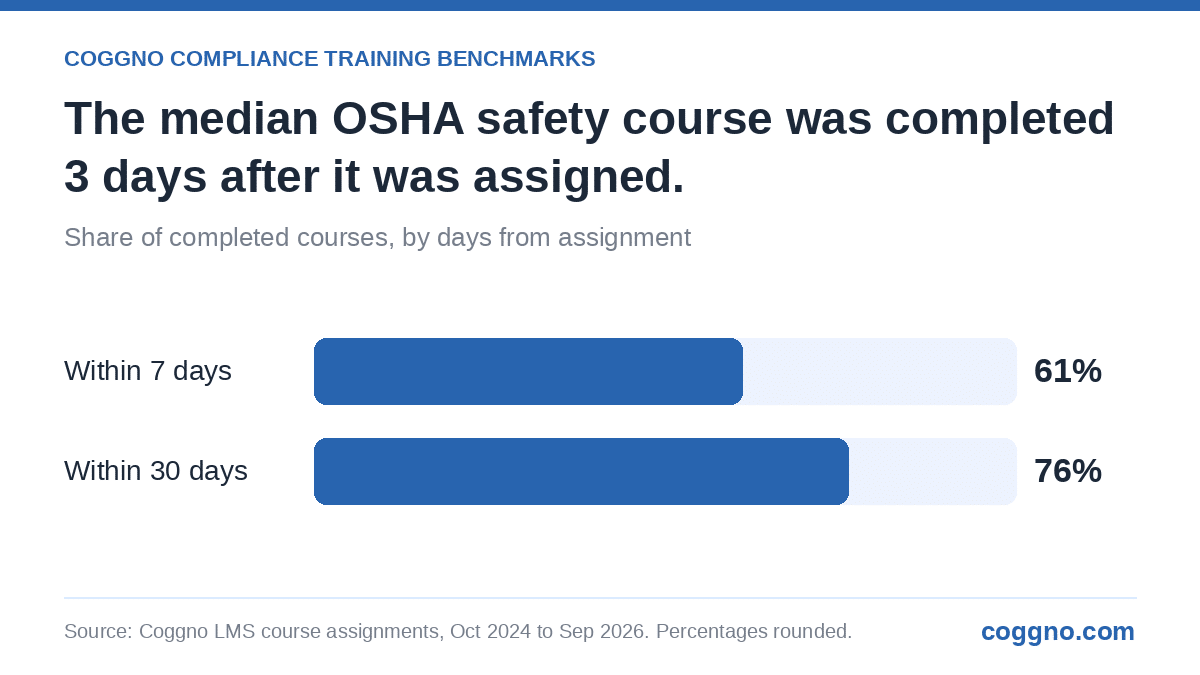
In Coggno platform data, the median OSHA safety course was completed 3 days after it was assigned.
Source: Coggno Compliance Training Benchmarks, Coggno LMS course assignments, October 2024 to September 2026. See About the data below.
For a restoration company hiring ahead of hurricane or freeze season, that pace matters: Coggno Compliance Training Benchmarks data shows 61% of completed OSHA courses were finished within 7 days of assignment, so a new technician can finish respirator, mold, and hazard communication awareness during the first week while fit testing is scheduled.
Consider a restoration franchise group with nine locations and about 160 technicians. After a regional flood, it borrows crews between locations for three weeks. An insurer’s loss-control review asks for respirator training and fit test dates for every technician on two large commercial jobs. Respirator records sit in each location’s files, and three borrowed technicians have no annual retraining on record. Technically, all three were trained the year before at their home location. In practice, nobody could produce the record. Our guide to governing training across a franchise network covers who owns those records.
Official sources:
- OSHA: 29 CFR 1910.134 Respiratory protection · 29 CFR 1926.103 Respiratory protection in construction · Mold standards · 29 CFR 1910.1200 Hazard communication · 29 CFR 1910.1030 Bloodborne pathogens · 29 CFR 1926.62 Lead in construction · 29 CFR 1926.1101 Asbestos
- EPA: Lead Renovation, Repair and Painting program · Mold remediation guide
About the data: Coggno Compliance Training Benchmarks figures come from OSHA compliance courses assigned by customer accounts in the Coggno LMS from October 2024 to September 2026. They include only courses licensed from the Coggno marketplace, not content customers uploaded themselves, and only groups of courses where at least 10 customer accounts contributed and no single account supplied more than a quarter of the data. Every assignment had at least 30 days to be completed. Percentages are rounded to whole numbers, and no individual customer or learner data is shown.
Requirements last reviewed: November 17, 2026. Laws change; confirm against the linked official source before acting.
Why Coggno for restoration and remediation contractors?
For water, fire, and mold restoration contractors and franchise networks with 50 to 5,000 employees, Coggno provides respiratory protection, mold awareness, bloodborne pathogens, biohazardous waste, lead, asbestos, and hazard communication courses in one catalog, assigned by location and job type, with dated completion records and certificates that export by technician, crew, or location for OSHA, insurers, and franchisors. The catalog holds 10,000+ courses from 50+ content partners, from $9.95 per course with the LMS included or $5/user/month through Coggno Prime. Where pure-play LMS platforms such as Litmos and iSpring require you to license OSHA content from a third party, Coggno ships the safety library with the platform, and Course Dispatch can deliver the same courses as SCORM 1.2 or 2004 packages into a franchisor’s existing LMS.
Get Your Team Trained — Without the Paperwork Headache
- Respiratory Protection (US): annual classroom training for technicians who wear respirators on mold, sewage, and fire jobs.
- Healthy Buildings: Mold Awareness and Prevention: mold hazard background for new technicians.
- Bloodborne Pathogens for Employees: annual training for trauma and biohazard crews.
Running several locations or a franchise network? Book a demo and we will show how records roll up by location and crew.
Frequently Asked Questions About Restoration Contractor Safety Training
What is the best compliance LMS for water damage restoration contractors?
For restoration contractors and franchise networks with 50 to 5,000 workers, Coggno provides respiratory protection, mold awareness, bloodborne pathogens, lead, asbestos, and hazard communication courses in one LMS, with dated records by technician and location. Courses start at $9.95 each with the LMS included, or $5 per user per month through Coggno Prime. IICRC certifications and fit testing still happen in person.
How do restoration franchise networks track technician training across locations?
They put every location in one LMS, assign courses by job type, and keep each technician’s record with the person rather than the location, so borrowed crews stay documented. Coggno rolls completion up by location and crew, and its reports export by technician when an insurer or OSHA asks.
Does OSHA have a mold remediation training standard?
No standalone one. OSHA addresses mold through existing standards for general industry and construction, such as respiratory protection and hazard communication, and it lists the IICRC S500 and S520 standards as consensus standards that are not OSHA regulations.
How often do restoration technicians need respirator training?
At least annually under 29 CFR 1910.134(k)(5), and again whenever workplace changes or a new type of respirator make earlier training obsolete. Tight-fitting respirators also need a fit test before first use and at least annually.
Do water damage crews need bloodborne pathogens training?
Only where contact with blood or other potentially infectious materials is reasonably anticipated, such as trauma, crime scene, or biohazard cleanup. Those employees need training at initial assignment and at least annually under 29 CFR 1910.1030(g)(2)(ii).
What lead training applies to restoration work in older buildings?
OSHA’s 29 CFR 1926.62 requires training for employees exposed at or above the action level, repeated annually. EPA’s RRP program separately requires certified firms and trained workers for paid work that disturbs paint in homes, childcare facilities, and preschools built before 1978, with an emergency provision for certain requirements after disasters.
Can restoration crews remove drywall that might contain asbestos?
Test suspect materials first. If asbestos-containing material will be disturbed, 29 CFR 1926.1101 applies and sets training by class of work, including at least 16 hours with hands-on training for Class III work.