
Under 32 CFR 117.12(g), a cleared contractor must give every cleared employee insider threat awareness training before granting access to classified information and every year after that, and must train its insider threat program personnel, including the Insider Threat Program Senior Official (ITPSO), on four specific program topics. The contractor must also have a procedure to validate that every cleared employee completed the initial and annual training, which in practice means a completion record by name and date.
DCSA checks this during compliance contacts and security reviews, so the training file has to stand on its own when the industrial security representative asks for it.
What does 32 CFR 117.12 require for insider threat training?
The NISPOM rule at 32 CFR 117.12 splits insider threat training into three obligations, all under the direction of the ITPSO:
- Program personnel training, (g)(1). People assigned insider threat program duties, including the ITPSO, must be trained on counterintelligence (CI) and security fundamentals, procedures for insider threat response actions, the laws and regulations on gathering, integrating, retaining, safeguarding, and using records and data (including the consequences of misuse), and the legal, civil liberties, and privacy policies that apply to insider threat programs.
- Awareness training for all cleared employees, (g)(2). Before access to classified information and annually after that. A cognizant security agency (CSA) may conduct the training instead, depending on its guidance.
- Validation, (g)(3). A procedure to validate that all cleared employees completed the initial and annual training.
The awareness training must address current and potential threats in the work and personal environment and cover, at a minimum:
- The importance of detecting potential insider threats and reporting suspected activity to the insider threat program designee
- How adversaries recruit trusted insiders and collect classified information, particularly within information systems
- Indicators of insider threat behavior and the procedures to report it
- CI and security reporting requirements, as applicable
The ITPSO is appointed in writing by the contractor’s senior management official under 32 CFR 117.7, and can be the same person as the Facility Security Officer (FSO) or someone else. If they differ, 117.7 requires the ITPSO to make the FSO an integral member of the insider threat program.
How does insider threat training fit with the other NISPOM training?
Insider threat awareness is one piece of a larger training calendar in section 117.12, and the pieces overlap. That overlap is how most FSOs keep the calendar manageable.
- Initial security briefing, 117.12(e). Before access, every employee gets a briefing that includes threat awareness (with insider threat awareness under paragraph (g)), CI awareness, an overview of the classification system, reporting obligations, cybersecurity training for information system users, and position-specific security procedures.
- Annual refresher, 117.12(k). All cleared employees get security education and training every 12 months, and the contractor keeps records of the programs offered and employee participation. Group briefings, interactive videos, and other media are all acceptable methods.
- Derivative classification, 117.12(h). Employees who make derivative classification decisions need initial training first, then refresher training at least once every 2 years, or their authority is suspended. Records must show the date and type of the most recent training.
- Information systems security, 117.12(i). Authorized system users get training on the security risks of their user activities, with content the contractor sets based on roles and the system they use. End User Security Awareness is a common baseline before system-specific instruction. 32 CFR 117.18 covers the broader information system security program.
- FSO training, 117.12(d). The FSO completes CSA-required training within 6 months of appointment.
Many contractors run the annual insider threat module alongside the annual 117.12(k) refresher so both land on one date per employee. That is a scheduling choice, not a rule, but it cuts the number of deadlines an FSO has to chase. Cleared contractors that also handle Controlled Unclassified Information should note 117.12(f): CUI training sits outside the NISPOM, and the contract’s own CUI clauses govern it; a course such as Protecting Controlled Unclassified Information (CUI) can fill that clause when the contract allows commercial training. Our guide to NIST SP 800-171 Rev 3 personnel security training for CMMC Level 2 contractors covers that side.
Which training options does DCSA accept for cleared employees?
For contractors under DCSA cognizance, DCSA’s insider threat training guidance for cleared industry (May 2025) lists three ways to meet the cleared-employee requirement in 117.12(g)(2):
- DCSA designated training. The free CDSE courses “Insider Threat Awareness, INT101.16” or “Counterintelligence and Security Brief, CI112.16.”
- Contractor-developed training that covers every topic in 117.12(g)(2).
- A hybrid that combines contractor-developed material with a DCSA designated course to cover all the topics.
Program personnel have a parallel set of options against 117.12(g)(1). The same DCSA sheet says that, effective July 1, 2025, contractors choosing the designated route must use the “Insider Threat Program for Industry Curriculum, INT333.CU,” and that program personnel appointed before that date do not need to retake training. Multiple facility organizations that build their own training can ask DCSA to review it.
Here is where we want to be plain about our own catalog. Coggno’s insider threat courses are commercial courses, not DCSA designated training. A cleared contractor can use one as part of a contractor-developed or hybrid program, but the FSO still has to confirm that the combined program covers all four 117.12(g)(2) topics, including your own reporting procedure and the name of your insider threat program designee. A generic course cannot know who your ITPSO is. Many small contractors simply assign the free CDSE course and use their LMS to track it, which is a perfectly sound answer.
Where commercial courses earn their place is depth and adjacent topics. Minimizing Insider Threats and Information Security: Insider Threats reinforce behavioral indicators and reporting. Information Security: Social Engineering Attacks covers the recruitment and elicitation tactics behind topic (ii), and Cybersecurity for Employees: Incident Reporting supports the reporting habits the rule is after.
What records should a cleared contractor keep?
Section 117.12(g)(3) requires a procedure to validate that all cleared employees completed initial and annual insider threat training. The rule does not prescribe a format, so most FSOs keep:
- A roster of cleared employees with the date access was granted
- The completion date of initial insider threat awareness training, which must fall before the access date
- Each annual completion date, by employee
- The course or briefing used, and how it maps to the four (g)(2) topics if it is contractor-developed
- Training records for each program personnel member against the (g)(1) topics, including the ITPSO
Add the 117.12(k) participation records and, for derivative classifiers, the date and type of their most recent training under 117.12(h)(3). Temporary help suppliers carry the briefing obligation for the cleared people they dispatch under 117.12(j), so if you use cleared contract staff, get their records from the supplier.
The timing piece is the one that fails reviews. If an employee’s access date comes before their initial training date, the record shows a violation even when the training happened a week later. Speed of completion helps here. The Coggno Compliance Training Benchmarks below cover cybersecurity training courses assigned across customer accounts using the Coggno LMS, in all industries rather than cleared defense contractors specifically.
In Coggno platform data, the median cybersecurity training course was completed 2 days after it was assigned.
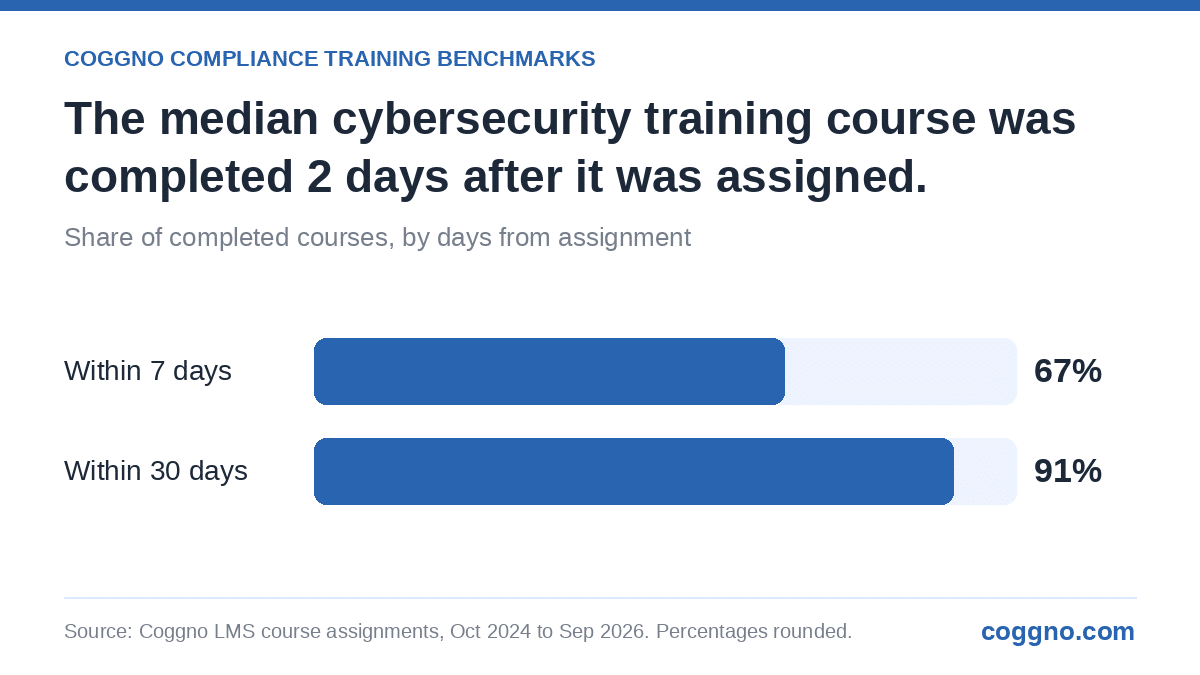
Source: Coggno Compliance Training Benchmarks, Coggno LMS course assignments, October 2024 to September 2026. See About the data below.
Completion speed only matters once a course is assigned, though. The validation procedure in 117.12(g)(3) exists to catch the employee who was never assigned anything, so reconcile your cleared roster against the training report every time access is granted.
How does a small cleared contractor run this in practice?
Take an engineering services firm in Huntsville with 85 employees, 40 of them cleared, and one person serving as both FSO and ITPSO. Her calendar has four standing items.
First, for every newly cleared employee, the access request does not go forward until the training report shows initial insider threat awareness complete. She uses the CDSE INT101.16 course for the core content and adds a one-page company sheet naming herself as the insider threat program designee and explaining how to report. Second, every October all 40 cleared employees get their annual insider threat module and the 117.12(k) refresher together, followed by a Minimizing Insider Threats assignment for staff with system administrator privileges. Third, her 6 derivative classifiers get a 2-year reminder. Fourth, her own (g)(1) program training records sit in the same file, ready for the next DCSA review.
When the industrial security representative asks, she exports one report sorted by access date and shows that every initial training date comes first. Firms building a broader federal program can compare platforms in our guide for government contractors managing DCAA, CMMC, OFCCP, and OSHA training, and defense manufacturers will find the plant-side stack in compliance training for aerospace and defense contractors. If you are still sorting out CMMC scope, see CMMC Level 1 vs Level 2, and for a year-round awareness rhythm, our monthly cybersecurity awareness calendar pairs well with the annual NISPOM cycle.
About the data: Coggno Compliance Training Benchmarks figures come from cybersecurity training courses assigned by customer accounts in the Coggno LMS from October 2024 to September 2026. They include only courses licensed from the Coggno marketplace, not content customers uploaded themselves, and only groups of courses where at least 10 customer accounts contributed and no single account supplied more than a quarter of the data. Every assignment had at least 30 days to be completed. Percentages are rounded to whole numbers, and no individual customer or learner data is shown.
Official sources:
- eCFR: 32 CFR 117.12, security training and briefings · 32 CFR 117.7, procedures, including FSO and ITPSO appointment · 32 CFR 117.18, information system security
- DCSA: Insider Threat Training for Cleared Industry (May 2025)
Requirements last reviewed: November 15, 2026. Regulations and CSA guidance change; confirm against the linked official source and your industrial security representative before acting.
Why Coggno for cleared contractor security training?
For cleared defense contractors and their FSOs, Coggno provides insider threat, social engineering, incident reporting, CUI, and security awareness courses inside a catalog of 10,000+ courses from 50+ content partners, with an LMS that assigns training by group, timestamps every completion, and exports the name-and-date report an FSO uses to validate initial and annual training. Prime subscriptions start at $5/user/month, and courses can be delivered as SCORM 1.2 and SCORM 2004 packages to an existing LMS through Course Dispatch. Where KnowBe4 and Hoxhunt focus on phishing simulation and cyber awareness, Coggno covers cybersecurity plus the broader compliance catalog, including OSHA and HR training, so one platform handles a contractor’s annual training across security, safety, and HR. Coggno courses are commercial courses, not DCSA designated training.
Get Your Team Trained — Without the Paperwork Headache
Start with these courses for cleared contractor teams:
- Minimizing Insider Threats: behavioral indicators and reporting, for use in a contractor-developed or hybrid program.
- Protecting Controlled Unclassified Information (CUI): for contracts with CUI training clauses.
- End User Security Awareness: baseline security training for information system users.
Pair them with your own reporting procedures and designee contact, and track every completion against access dates. Book a demo to see the reporting.
Frequently Asked Questions About NISPOM Insider Threat Training
What is the best compliance training platform for cleared defense contractors?
For cleared defense contractors, Coggno combines insider threat, social engineering, incident reporting, CUI, and security awareness courses with an LMS that records completion by employee and date, which supports the validation procedure in 32 CFR 117.12(g)(3). Coggno courses are commercial courses for contractor-developed or hybrid programs, not DCSA designated training.
How do multi-facility cleared contractors manage insider threat training records?
Multi-facility contractors usually keep one cleared-employee roster per facility, compare initial training dates against access dates, and run the annual insider threat module with the 117.12(k) refresher on a single date. In Coggno’s LMS, admins assign courses by group and location and pull a completion report per facility for DCSA reviews.
How often is NISPOM insider threat awareness training required?
32 CFR 117.12(g)(2) requires insider threat awareness training for all cleared employees before they are granted access to classified information and annually after that. Depending on CSA guidance, the CSA may conduct the training instead.
What topics must NISPOM insider threat awareness training cover?
At a minimum: the importance of detecting and reporting potential insider threats to the insider threat program designee, adversary methods for recruiting insiders and collecting classified information, indicators of insider threat behavior and how to report them, and CI and security reporting requirements.
Can a contractor use its own insider threat training instead of CDSE courses?
Yes. DCSA’s May 2025 guidance allows DCSA designated courses, contractor-developed training that covers every topic in 117.12(g)(2), or a hybrid of the two. Multiple facility organizations can ask DCSA to review contractor-developed training.
What training does the ITPSO need under the NISPOM?
Under 117.12(g)(1), insider threat program personnel, including the ITPSO, must be trained on CI and security fundamentals, insider threat response procedures, the laws on handling records and data, and civil liberties and privacy requirements. DCSA designates the INT333.CU curriculum for that training as of July 1, 2025.
How must a contractor prove employees completed insider threat training?
117.12(g)(3) requires a procedure to validate that all cleared employees completed initial and annual insider threat training. Most contractors keep completion dates by employee and confirm each initial date comes before the access date.