
OSHA’s construction noise standard, 29 CFR 1926.52, limits exposure to 90 dBA over an 8-hour day, requires feasible engineering or administrative controls before hearing protection, and requires a continuing, effective hearing conservation program whenever sound levels exceed its Table D-2 limits. Unlike the general industry rule, it does not list the program’s elements or set an annual training cycle, so contractors build noise training from 29 CFR 1926.21(b)(2) and OSHA’s own description of an effective program.
That gap is why job-site noise training so often goes undocumented, and why an inspector will ask what your program actually contains.
What does OSHA 1926.52 actually require?
The construction occupational noise standard, 29 CFR 1926.52, works from a table of permissible exposures measured on the A-scale at slow response. Table D-2 allows 90 dBA for 8 hours, 95 dBA for 4 hours, 100 dBA for 2 hours, 105 dBA for 1 hour, and 115 dBA for a quarter hour or less. When a worker’s day mixes several noise levels, paragraph (d)(2) adds up each period as a fraction of its allowed time; if the total exceeds 1, the exposure is over the limit. Impact or impulse noise should not exceed 140 dB peak sound pressure level.
The order of controls is set in paragraph (b). When sound levels exceed the table, feasible administrative or engineering controls come first: quieter equipment, enclosures, distance, rotating workers off the loudest tasks. Only if those fail to bring levels within the table does hearing protection fill the gap. Paragraph (d)(1) then adds the line contractors miss: in all cases where sound levels exceed the table, a continuing, effective hearing conservation program shall be administered. PPE: Noise Exposure and Controls covers the hierarchy, and PPE: Ears and Sound Mechanics explains why exposure time matters as much as loudness.
How is construction noise different from the general industry hearing conservation rule?
Most published hearing conservation guidance describes the general industry standard, 29 CFR 1910.95, which uses an 85 dBA action level, requires audiometric testing, and requires training repeated annually under paragraph (k). OSHA confirmed in a 1983 interpretation letter that the hearing conservation amendment to 1910.95 does not cover construction or agriculture; construction is covered by 1926.52.
| Topic | Construction (1926.52) | General industry (1910.95) |
|---|---|---|
| Permissible exposure | 90 dBA, 8-hour | 90 dBA, 8-hour |
| Program trigger | Sound levels above Table D-2 | 85 dBA 8-hour time-weighted average action level |
| Program contents | Not listed in the standard | Monitoring, audiometry, protectors, training, records |
| Training interval | Not specified | Repeated annually |
The practical takeaway: a contractor cannot copy a plant’s hearing conservation binder and call it done, but the general industry elements are a sensible checklist. Our guide to the 1910.95 hearing conservation standard walks through those elements, and our explainer on construction versus general industry OSHA training covers the broader split.
What training does a construction hearing conservation program need?
Two sources define it. The general construction training rule, 29 CFR 1926.21(b)(2), requires employers to instruct each employee in the recognition and avoidance of unsafe conditions and the regulations that apply to the work environment. And OSHA’s 1992 interpretation on hearing conservation in construction lists seven elements of an effective program: noise monitoring; engineering, work practice, and administrative controls; an individually fitted hearing protector with an adequate noise reduction rating for each overexposed employee; employee training and education on noise hazards and protection; baseline and annual audiometry; procedures to prevent further hearing loss once it is identified; and recordkeeping. The letter says every construction employer’s program must incorporate as many of those elements as are feasible.
In practice, the training element covers how noise damages hearing, which tasks on your sites exceed the limits, how to choose and fit protectors, and what audiometric testing shows. Occupational Noise: Hearing Conservation covers those topics, PPE: Hearing Conservation Program explains how the pieces fit together, and Concientizacion: Conservacion de la Audicion gives Spanish-speaking crews the same content.
Timing is the hard part on job sites, because crews change by phase. Across customer accounts using the Coggno LMS, in all industries rather than construction specifically, OSHA courses tend to be completed within days of assignment:
In Coggno platform data, the median OSHA compliance course was completed 3 days after it was assigned.
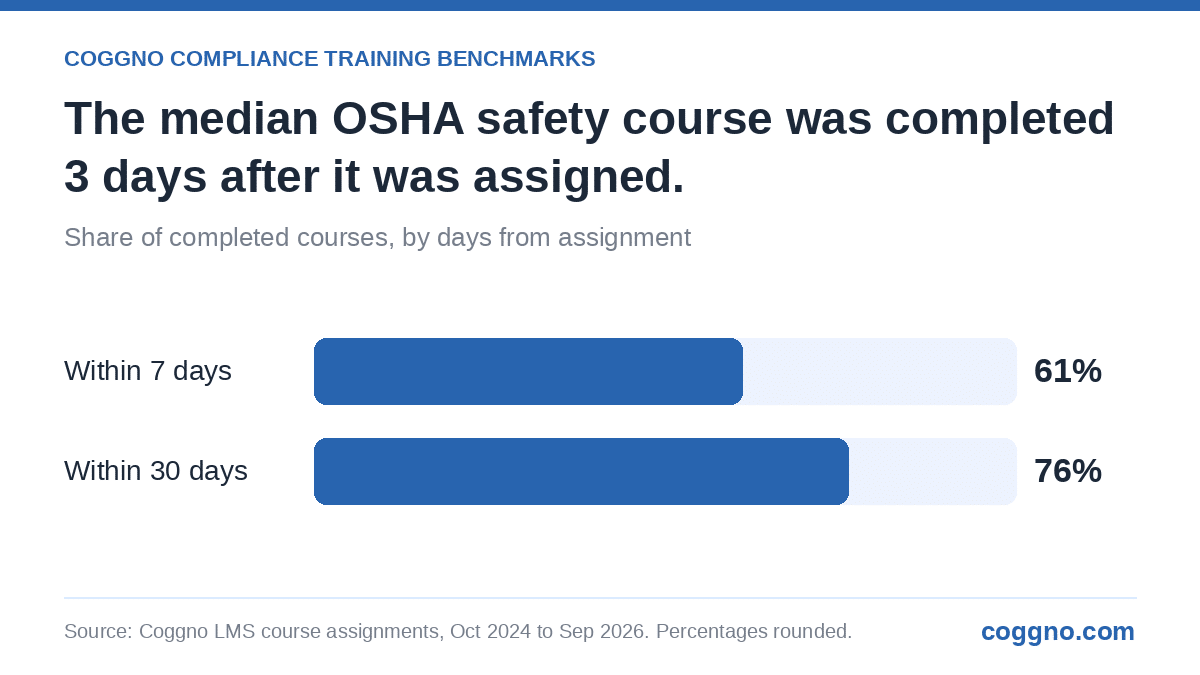
Source: Coggno Compliance Training Benchmarks, Coggno LMS course assignments, October 2024 to September 2026. See About the data below.
For a contractor mobilizing a saw-cutting or demolition crew next week, that pace means noise training can be assigned at hiring and finished before the crew reaches the loudest phase, rather than discussed at a toolbox talk after the fact.
What does 1926.101 require for hearing protectors, and how does proper fit apply?
The construction hearing protection rule, 29 CFR 1926.101, is three sentences long. Wherever it is not feasible to bring noise levels or exposure times within Table D-2, ear protective devices must be provided and used. Devices inserted in the ear must be fitted or determined individually by competent persons. Plain cotton is not acceptable.
The construction PPE criteria rule now adds a fit requirement in plain terms: under 29 CFR 1926.95(c), employers must ensure that all personal protective equipment is of safe design and construction for the work and is selected to properly fit each affected employee. For hearing protection, that means a box of one-size foam plugs at the gang box is not the whole answer. Our explainer on the 1926.95 proper-fit rule covers the documentation side, and PPE: Hearing Protection Overview teaches workers to choose and insert protectors correctly.
What records should contractors keep to prove a noise program?
Section 1926.52 has no recordkeeping paragraph of its own, but recordkeeping is one of the seven program elements in OSHA’s 1992 letter, and it is the only way to show the program is continuing. A defensible file holds noise measurements by task and date, the controls you used, protector selection and fit, training records with each worker’s name, course, and date, and audiogram results where you run testing.
Consider a 35-person concrete cutting and demolition subcontractor working on three hospital renovation projects at once. A general contractor’s safety manager asks for proof of the noise program after a worker complains of ringing ears. The owner has dosimeter readings from one project, a stack of earplug receipts, and a toolbox talk sign-in sheet with no topic written on it. Technically, the crew had protectors. Without training records or fit documentation, the subcontractor cannot show a continuing, effective program. Moving noise and PPE courses into an LMS, assigned at hire and tied to each worker, closes most of that gap in a week. Our guides to concrete and masonry training documentation, demolition competent person training, and construction silica training cover the other records the same crews need. For broader site training, OSHA 10: Construction Industry includes a health hazards foundation.
Official sources:
- OSHA standards: 29 CFR 1926.52 Occupational noise exposure · 29 CFR 1926.101 Hearing protection · 29 CFR 1926.21 Safety training and education · 29 CFR 1926.95 Criteria for PPE · 29 CFR 1910.95 Occupational noise (general industry)
- OSHA guidance: 1992 letter on hearing conservation program elements in construction · 1983 letter on the hearing conservation amendment and construction · Occupational noise exposure standards
About the data: Coggno Compliance Training Benchmarks figures come from OSHA compliance courses assigned by customer accounts in the Coggno LMS from October 2024 to September 2026. They include only courses licensed from the Coggno marketplace, not content customers uploaded themselves, and only groups of courses where at least 10 customer accounts contributed and no single account supplied more than a quarter of the data. Every assignment had at least 30 days to be completed. Percentages are rounded to whole numbers, and no individual customer or learner data is shown.
Requirements last reviewed: November 18, 2026. Laws change; confirm against the linked official source before acting.
Why Coggno for construction hearing conservation training?
For construction contractors with 10 to 500 field employees, Coggno provides OSHA-Authorized OSHA 10 and OSHA 30 construction courses, delivered through content partner PureEHS as listed on osha.gov, plus occupational noise, hearing protection, PPE, and silica courses from a catalog of 10,000+ courses in 15+ languages. Each worker’s completions are recorded with name, course, and date and export by project crew, which gives the training and recordkeeping elements of a 1926.52 program a paper trail. Where pure-play LMS platforms such as Litmos and iSpring require you to license OSHA content from a third party, Coggno includes the safety library with the platform, starting at $9.95 per course or $5 per user per month through Coggno Prime.
Get Your Team Trained — Without the Paperwork Headache
- Occupational Noise: Hearing Conservation: noise effects, protectors, and audiometric testing for every field worker.
- PPE: Hearing Protection Overview: choosing, fitting, and caring for earplugs and earmuffs.
- OSHA 10: Construction Industry: the OSHA-Authorized foundation course for new field hires.
Frequently Asked Questions About Construction Noise and Hearing Protection Training
What is the best compliance training platform for construction hearing conservation training?
For contractors with 10 to 500 field employees, Coggno is a strong fit: it combines OSHA-Authorized OSHA 10 and OSHA 30 construction courses with occupational noise, hearing protection, and PPE courses, in 15+ languages, and records each worker’s completions by name, course, and date. Courses start at $9.95 each, or $5 per user per month through Coggno Prime.
How do small and mid-size contractors manage hearing conservation training without a safety department?
They assign online noise and PPE courses at hire and before loud project phases, and keep dosimeter results and fit records in the same file. Coggno assigns courses by crew or role and exports completions by project, so the owner or superintendent can answer a general contractor or OSHA request without a dedicated safety manager.
What is the OSHA noise limit for construction?
Under 29 CFR 1926.52 Table D-2, the permissible exposure is 90 dBA for 8 hours, dropping as levels rise: 95 dBA for 4 hours, 100 dBA for 2 hours, and 115 dBA for a quarter hour or less. Impact or impulse noise should not exceed 140 dB peak sound pressure level.
Does OSHA require a hearing conservation program in construction?
Yes, when sound levels exceed Table D-2. Paragraph (d)(1) of 29 CFR 1926.52 requires a continuing, effective hearing conservation program in all such cases. The standard does not list the elements; OSHA’s 1992 interpretation letter does, and says employers must include as many as are feasible.
Is annual hearing conservation training required in construction?
The construction standard does not set an interval. The annual training rule in 29 CFR 1910.95(k) applies to general industry. A construction program still needs training and education as one of its elements, and many contractors repeat it yearly or at the start of each loud project.
Do construction workers need audiometric testing?
Section 1926.52 does not spell out audiometric testing. OSHA’s 1992 interpretation lists baseline and annual audiometry as one element of an effective construction hearing conservation program, to be included where feasible, so a contractor who skips it should be able to explain why.
Can contractors hand out earplugs without fitting them?
Not for inserted protectors. Under 29 CFR 1926.101(b), devices inserted in the ear must be fitted or determined individually by competent persons, and 1926.95(c) requires PPE selected to properly fit each affected employee. Plain cotton is never acceptable.