
OSHA’s general industry silica standard, 29 CFR 1910.1053, requires employers to include silica in their hazard communication program and to make sure each covered employee can demonstrate knowledge of silica’s health hazards, the tasks that create exposure, the controls and respirators in use, the standard itself, and the medical surveillance program. It covers foundries, brick and ceramics plants, glass makers, and other non-construction operations unless objective data shows exposure will stay below 25 µg/m³ as an 8-hour average under any foreseeable conditions.
The training paragraph is short, but it rests on exposure assessment, a written control plan, and medical surveillance, and an inspector will test all of it by talking to the people on your floor.
Who does OSHA 1910.1053 cover?
The respirable crystalline silica standard for general industry and maritime, 29 CFR 1910.1053, applies to all occupational exposures to respirable crystalline silica except three: construction work, which falls under 29 CFR 1926.1153; agricultural operations; and exposures from processing sorptive clays. It also does not apply where an employer has objective data showing exposure will remain below 25 µg/m³ as an 8-hour time-weighted average under any foreseeable conditions. A third carve-out covers tasks indistinguishable from a construction task on the 1926.1153 Table 1 list that are not performed regularly in the same environment, if the employer follows the construction rule for them.
In practice, covered operations include foundries, brick, tile, and ceramics plants, glass manufacturing, concrete products, and stone countertop fabrication. If your crews also work on construction sites, the rules split by task; our guide to the construction silica standard, 1926.1153 covers that side, and our foundry compliance training guide covers the molten-metal hazards that sit next to silica in a casting shop. For new hires, Silica Awareness: What is Silica? and Silica Awareness – Orientation set the baseline. OSHA’s general industry silica page collects the agency’s fact sheets and FAQs.
What are the silica exposure limits and assessment rules?
The permissible exposure limit is 50 µg/m³ as an 8-hour time-weighted average, and the action level is 25 µg/m³. Under paragraph (d), employers must assess the exposure of each employee who is or may reasonably be expected to be exposed at or above the action level, using either the performance option (any combination of air monitoring and objective data that accurately characterizes exposure) or the scheduled monitoring option (personal breathing zone samples for each shift, job classification, and work area, with representative sampling of the highest-exposed workers allowed).
Where exposure is, or can reasonably be expected to be, above the PEL, paragraph (e) requires a regulated area: demarcated, posted with the required danger sign at every entrance, limited to authorized persons, with respirators provided to everyone who enters. Engineering and work practice controls come first under paragraph (f)(1); respirators supplement them when controls cannot reach the PEL. Silica Awareness: Silica Exposure explains how exposure is measured, and our guide to abrasive blasting safety training shows how one of the highest-exposure tasks is controlled.
What must silica training cover under 1910.1053(j)?
Paragraph (j)(1) ties silica to hazard communication. The employer must include respirable crystalline silica in the program required by the hazard communication standard, 29 CFR 1910.1200, give employees access to labels and safety data sheets, train them under the HCS and paragraph (j)(3), and address at least four hazards: cancer, lung effects, immune system effects, and kidney effects. HazCom training happens at initial assignment and whenever a new chemical hazard enters the work area. Hazard Communication Safety Data Sheets (US) covers reading the SDS section that lists silica, and our post on the 2024 HazCom final rule explains the label changes.
Paragraph (j)(3)(i) then sets an outcome test. Each covered employee must be able to demonstrate knowledge and understanding of five things: the health hazards of silica exposure; the specific tasks in your workplace that could cause exposure; the specific measures you use to protect them, including engineering controls, work practices, and respirators; the contents of the standard; and the purpose and a description of the medical surveillance program. Under (j)(3)(ii), a copy of the standard must be readily available to each covered employee at no cost.
Two things stand out. The standard sets no hours and no refresher interval, and it measures knowledge, not attendance. A generic course can cover the hazards and the standard; your own shakeout, grinding, or saw-cutting tasks and controls have to be taught on site. Crystalline Silica Awareness and Silica Awareness: Silica Prevention cover the common layer, and Concientización sobre sílice cristalina serves Spanish-speaking crews.
Assigning a course is not the same as training someone. Across customer accounts using the Coggno LMS, in all industries rather than silica-exposed workplaces specifically, the gap between assignment and completion is measurable:
In Coggno platform data, 81% of assigned OSHA compliance courses were started and 73% were completed.
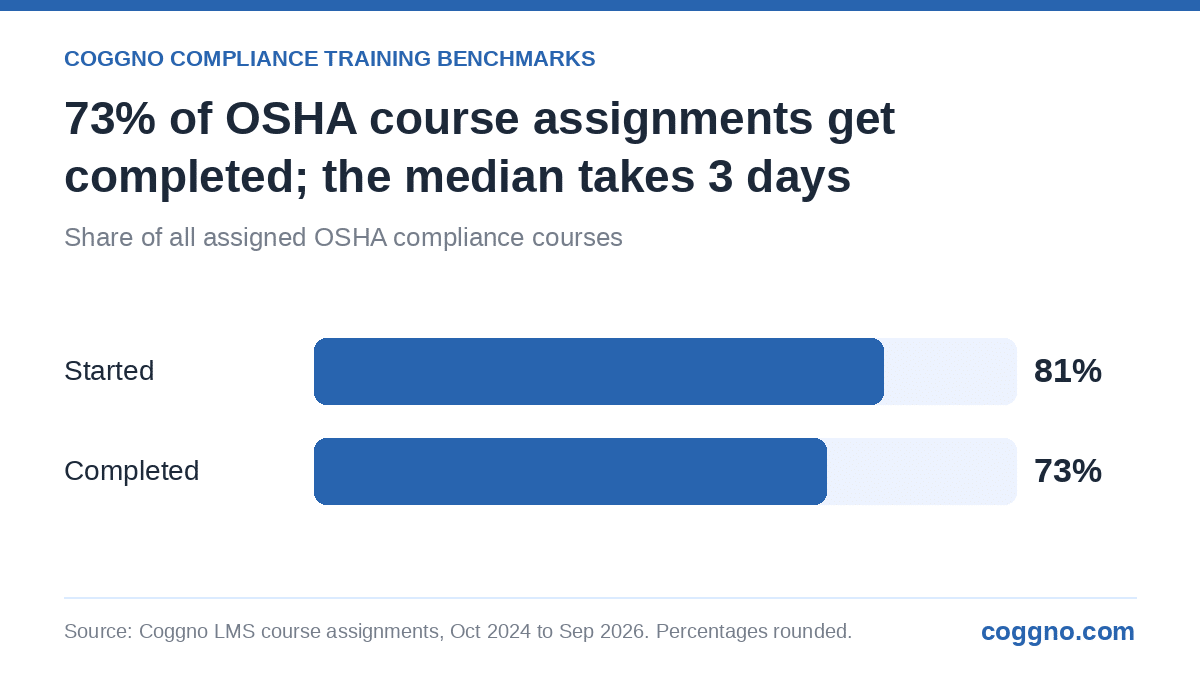
Source: Coggno Compliance Training Benchmarks, Coggno LMS course assignments, October 2024 to September 2026. See About the data below.
For a silica program, that gap is the argument for tracking: the standard asks whether each covered employee can demonstrate knowledge, and an assignment nobody finished proves nothing. Reviewing a completion report before each shift rotation catches the stragglers before an inspector does.
What do the written control plan and medical surveillance require?
Under paragraph (f)(2), the written exposure control plan describes the tasks that involve silica exposure, the engineering controls, work practices, and respiratory protection for each task, and the housekeeping measures used to limit exposure. It must be reviewed at least annually and made available to covered employees. Where respirators are needed, the respiratory protection standard, 29 CFR 1910.134, brings its own training, medical evaluation, and fit testing duties. Respiratory Protection Training and Respirator Fit Testing and Program Steps cover those; our guides to annual respirator fit testing and respiratory protection training go deeper.
Medical surveillance is required for each employee who will be exposed at or above the action level for 30 or more days per year, at no cost to the employee. The initial exam happens within 30 days after initial assignment unless the employee had a qualifying exam in the last three years, and periodic exams follow at least every three years, or more often if the licensed health care professional recommends it. Paragraph (j)(3)(i)(E) means employees must also understand why the program exists, which is the item most often skipped in generic training.
What records must employers keep under the silica standard?
Paragraph (k) lists three record types: air monitoring data (date, task, sampling method, results, laboratory, PPE worn, and the names and job classifications of employees represented), objective data relied on for exemptions or assessment, and medical surveillance records. These are kept under the access to exposure and medical records standard, 29 CFR 1910.1020, which sets at least 30 years for exposure records and the duration of employment plus 30 years for medical records.
The standard does not list a training record. Because compliance turns on whether employees can demonstrate knowledge, a dated record of each course, plus the floor session where you walked through your own tasks and controls, is still your best evidence. Silica remains an enforcement focus: OSHA’s National Emphasis Program for respirable crystalline silica, CPL 03-00-023, directs inspections at workplaces with silica exposure.
Consider a 180-employee brick and paver plant with crushing, pressing, and kiln operations on two shifts. Air monitoring puts crusher operators above the action level, so they are in medical surveillance. During an inspection, the compliance officer asks a crusher operator which controls protect him and why he gets chest X-rays. He knows the dust collector but not the medical program. Technically, the plant ran a silica class last year. Without a record showing he completed it, or a refresher after a job change, the plant has a hard time showing (j)(3) was met. Our beryllium standard guide shows the same documentation pattern for a related substance standard.
Official sources:
- OSHA standards: 29 CFR 1910.1053 Respirable crystalline silica · 29 CFR 1910.1200 Hazard communication · 29 CFR 1910.134 Respiratory protection · 29 CFR 1910.1020 Exposure and medical records
- OSHA guidance: Silica in general industry and maritime · Crystalline silica overview · CPL 03-00-023 Silica National Emphasis Program
About the data: Coggno Compliance Training Benchmarks figures come from OSHA compliance courses assigned by customer accounts in the Coggno LMS from October 2024 to September 2026. They include only courses licensed from the Coggno marketplace, not content customers uploaded themselves, and only groups of courses where at least 10 customer accounts contributed and no single account supplied more than a quarter of the data. Every assignment had at least 30 days to be completed. Percentages are rounded to whole numbers, and no individual customer or learner data is shown.
Requirements last reviewed: November 18, 2026. Laws change; confirm against the linked official source before acting.
Why Coggno for silica compliance training in general industry?
For foundries, brick and ceramics plants, glass makers, and other manufacturers with 50 to 1,000 employees, Coggno provides crystalline silica awareness, silica exposure and prevention, respiratory protection, fit testing, and hazard communication courses from a catalog of 10,000+ courses in 15+ languages, with completion records by employee, course, and date that support the (j)(3) demonstrate-knowledge requirement. Where pure-play LMS platforms such as Litmos and iSpring require you to license OSHA content from a third party, Coggno includes the safety library with the platform, starting at $9.95 per course or $5 per user per month through Coggno Prime, and Course Dispatch delivers the same courses as SCORM 1.2 or 2004 packages into an LMS you already run.
Get Your Team Trained — Without the Paperwork Headache
- Crystalline Silica Awareness: silica health hazards, exposure sources, and controls for every covered employee.
- Respiratory Protection Training: respirator use, limits, and maintenance for workers in regulated areas.
- Hazard Communication Safety Data Sheets (US): how to read the SDS for silica-containing materials.
Frequently Asked Questions About OSHA Silica Training in General Industry
What is the best compliance training platform for silica training in manufacturing?
For manufacturers with 50 to 1,000 employees, Coggno is a strong fit: it combines crystalline silica, respiratory protection, fit testing, and hazard communication courses from a 10,000+ course catalog, in 15+ languages, with records by employee, course, and date. Courses start at $9.95 each, or $5 per user per month through Coggno Prime. Task-specific instruction on your own controls still happens on the floor.
How do mid-market manufacturers manage silica training without a dedicated safety department?
They assign online silica and respirator courses at hire and after job changes, then record a short floor session on site-specific tasks and controls against the same employee file. Coggno assigns courses by role and shift and exports completions by department, so a plant manager can show which covered employees are current.
Who needs silica training under OSHA 1910.1053?
Every employee covered by the standard, which means anyone with occupational exposure to respirable crystalline silica outside construction, agriculture, and sorptive clay processing, unless objective data shows exposure will stay below 25 µg/m³ under any foreseeable conditions. All covered employees must also get hazard communication training that includes silica.
How often is silica training required in general industry?
No interval is written into 1910.1053. Employees must be able to demonstrate the knowledge listed in paragraph (j)(3) at any time, and HazCom training is required at initial assignment and when a new chemical hazard is introduced. Many employers refresh silica training annually and after task or control changes.
What is the silica action level and PEL for general industry?
The action level is 25 µg/m³ and the permissible exposure limit is 50 µg/m³, both as an 8-hour time-weighted average. Exposure assessment is required for employees at or above the action level, and regulated areas are required where exposure exceeds the PEL.
When is medical surveillance required under the general industry silica standard?
For each employee who will be exposed at or above the action level for 30 or more days per year. The initial exam is due within 30 days after initial assignment unless a qualifying exam was done in the last three years, and periodic exams follow at least every three years.
How long must silica exposure and medical records be kept?
Under 29 CFR 1910.1020, which the silica standard points to, exposure records are kept for at least 30 years and medical records for the duration of employment plus 30 years. The silica standard itself lists air monitoring data, objective data, and medical surveillance records.