
Financial Compliance
8h 15 min! Run Time
Employees
only
of Completion
What you'll learn
Description
Banking and financial roles come with a web of regulations that staff must understand to stay compliant. This course introduces the essentials of financial compliance.
What this course covers:
- Core banking regulations and why they matter
- FDIC protections and Regulation E
- Serving the unbanked responsibly
- Robbery preparedness and response
Designed for bank staff, tellers, and financial services employees.
System Requirements
See System Requirements in the Coggno Knowledge Base
Author

Financial Compliance


The Equal Credit Opportunity Act, implemented by Regulation B, bars creditors from discriminating against applicants on prohibited grounds. This course explains the rules.
What this course covers:
- The nine prohibited bases for credit discrimination
- What Regulation B forbids in lending
- Rules for taking and evaluating applications
- Consumer rights under Regulation B
Designed for lenders, loan officers, and financial compliance teams.

Regulation DD implements the Truth in Savings Act, which helps consumers compare deposit accounts through uniform disclosures.
What this course covers:
- Why Congress passed the Truth in Savings Act
- The account disclosures Regulation DD requires
- How disclosures let consumers compare institutions
- How the rule supports informed deposit decisions
Built for deposit and compliance staff who prepare account disclosures.

Part 1 covered the disclosures Regulation DD requires. This course turns to how deposit accounts may be advertised.
What this course covers:
- The advertising requirements under Regulation DD
- How the rule keeps deposit account promotions truthful
- What institutions must include and avoid in advertising
- How the rules protect consumers comparing accounts
For marketing and compliance staff who advertise deposit accounts.

The Home Mortgage Disclosure Act (HMDA), enacted in 1975 and implemented through the Federal Reserve Board's Regulation C, requires covered lenders to collect and disclose data about home loan activity.
What this course covers:
- How HMDA and Regulation C build on the Fair Housing Act
- Which financial institutions the law applies to
- Which loan transactions are covered and which are excluded
- What lenders must record, report, and disclose
Ideal for mortgage lenders and compliance staff subject to HMDA reporting.

Signed into law in 1968 as Title VIII of the Civil Rights Act, the Fair Housing Act protects people from discrimination in housing.
What this course covers:
- The purpose and history of the Fair Housing Act
- Who is protected under the law
- The housing types that are covered
- Prohibited actions in selling, renting and lending
For real estate, lending and housing professionals who must comply with fair housing law.

The Homeowners Protection Act, also called the PMI Cancellation Act, protects homeowners from paying private mortgage insurance longer than the law requires.
What this course covers:
- The basics of private mortgage insurance (PMI)
- Methods for cancelling PMI at the 20% equity threshold
- Exceptions to PMI cancellation
- Required disclosures and civil liability for violations
Suited to mortgage servicers, lenders, and compliance staff.

With most Americans now relying on the internet and other electronic communications, protecting the personal information shared in everyday transactions has become a major concern.
What this course covers:
- What consumer privacy, also called customer privacy, means
- Why electronic communications heighten privacy risks
- The personal information revealed during everyday transactions
- Why protecting consumer data matters
Ideal for employees who handle customer information and personal data.

The Fair Credit Reporting Act (FCRA) governs how consumer credit information is collected, used, and shared. This course explains what the law requires of businesses.
What this course covers:
- The origins of the FCRA and the FACT Act amendments
- Permissible uses of consumer credit reports
- What happens when someone becomes a victim of fraud
- Guidelines for the proper disposal of credit reports
Suited to HR, lending, and compliance staff who handle credit data.

Under the Equal Credit Opportunity Act and Regulation B, creditors cannot discriminate when deciding who receives credit.
What this course covers:
- What ECOA and Regulation B require of creditors
- Which questions may and may not be asked of applicants
- What information can be used in a credit decision
- How to recognize and prevent credit discrimination
Useful for lending and credit staff who make or support credit decisions.

Adult financial abuse is a growing problem across the country, driven in part by an aging population and rising rates of dementia and Alzheimer's among older Americans.
What this course covers:
- Why adult financial abuse is increasing as Americans live longer
- How age, dementia, and Alzheimer's raise the risk of exploitation
- Who is most vulnerable to financial abuse and why
- Warning signs that point to potential financial abuse
Ideal for financial professionals, caregivers, and staff who work with older and at-risk adults.

California reports the most cases of adult financial abuse in the nation, fueled by its large and growing population of residents 65 and older.
What this course covers:
- Why California leads the country in reported adult financial abuse cases
- The Financial Elder Abuse Reporting Act of 2005 (FEAR) and what it requires
- How California's aging population shapes financial abuse risk
- Recognizing and responding to elder financial exploitation
Ideal for California financial professionals, caregivers, and staff serving older adults.

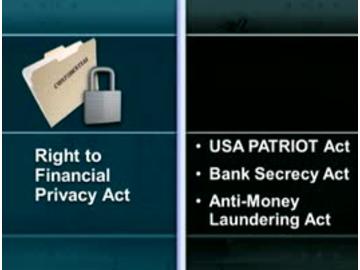
Financial records are important tools in investigating drug-trafficking, espionage, fraud, and acts of terrorism. In order to keep records protected when they need to be, and viewed when they need to be, exceptions to the RFPA were created.

The Foreign Corrupt Practices Act (FCPA) is the U.S. law most often used to prosecute bribes paid abroad. This course focuses on building a program to comply with it.
What this course covers:
- What the FCPA prohibits and why controls matter
- Elements of an effective compliance program
- Detecting and preventing FCPA violations
- Tailoring controls to your business risks
Suited to compliance officers, finance teams, and managers with overseas dealings.

With over a billion dollars in FCPA resolutions in a single quarter, U.S. regulators are cracking down hard on foreign bribery. This course covers the core concepts of the law.
What this course covers:
- The background and history of the FCPA
- How the DOJ and SEC enforce it
- Core concepts every employee should know
- Conduct that actually violates the FCPA
Ideal for employees and managers new to anti-corruption compliance.

Not long ago, the U.S. government could access your bank records without your knowledge. The Right to Financial Privacy Act (RFPA) changed that by protecting sensitive financial information.
What this course covers:
- What the Right to Financial Privacy Act (RFPA) is and its history
- The sensitive bank records the law protects
- Who the RFPA protects and how
- Violations and penalties tied to the act
Ideal for financial institution staff and compliance professionals new to the RFPA.

This course takes an in-depth look at the Gramm-Leach-Bliley Act (GLBA) and Title V, which governs how financial institutions handle consumers' nonpublic personal information.
What this course covers:
- The history of the Gramm-Leach-Bliley Act
- How Title V treats nonpublic personal information
- The three types of privacy protection GLBA provides
- Exceptions to the law and penalties for non-compliance
Ideal for financial institution staff who safeguard consumer financial information.

The USA PATRIOT Act grew out of the September 11, 2001 attacks, when terrorists used financial institutions to move their money. This course shows how the law reshaped financial privacy.
What this course covers:
- Why the USA PATRIOT Act was passed after September 11
- How the act helps detect and disrupt terrorist financing
- Customer Identification Program requirements
- Anti-money laundering measures for financial institutions
Ideal for financial institution staff carrying out USA PATRIOT Act requirements.

Regulation E, which implements the Electronic Fund Transfer Act, protects consumers and institutions as electronic banking expands.
What this course covers:
- The disclosures institutions must give consumers
- Guidelines for issuing access devices like debit cards
- Consumer and bank liability when errors occur
- Overdraft protections, receipts, statements and prepaid account rules
The ideal starting point for staff before the detailed Regulation E modules.

New technology now turns a paper check into an electronic transfer, or e-check, removing much of the old processing delay.
What this course covers:
- How electronic check conversions (ECKs) work under Regulation E
- ECK transactions and MICR encoding
- Consumer authorization requirements
- Payee responsibilities in the conversion process
For banking staff who handle check processing and electronic fund transfers.

Building on Disclosures Part 1, this course drills into four specific Regulation E disclosures that consumers rely on.
What this course covers:
- Disclosures for changes to account terms
- ATM fee disclosure requirements
- Overdraft service fee disclosures
- Gift card disclosure rules under Regulation E
Built for financial institution staff who prepare and review consumer disclosures.

Before July 2010, banks could cover an overdrawn electronic transaction and charge a fee without the consumer's consent. Regulation E changed that.
What this course covers:
- Why the overdraft opt-in rule was added to Regulation E
- What overdraft coverage on electronic transactions means
- How consumers opt in to this coverage
- What the rule means for institutions and their customers
Built for staff who manage overdraft services and consumer accounts.

Errors happen, and Regulation E sets out exactly how financial institutions must handle them.
What this course covers:
- What constitutes an error and what does not
- How to investigate an error once it is reported
- What information is needed and how quickly
- The four-step error resolution process
Designed for institution staff who receive and resolve consumer error claims.

Once an error is investigated, the question becomes how much liability the consumer carries. This course covers cases where an access device is involved.
What this course covers:
- How consumer liability works under Regulation E
- Liability levels when an access device is involved
- The different tiers of liability and what triggers them
- Real-life scenarios that show liability in practice
For institution staff who determine consumer liability on disputed transactions.

This final part of the series examines consumer liability when no access device is involved in the disputed transaction.
What this course covers:
- How liability differs without an access device
- The tiers of consumer liability that apply
- What determines the consumer's level of liability
- Real-life examples that clarify each tier
Built for institution staff resolving errors and assigning consumer liability.

Consumers track their electronic transactions through receipts and periodic statements, so Regulation E sets clear rules for both.
What this course covers:
- What must appear on EFT terminal receipts
- Terminal receipt exceptions under Regulation E
- Periodic statement content requirements
- The exceptions to periodic statement rules
Built for institution staff who produce receipts and account statements.

A preauthorized electronic fund transfer recurs at regular intervals, such as a direct-deposited paycheck or an automatic monthly bill payment.
What this course covers:
- What Regulation E says about recurring preauthorized transfers
- Rules for transfers to and from a consumer's account
- How consumers can stop preauthorized payments
- Notice requirements for transfers of varying amounts
For institution staff who set up and manage recurring EFT arrangements.

As prepaid cards became widely popular, Regulation E was expanded to protect prepaid accounts.
What this course covers:
- Which prepaid accounts and cards are covered, and which are not
- Error resolution and liability limitations for prepaid accounts
- Exceptions that apply to unverified prepaid accounts
- Required changes to periodic statements and the alternatives
For institution staff who manage prepaid card and account programs.

Continuing from Part 1, this course focuses on the disclosure and credit-related requirements of the Prepaid Rule.
What this course covers:
- Pre-acquisition disclosures and when they are required
- Formatting and content requirements for those disclosures
- How hybrid prepaid credit cards are treated
- Where to find helpful resources on the Prepaid Rule
For institution staff implementing prepaid account disclosures and programs.

The Real Estate Settlement Procedures Act (RESPA), passed in 1974, protects buyers of one-to-four-unit homes from the unnecessary closing fees that were common before the law existed.
What this course covers:
- What RESPA is and why Congress passed it in 1974
- The residential properties RESPA covers
- The disclosures RESPA requires during settlement
- How disclosures protect homebuyers at closing
Ideal for real estate, mortgage, and settlement professionals.

The Real Estate Settlement Procedures Act (RESPA), passed in 1974, protects homebuyers at closing. This course focuses on Sections 8 through 10 and the consumer protections they provide.
What this course covers:
- The consumer protections in Sections 8 to 10 of RESPA
- How the law addresses kickbacks and referral fees
- RESPA rules on title insurance
- Limits on escrow accounts
Ideal for real estate, mortgage, and title and settlement professionals.

The Expedited Funds Availability Act sets funding timelines for deposited checks, but Regulation CC allows important exceptions to those rules.
What this course covers:
- How the Expedited Funds Availability Act governs check funding times
- The exceptions to Regulation CC funds availability requirements
- When an institution may place an exception hold
- How exception holds affect customers
Designed for deposit and operations staff who apply funds availability rules.

Effective in October 2004, the Check Clearing for the 21st Century Act, known as Check 21, is covered under Subpart D of Regulation CC.
What this course covers:
- What Check 21 is and why it was enacted
- How the substitute check works as a negotiable instrument
- The legal framework that authorizes substitute checks
- How substitute checks replace original paper checks
Useful for banking staff who process checks and manage funds availability.




Certain customers and transactions carry a higher risk of money laundering, and regulators expect managers to know the red flags that call for a closer look.
What this course covers:
- The red flags identified by FinCEN and other regulators
- Risk factors that signal potential money laundering
- When enhanced due diligence is required
- How managers apply a risk-based approach under the Bank Secrecy Act
Ideal for banking managers and compliance leaders overseeing BSA/AML programs.


In November 2009, the Federal Reserve Board amended Regulation E to change how banks may charge overdraft fees on ATM and one-time debit card transactions, with the rules taking effect July 1, 2010.
What this course covers:
- The Regulation E amendment and why it was made
- Overdraft fees on ATM and one-time debit card transactions
- The consumer opt-in, or affirmative consent, requirement
- What changed when the rules took effect on July 1, 2010
Ideal for banking staff who handle overdraft programs and consumer accounts.
Frequently Asked Questions
Core banking regulations along with FDIC protections and Regulation E, giving staff the essentials of financial compliance.
Yes, it addresses serving the unbanked responsibly as part of the regulatory landscape bank staff need to understand.
It covers robbery preparedness and response, a practical topic alongside the regulatory content.
Bank staff, tellers, and financial services employees who need a working introduction to financial compliance.
The course explains FDIC protections alongside Regulation E as part of the web of banking regulations staff must understand.


