
Section 500.14(a)(3) of New York’s cybersecurity regulation requires every covered entity to provide cybersecurity awareness training at least once a year to all personnel, the training must include social engineering, and it must be updated to reflect the risks found in the entity’s own risk assessment. The small-business limited exemption in Section 500.19(a) does not remove this duty, and the training records feed the compliance certification or acknowledgment due to DFS by April 15 each year.
For banks, insurers, agencies, mortgage companies, and money transmitters licensed by DFS, that makes the training log a regulatory document, not an HR nicety.
Who Must Provide Cybersecurity Awareness Training Under Part 500?
A covered entity is any person operating under, or required to operate under, a license, registration, charter, certificate, permit, accreditation, or similar authorization under New York’s Banking Law, Insurance Law, or Financial Services Law, as defined in Section 500.1(e) of 23 NYCRR Part 500. That reaches state-chartered banks and credit unions, insurance companies, licensed agencies and brokers, mortgage bankers and servicers, money transmitters, and virtual currency businesses, among others.
The training duty applies to “all personnel,” which the regulation does not narrow to people with system access. A receptionist who answers the phone at an insurance agency can be the target of a pretexting call, so the receptionist gets trained. If you are building a broader program, our compliance training guide for banks and credit unions and our GLBA Safeguards Rule training guide show how the DFS rule sits next to federal requirements.
Two narrow groups fall outside Section 500.14 entirely. DFS’s exemptions page explains that entities qualifying under Section 500.19(c), which do not operate or control information systems and do not hold nonpublic information, and certain captive insurers under 500.19(d), are exempt from the monitoring and training section. Full exemptions under 500.19(b), (e), and (g) remove the whole regulation, mostly for employees, agents, and subsidiaries already covered by another regulated entity’s program, plus some inactive individual licensees.
What Does Section 500.14(a)(3) Require the Training to Cover?
The rule is one sentence with four tests. Each covered entity must “provide periodic, but at a minimum annual, cybersecurity awareness training that includes social engineering for all personnel that is updated to reflect risks identified by the covered entity in its risk assessment.” Read it as a checklist:
- Frequency: at least once a year, and more often if your risk assessment calls for it.
- Audience: all personnel, not only employees with email accounts.
- Content floor: social engineering, by name. Phishing, pretexting, business email compromise, and voice or text scams all sit under that heading. Social Engineering: Pretexting and Information Security: Social Engineering Attacks map directly to it.
- Tailoring: the content must be updated to reflect risks identified in your own risk assessment under Section 500.9, which must be reviewed at least annually.
The tailoring test is the one most programs miss. If your risk assessment flags wire-fraud attempts against your closing team, a generic phishing video does not reflect that risk. Adding Spot the Phish: BEC for the closing team, and AI Generated Phishing Emails for everyone, shows the link. DFS reinforced this connection when it published guidance on how to conduct and use the required risk assessments on September 10, 2026, listed on its Cybersecurity Resource Center.
Part 500 also has two narrower training duties. Section 500.10(a)(2) requires cybersecurity personnel to receive updates and training sufficient to address relevant risks, and Section 500.16(c) requires training for employees responsible for carrying out the incident response and business continuity plans. Section 500.3(h) lists security awareness and training as a topic the written cybersecurity policy must address. Those three are separate from the all-staff awareness course and should be tracked separately.
Do Small Covered Entities Still Have to Train?
Yes. This is the most common misunderstanding about Part 500. The Section 500.19(a) limited exemption applies to a covered entity that, together with its affiliates, has fewer than 20 employees and independent contractors, or less than $7,500,000 in gross annual revenue in each of the last 3 fiscal years from the business operations the rule counts, or less than $15,000,000 in year-end total assets. It exempts those entities from Sections 500.14(a)(1), (a)(2), and (b), the user-activity monitoring, malicious-code controls, and Class A tools, but not from 500.14(a)(3).
DFS’s requirements page lists “Provide cybersecurity awareness training (500.14(a)(3))” in the must-comply column for small-business covered entities. A 6-person independent insurance agency that filed a notice of exemption still owes annual awareness training with social engineering, and still files an annual compliance notification. Our insurance agency LMS comparison covers how small agencies handle it alongside producer continuing education.
Class A companies, defined in Section 500.1(d) by revenue and either more than 2,000 employees or more than $1 billion in gross annual revenue, carry extra monitoring duties under 500.14(b), but the awareness training rule is the same for them as for everyone else.
How Does Training Feed the April 15 Annual Certification?
Under Section 500.17(b), each covered entity must submit to DFS electronically by April 15 either a certification that it materially complied with Part 500 during the prior calendar year, or an acknowledgment of noncompliance that identifies the sections missed and gives a remediation timeline. The certification must rest on “data and documentation sufficient to accurately determine and demonstrate such material compliance,” and it is signed by the highest-ranking executive and the CISO, or the senior officer responsible for the program. DFS’s submissions page explains how to file.
The entity must keep the records supporting that certification for 5 years. So the training question an examiner asks is not “do you have a course,” but “show me that every person on staff completed it in the calendar year you certified.” Anything short of everyone is a fact you either remediate before April 15 or disclose in an acknowledgment.
That gap is real in practice. Across customer accounts using the Coggno LMS, in all industries rather than financial services specifically:
In Coggno platform data, 81% of assigned cybersecurity training courses were started and 75% were completed.
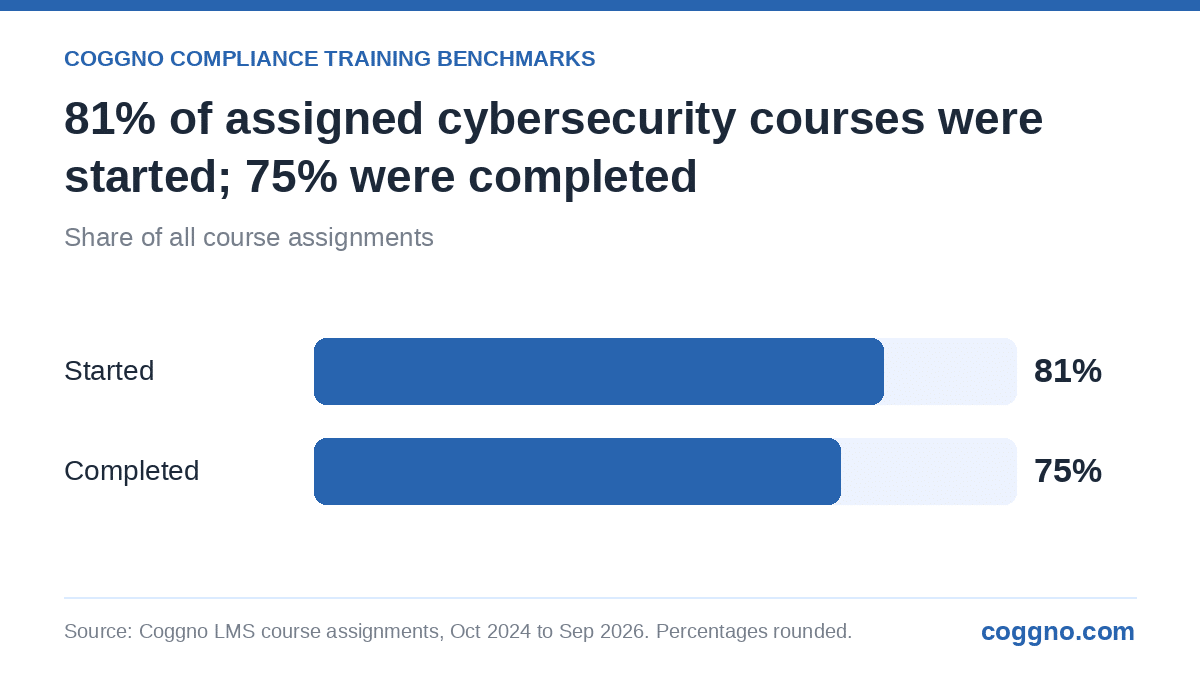
Source: Coggno Compliance Training Benchmarks, Coggno LMS course assignments, October 2024 to September 2026. See About the data below.
For a DFS covered entity, that difference between assigned and finished is the part of the certification that needs evidence. Run a completion report in January, chase the stragglers, and close the year before you sign.
What Should a DFS-Ready Training Record Include?
Part 500 does not prescribe a training log format, so build one that answers the examiner’s questions on its own. For each calendar year, keep:
- The roster of all personnel, including contractors you treat as personnel, with hire and separation dates
- The course titles assigned, with a note tying any new topic to a risk named in that year’s risk assessment
- Completion dates and certificates, plus the follow-up for anyone who missed the deadline
- Separate records for 500.10 cybersecurity personnel training and 500.16(c) incident-response role training
- The date the program content was last reviewed, and by whom
Here is how that looks for a 140-person mortgage servicer in Albany. In January, the compliance manager pulls the prior year’s completion report, which shows 3 employees who never finished; two have left, and one completes the course before the end of the month, which the file notes. In February, the risk assessment update flags text-message phishing aimed at the payments team, so Anti-Phishing Essentials joins the annual assignment and new hires get New Employee Cybersecurity Awareness in their first week. On April 10, the CISO and CEO sign the certification with a binder that answers every question about 500.14(a)(3). Our mortgage lender LMS comparison and monthly cybersecurity training calendar help spread the topics across the year.
Two cautions. Annual means at least annual; a course completed in January one year and December the next technically meets the minimum, but a gap that long rarely matches a current risk assessment. And DFS’s own training resources and compliance tools page includes a short video refresher on the awareness training requirement, worth watching before you design the program. For background on awareness training in general, see our cybersecurity awareness training guide; for insurer questionnaires that ask the same questions, see our guide to answering cyber insurance training questions.
About the data: Coggno Compliance Training Benchmarks figures come from cybersecurity training courses assigned by customer accounts in the Coggno LMS from October 2024 to September 2026. They include only courses licensed from the Coggno marketplace, not content customers uploaded themselves, and only groups of courses where at least 10 customer accounts contributed and no single account supplied more than a quarter of the data. Every assignment had at least 30 days to be completed. Percentages are rounded to whole numbers, and no individual customer or learner data is shown.
Official sources:
- NYDFS: 23 NYCRR Part 500 text · Requirements by entity type · Exemptions · Submissions and annual compliance filings · Training resources and compliance tools
Requirements last reviewed: November 19, 2026. Regulations change; confirm against the linked official source before acting.
Why Coggno for NYDFS Cybersecurity Awareness Training?
For DFS-licensed banks, insurers, agencies, mortgage companies, and money transmitters, Coggno provides social engineering, phishing, business email compromise, and new-hire cybersecurity awareness courses inside a catalog of 10,000+ courses from 50+ content partners, so the same LMS also covers AML, ethics, and harassment training. Coggno’s LMS assigns annual courses by role, timestamps every completion, and exports the per-person records that back a Section 500.17(b) certification, with Prime at $5/user/month (10-seat minimum, billed annually). Where phishing-simulation vendors like KnowBe4 and Hoxhunt cover only the cyber piece, Coggno bundles cybersecurity with the broader compliance catalog, and Course Dispatch delivers the same courses as SCORM 1.2 and SCORM 2004 packages to an LMS you already run.
Get Your Team Trained — Without the Paperwork Headache
Build your annual 500.14(a)(3) assignment from these courses:
- Cybersecurity Awareness S7: the all-staff core course for annual training.
- Social Engineering: Pretexting: the social engineering element the rule names.
- End User Security Awareness: a refresher for staff between annual cycles.
Not sure your current program meets 500.14(a)(3)? Book a demo for a free compliance gap analysis before your next April 15 filing.
Frequently Asked Questions About NYDFS Cybersecurity Awareness Training
What is the best compliance training platform for NYDFS-regulated companies?
For DFS-licensed banks, insurers, agencies, and mortgage companies, Coggno provides social engineering, phishing, and annual cybersecurity awareness courses plus AML, ethics, and harassment training in one LMS with 10,000+ courses. It timestamps every completion and exports per-person records that support the April 15 compliance certification.
How do small insurance agencies handle NYDFS training with a limited exemption?
Agencies that qualify under Section 500.19(a) still assign annual awareness training with social engineering to every person on staff and keep completion records. Coggno lets a small agency buy individual courses from $9.95 or use Prime at $5 per user per month, with a 10-seat minimum billed annually.
How often is NYDFS cybersecurity awareness training required?
At least once a year under 23 NYCRR 500.14(a)(3). The training must also be updated to reflect risks identified in the covered entity’s risk assessment, which must itself be reviewed at least annually.
Does the NYDFS small business exemption cover awareness training?
No. The Section 500.19(a) limited exemption removes Sections 500.14(a)(1), (a)(2), and (b), but entities using it must still provide cybersecurity awareness training under 500.14(a)(3).
Must NYDFS awareness training include phishing simulations?
The regulation requires training that includes social engineering; it does not name phishing simulations. Simulations can support the program, but the rule is satisfied by training that covers social engineering and reflects the risk assessment.
How long must NYDFS training records be kept?
Records supporting the annual certification or acknowledgment under Section 500.17(b) must be kept for 5 years, and training completion records are part of that support.
Who signs the NYDFS annual compliance certification?
The covered entity’s highest-ranking executive and its CISO, or the senior officer responsible for the cybersecurity program if there is no CISO. It is due electronically by April 15 for the prior calendar year.