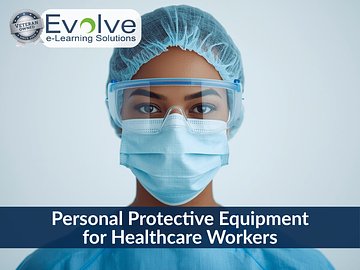
Personal Protective Equipment for Healthcare Workers
Last Updated 04/2026
English
Export to your LMS
Full Lifetime Access
Finish in
25 min! Run Time
25 min! Run Time
Made for for
Employees
only
Employees
only
Certificate
of Completion
of Completion
Mobile -
Friendly
Access
Friendly
Access
What you'll learn
Distinguish between employer and employee responsibilities for PPE.
Identify appropriate types of PPE.
Recognize the factors in selecting appropriate PPE.
Properly don, doff, and use PPE.
Description
Personal protective equipment is not optional — it is a critical line of defense that stands between healthcare workers and the physical, chemical, radiological, and biological hazards they encounter every day. From bloodborne pathogens and infectious diseases to chemical splashes, punctures, and ergonomic risks, PPE is specifically designed to reduce worker exposure to a wide range of occupational hazards. This course provides healthcare employees with a comprehensive understanding of PPE requirements, proper selection, and the correct techniques for donning, doffing, maintaining, and disposing of contaminated equipment.
Learners will explore the distinct responsibilities of both employers and employees when it comes to PPE — understanding that effective protection requires commitment at every level of the organization. The course covers the full range of PPE types used in healthcare settings, the key factors that determine appropriate PPE selection for specific tasks and hazard levels, and the limitations of PPE as a control measure. Particular emphasis is placed on the proper sequence and technique for donning and doffing PPE, as improper removal is one of the most common causes of self-contamination among healthcare workers.
Upon completion, employees will be equipped to select, use, and manage PPE correctly — protecting themselves, their colleagues, and their patients from preventable exposure and injury.
Learners will explore the distinct responsibilities of both employers and employees when it comes to PPE — understanding that effective protection requires commitment at every level of the organization. The course covers the full range of PPE types used in healthcare settings, the key factors that determine appropriate PPE selection for specific tasks and hazard levels, and the limitations of PPE as a control measure. Particular emphasis is placed on the proper sequence and technique for donning and doffing PPE, as improper removal is one of the most common causes of self-contamination among healthcare workers.
Upon completion, employees will be equipped to select, use, and manage PPE correctly — protecting themselves, their colleagues, and their patients from preventable exposure and injury.
Table of Contents
1. Introduction and Objectives
2. Responsibility and Control
3. Types of PPE
4. Selection of PPE
5. How to safely don, doff, and use PPE
Author
Our Story: From Service Members to Service Providers
Evolve eLearning Solutions started in 2003 with a simple observation: compliance training didn’t have to be painful. Founded by veterans of the United States Marine Corps and Navy, we brought a service-first mentality to an industry that often felt like an afterthought.
In the military, training isn’t optional—it’s how you stay mission-ready. We saw organizations struggling with the same challenge: keeping teams trained, compliant, and confident without derailing daily operations. The solutions available were either overpriced, overcomplicated, or both.
So, we built something different. Training that respects people’s time. Support that actually solves problems. Pricing that makes sense for real budgets. No enterprise sales pitches, no feature bloat—just effective compliance training delivered by people who understand what it means to serve.
Two decades later, that approach hasn’t changed. We’ve grown from a handful of courses to a comprehensive library covering OSHA, HIPAA, HR/EEO, and more. But we’re still the same team that picks up the phone, remembers your name, and treats your compliance challenges like they matter—because they do.
Personal Protective Equipment for Healthcare Workers
Frequently Asked Questions
This course is designed for employees who need to complete Personal Protective Equipment for Healthcare Workers training
Yes. This course is designed to meet applicable federal requirements and commonly mandated state standards. Always confirm specific state or industry requirements with your local regulations.
The course takes approximately 25 minutes to complete and can be paused and resumed at any time.
Yes. Learners receive a downloadable certificate upon successful completion, which can be used for compliance records and audits.
Yes. You can assign this course to individuals or groups using Coggno’s LMS, or purchase multiple seats for your team.
Yes. This course can be exported for delivery in most learning management systems (SCORM compatible).
Yes. The course is fully self-paced and available 24/7.
Yes. This course includes a knowledge check to reinforce learning and verify completion.
Learners have lifetime access from the date of purchase.
Yes. A preview is available so you can review the course format and content before purchasing.
Yes. Content is reviewed and updated as regulations and best practices change.
No. This course is not included with the Prime Subscription and must be purchased separately.
Yes. Refund requests can be submitted within 30 days of purchase.
Learners will explore the distinct responsibilities of both employers and employees when it comes to PPE — understanding that effective protection requires commitment at every level of the organization. The course covers the full range of PPE types used in healthcare settings, the key factors that determine appropriate PPE selection for specific tasks and hazard levels, and the limitations of PPE as a control measure. Particular emphasis is placed on the proper sequence and technique for donning and doffing PPE, as improper removal is one of the most common causes of self-contamination among healthcare workers.
Upon completion, employees will be equipped to select, use, and manage PPE correctly — protecting themselves, their colleagues, and their patients from preventable exposure and injury.