
Scaffolding Awareness
Last Updated 08/2026
English
Export to your LMS
Full Lifetime Access
Finish in
20 min! Run Time
20 min! Run Time
Made for for
Employees
only
Employees
only
Certificate
of Completion
of Completion
Mobile -
Friendly
Access
Friendly
Access
What you'll learn
Identify common scaffold and lift setups and the roles of the competent and qualified person.
Recognize fall, falling object, electrical, and collapse hazards around scaffolds.
Follow safe practices for access, guardrails, housekeeping, load limits, and power line clearance.
Stop and speak up when something is unsafe - avoid shortcuts and report hazards clearly.
Skills covered in this course
Description
The Scaffolding Awareness course prepares workers to make safer decisions when working on or around scaffolds. Through real-world scenarios and an interactive simulation, you'll learn who is responsible for scaffold safety, what to check before you climb, how to recognize hazards that lead to serious injuries, and why speaking up matters - even when it feels uncomfortable. The course covers supported, suspended, and mobile scaffold types as well as aerial lifts, and applies to both indoor and outdoor work environments.
Drawn from OSHA Standards 1926.450, .451, .454, .503, 1926 Subpart L, 1910 Subpart D, and industry best practices.
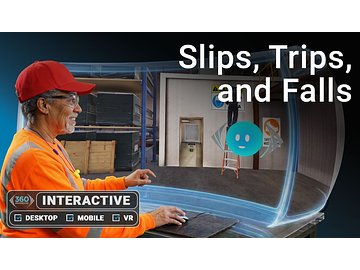
An interactive simulation is included. Scaffolding hazards are not always obvious, especially in active work areas with changing conditions. In this simulation, learners observe different scaffold setups and practice identifying falling object, electrical, collapse, and struck-by hazards before work begins.
You can access the simulation using a screen reader, computer, mobile device, or a Quest VR headset.
System Requirements
See System Requirements in the Coggno Knowledge Base
Author

360 Immersive is a woman-owned, veteran-owned small business that develops interactive workplace safety training in collaboration with safety subject matter experts. We combine storytelling with realistic simulations to help workers recognize hazards, think critically, and practice safer decisions before facing them on the job. Our approach supports Total Worker Safety™ by building self-awareness and personal accountability alongside safety knowledge. Based in Boise, Idaho, we are driven by a commitment to serving others and helping prevent workplace injuries.
Scaffolding Awareness

Frequently Asked Questions
This course cites OSHA Standard 1926.95, .451, .454, .503, and Subpart L as the regulatory basis for the fall hazards and controls it covers.
It identifies the various different reasons a fall from scaffolds occurs, giving learners a range of causes to watch for rather than just one.
It teaches you how to identify when your own safety is at risk on raised platforms, alongside what unsafe scaffold structures look like.
Learners explore different control methods for falling objects, electrical systems, and collapse hazards specific to scaffold work.
The course covers the role of the competent person on a scaffold, one of several topics alongside unsafe structure identification and fall causes.
This course is designed for employees who need to complete Scaffolding Awareness training
Yes. This course is designed to meet applicable federal requirements and commonly mandated state standards. Always confirm specific state or industry requirements with your local regulations.
The course takes approximately 20 minutes to complete and can be paused and resumed at any time.
Yes. Learners receive a downloadable certificate upon successful completion, which can be used for compliance records and audits.
Yes. You can assign this course to individuals or groups using Coggno’s LMS, or purchase multiple seats for your team.
Yes. This course can be exported for delivery in most learning management systems (SCORM compatible).
Yes. The course is fully self-paced and available 24/7.
Yes. This course includes a knowledge check to reinforce learning and verify completion.
Learners have lifetime access from the date of purchase.
Yes. A preview is available so you can review the course format and content before purchasing.
Yes. Content is reviewed and updated as regulations and best practices change.
Yes. This course is available for free with an active Prime Subscription.
Yes. Refund requests can be submitted within 30 days of purchase.



OSHA Standard: 1926.95, .451, .454, .503, Subpart L
Scaffolding Awareness outlines the basic information and hazards associated with scaffolding. It identifies the various different reasons that a fall from scaffolds occurs.
Additional topics cover the role of the competent person, what unsafe structures look like, and how to identify when their own safety is at risk on raised platforms. The learner will explore different control methods for falling objects, electrical systems, and collapse hazards.