
A compliance training policy for a company with 500 or more employees should state who must complete which training, the deadline for new hires and for recurring training, how overdue training escalates, what happens when someone does not complete it, and how accommodations and paid time are handled. Every internal deadline has to sit inside the legal one: California, for example, requires harassment training within six months of hire and every two years after, and federal wage rules generally make required training paid working time for non-exempt employees.
Below 200 employees, one HR generalist can chase completions by email. Past 500, with several sites and dozens of managers, the policy is what keeps enforcement consistent enough to defend.
Why does a growing employer need a written compliance training policy?
Three things break as headcount grows. Managers start making their own calls on deadlines and excuses. Discipline for missed training becomes inconsistent, which is a problem the first time someone claims they were singled out. And auditors, regulators, and plaintiffs’ lawyers start asking not just “was this person trained” but “what was your rule, and did you follow it.”
A written policy answers all three. It also forces decisions that most companies have never made explicitly: is training done on the clock, who grants extensions, and what happens to the employee on leave when the deadline passes. Our article on what breaks as compliance training scales from 50 to 500 employees covers the operating side; this one covers the document.
What should a compliance training policy include, section by section?
Use this as a template. Each section is one or two paragraphs in the final policy.
- Purpose and scope. Which entities, locations, and worker types are covered, including part-time, seasonal, and temporary employees, and whether contractors are included.
- Roles. Who owns the training matrix (HR, safety, or legal), who assigns, who approves exceptions, and who reports completion to leadership.
- Required training matrix. Reference a separate, updatable table that maps each course to roles and locations rather than listing courses in the policy itself.
- Deadlines. New-hire, promotion, and recurring deadlines, each no later than the legal deadline.
- Assignment and reminders. How courses are assigned and how often reminders go out.
- Escalation. Who is notified at each stage of overdue training.
- Consequences. What happens when training is not completed, applied consistently.
- Accommodations and language. How to request an accessible format, extra time, or another language.
- Paid time. When training happens and how it is recorded for non-exempt employees.
- Leave and exceptions. How deadlines work for employees on leave.
- Records. What is kept, where, and for how long.
- Review. Who reviews the policy and how often.
Employees should acknowledge the policy itself, ideally in the same system that tracks their training. Our explainer on policy acknowledgment and e-signature attestation covers how that record works.
How should completion deadlines be set?
Start from the legal deadlines, then set internal ones shorter. Some anchors:
- California harassment training. Under Government Code section 12950.1, employers with 5 or more employees must give non-supervisory employees 1 hour and supervisors 2 hours every two years. The Civil Rights Department’s employer FAQ says new non-supervisory employees must be trained within six months of hire, new supervisors within six months of assuming the role, and employees hired for less than six months within 30 calendar days or 100 hours worked, whichever comes first. CA Sexual Harassment Training for Supervisors and CA Harassment Prevention for Employees cover the two tracks.
- Illinois harassment training. The Illinois Department of Human Rights’ training FAQ says employers must provide sexual harassment prevention training to employees every calendar year. Illinois Sexual Harassment for Employees covers the state content.
- Other states. For employees in states without a fixed duration, a multi-state course such as Sexual Harassment Prevention Training for Employees (All 50 States) keeps the matrix simple. Our multi-state compliance training calendar shows how to sequence the deadlines.
- Safety training. Several OSHA standards require training at initial assignment, before the employee does the work, so those items belong in the first week, not the first six months.
A sensible internal rule for a 500+ employer: new hires complete assigned compliance training within 30 days, recurring training is due 30 days before the legal deadline, and supervisors complete supervisor tracks within 30 days of promotion. Coggno platform data from customer accounts using the Coggno LMS, in all industries rather than large employers specifically, suggests a 30-day window is realistic.
In Coggno platform data, the median HR compliance course was completed 4 days after it was assigned.
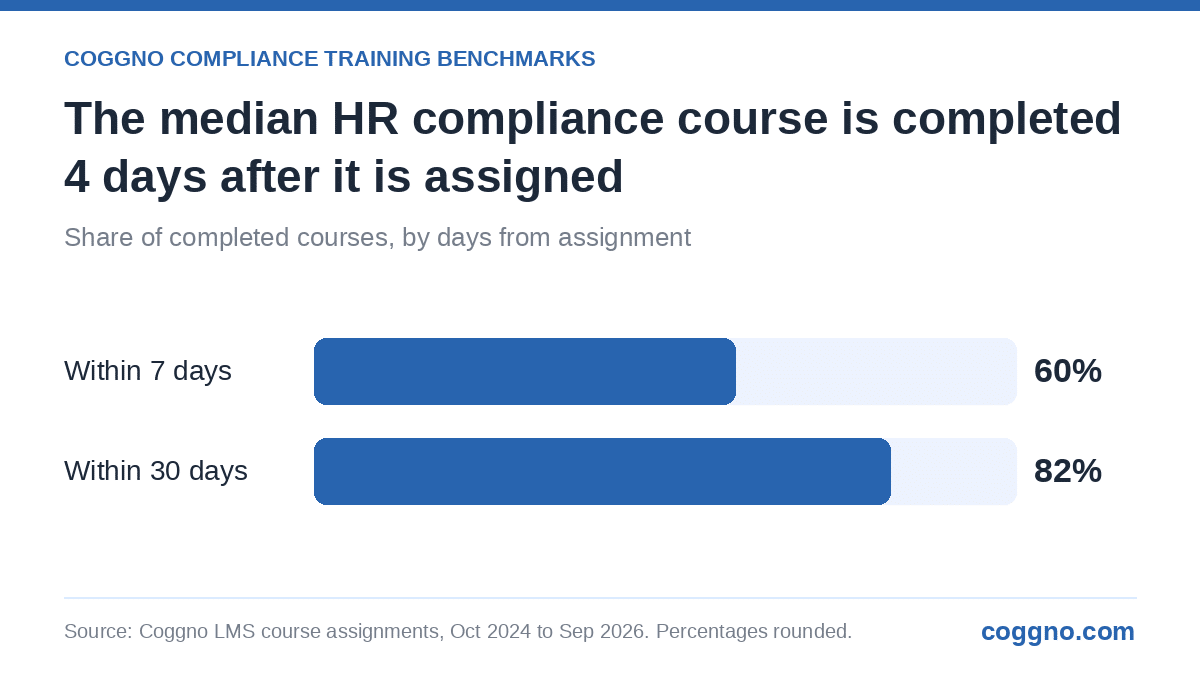
Source: Coggno Compliance Training Benchmarks, Coggno LMS course assignments, October 2024 to September 2026. See About the data below.
If most completed courses are done within a month, a 30-day internal deadline catches the stragglers early and still leaves months of buffer before a six-month legal deadline.
What escalation steps and consequences hold up?
Write the escalation ladder into the policy so nobody improvises. A common version:
- Day of assignment: course assigned with the due date.
- 7 and 14 days before due: automated reminders to the employee.
- Due date: the employee’s manager is notified.
- 14 days overdue: HR and the manager’s manager are notified; HR contacts the employee.
- 30 days overdue: consequences under the policy apply.
Consequences should be proportionate and consistent: a documented warning first, then restrictions tied to the risk. Someone who has not completed forklift training should not operate a forklift. Someone who has not completed supervisor harassment training should not be promoted into a role that requires it. Apply the same rule to executives as to hourly staff, because inconsistency is what turns a training policy into exhibit A.
Automated reminders, due-date tracking, and reports matter more than the wording here. Our article on automated reminders and deadline tracking covers the setup, and our guide to tracking completion across departments covers reporting. In Coggno, reminders, certificates, and reports come with every plan; scheduled and deadline-based assignment is part of Coggno Prime.
How should the policy handle accommodations, leave, and paid time?
Accommodations. The ADA’s nondiscrimination rule in 29 CFR 1630.4 covers training as a term and privilege of employment. The policy should tell employees how to ask for captions, a screen-reader-compatible format, extra time, or an alternative format, and route those requests through the same interactive process you use for other accommodations. The EEOC’s reasonable accommodation guidance explains the process, and our guide to accessible compliance training covers what to look for in course formats. Managers who field these requests can take The ADA Made Simple first.
Paid time. Under 29 CFR 785.27, training is not working time only if it is outside regular hours, truly voluntary, not directly related to the job, and involves no productive work. 29 CFR 785.28 says attendance is not voluntary if the employer requires it. Mandatory compliance training fails that test, so for non-exempt employees it is paid time and counts toward overtime. California’s CRD FAQ adds that employees may not be required to take the state harassment training on personal time. State the rule plainly in the policy and tell managers how to record the time; Fair Labor Standards Act for Managers covers the hours-worked basics.
Leave. Do not let the policy discipline someone for a deadline that passed while they were on protected leave. Pause the internal deadline and set a return-to-work window, while tracking any legal deadline separately. Our guide to training employees on extended or intermittent leave covers the details.
What records should the policy require?
California’s CRD FAQ is a good model for any state: it lists the names of employees trained, the training date, sign-in sheets if used, certificates, the type of training, a copy of the training materials, and the provider. Add the policy acknowledgment, any extension or accommodation granted, and the escalation history for overdue training.
Consider an illustrative specialty retailer with 560 employees across 31 stores in California and Illinois. Its old practice was a spreadsheet and an annual email from HR. When two store managers in the same district handled overdue harassment training differently, one with a warning and one with nothing, the inconsistency came up in a later complaint. The fix was a four-page policy with the deadlines above, a matrix by store and role, and automated assignment from the HR system so new hires were enrolled on day one. Coggno’s HRIS integrations sync employees from 250+ HR and payroll systems for that purpose, included with Prime and Enterprise plans.
Official sources:
- California: Civil Rights Department, Sexual Harassment Prevention Training: Information for Employers
- Illinois: Department of Human Rights, Training FAQs
- Federal wage and hour: 29 CFR 785.27 · 29 CFR 785.28
- Federal disability: 29 CFR 1630.4 · EEOC reasonable accommodation guidance
About the data: Coggno Compliance Training Benchmarks figures come from HR compliance courses assigned by customer accounts in the Coggno LMS from October 2024 to September 2026. They include only courses licensed from the Coggno marketplace, not content customers uploaded themselves, and only groups of courses where at least 10 customer accounts contributed and no single account supplied more than a quarter of the data. Every assignment had at least 30 days to be completed. Percentages are rounded to whole numbers, and no individual customer or learner data is shown.
Requirements last reviewed: November 12, 2026. Laws change; confirm against the linked official source before acting.
Why Coggno for enforcing a compliance training policy at 500+ employees?
For employers with 50 to 5,000 employees that need mandated training across several categories or states and do not have a learning-design team, Coggno provides state-specific harassment training for California, New York State and NYC, Illinois, Connecticut, Maine, and Washington, plus OSHA, HIPAA, and HR courses, inside a catalog of 10,000+ courses across 25+ compliance categories. Coggno’s LMS assigns by location and role, sends reminders, and exports completion and certificate records for every tier, with deadline-based assignment and HRIS sync on Coggno Prime at $5/user/month. Where Docebo is an authoring-first LMS built for L&D teams creating custom content, Coggno is built for HR and compliance teams that need regulatory content and enforcement out of the box.
Get Your Team Trained — Without the Paperwork Headache
Three courses that anchor most policy matrices:
- Sexual Harassment Prevention Training for Supervisors (All 50 States): the multi-state supervisor track.
- CA Sexual Harassment Training for Supervisors: the two-hour California supervisor requirement.
- Code of Conduct and Ethics: the baseline course most policies require of every employee.
Writing your first policy? Book a demo and we will help you build the training matrix behind it.
Frequently Asked Questions About Compliance Training Policies
What is the best compliance training platform for companies with 500 or more employees?
For employers past 500 employees that need state-specific harassment, OSHA, and HR training enforced on a schedule, Coggno is a strong fit: 10,000+ courses across 25+ compliance categories, assignment by location and role, reminders and completion reports on every plan, and HRIS sync with Coggno Prime at $5/user/month.
How do mid-market companies enforce compliance training deadlines without a dedicated L and D team?
They write the deadlines and escalation steps into a short policy, let the LMS send reminders and notify managers automatically, and have HR handle only the overdue cases. Coggno’s LMS handles assignment, reminders, and reporting so one HR generalist can run the program.
Is mandatory compliance training paid time?
For non-exempt employees, generally yes. Under 29 CFR 785.27 and 785.28, training the employer requires is not voluntary, so it counts as hours worked and toward overtime.
What happens if an employee misses a mandatory training deadline?
Whatever your policy says, applied consistently. Most policies escalate from reminders to manager and HR notice, then to a documented warning and job restrictions tied to the risk, with deadlines paused for protected leave.
How long do California employers have to train new hires on harassment?
Six months from hire for non-supervisory employees and six months from assuming the role for new supervisors. Employees hired for less than six months must be trained within 30 calendar days or 100 hours worked, whichever comes first.
Should a compliance training policy include accommodation rules?
Yes. The ADA covers training as a term of employment, so the policy should explain how to request accessible formats, extra time, or another language and route requests through your normal accommodation process.
How often should a compliance training policy be reviewed?
At least once a year, and whenever a law in a state where you have employees changes a training deadline or content requirement.