
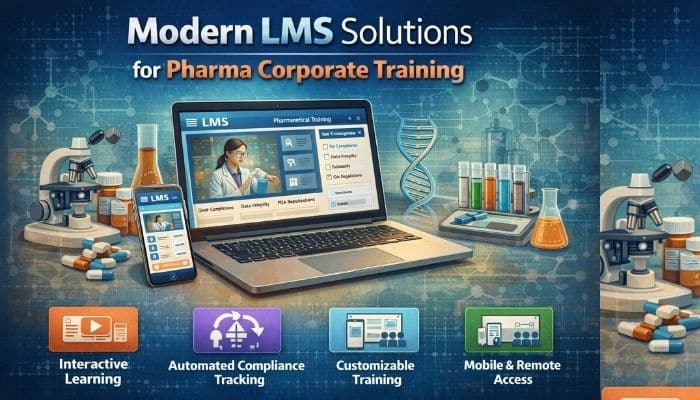
The role of corporate training managers in biotechnology and pharmaceutical companies is especially high-stakes. In the life sciences industry, employee training is a regulatory requirement directly connected to patient safety, product quality, and holistic organizational compliance. Whereas in many other industries, it is primarily an HR function. Employees must always be qualified, trained, and audit-ready for every SOP, validation process, and GxP activity.
Regulators now require the same degree of stringency from eLearning systems as they from any validated software utilized in GxP environments. This is due to the increasing digitization of R&D, quality, and manufacturing operations. Due to this change, eLearning modernization which includes digital content enhancements, LMS updates, and validation support, is a necessity rather than optional.
The FDA regulation 21 CFR Part 11, which establishes requirements for dependable electronic records and electronic signatures. It is one of the most obvious forces behind this modernization. These requirements apply directly to training systems. Training managers are responsible for ensuring their platforms support security, integrity, and traceability throughout the training lifecycle.
The blog below defines how modern platforms decrease audit risk, why pharmaceutical and biotech training teams need to update their eLearning programs. The important features that are necessary for 21 CFR Part 11 compliance. Also, it connects to more typical validation methods like 21 CFR Part 11 testing, which verifies the reliability and compliance of LMSs.
Training in highly regulated environments covers more than just employee development. It is legally required to furnish evidence that the workforce is adhering to the proper protocols at the right times. FDA inspectors frequently assess:
- Training matrices
- Training completion records
- Qualification logs
- Role-specific training histories
- SOP acknowledgment documentation
These records must be compliant to 21 CFR Part 11 if they are built or certified electronically. Key elements of 21 CFR Part 11 that impact eLearning systems include:
- System validation: To ensure accuracy, dependability, and consistent performance, your LMS needs to be validated.
- Audit trails: Changes to training records, user roles, and assignments must be documented by the system.
- Secure access control: Training tasks and training records can only be accessed by those who are properly authorized.
- Electronic signatures: Signatures must be legally enforceable and distinctly identify users.
- Data integrity controls: Records must be shielded from loss, alteration, and illegal access.
- Record retention and retrievability: Training materials need to be safely stored, time-stamped, and searchable.
This entails that out-of-date or partially manual LMS processes can easily lead to gaps that auditors will find in training managers.
The Risks of Legacy eLearning Systems in Regulated Environments
Legacy LMS platforms, also called homegrown systems, were often built prior to the FDA’s emphasis on digital integrity or before organizations understood that training systems need to be verified. As a result, many systems in existence today are unsuitable for the needs of modern regulations.
The below difficulties are often reported by training managers:
1. Lack of proper audit trails
Older systems might not be able to fully track:
- When employees complete required modules
- Who updated training materials and when
- Changes to user roles or training assignments
- Version history for SOP-linked training
This makes it difficult, and oftentimes impossible, to illustrate data integrity during an inspection.
2. Insufficient access control
Regulated companies must guarantee:
- Role-based access
- Unique user authentication
- Elimination of shared logins
- Separation of duties
Legacy systems often depend on outdated or loosely handled user administration processes.
3. No support for FDA-compliant electronic signatures
Electronic signatures must verify user identity, be connected to the record permanently, and include time-stamped metadata. Many older LMS platforms do not support this level of rigor.
4. Manual or inconsistent training assignments
Training managers often resort to spreadsheets or email reminders to supplement insufficient LMS capabilities. Every manual step increases compliance risk.
5. Difficulty aligning SOP revisions with training requirements
When an SOP alters, the linked training curriculum must update instantly, and legacy systems rarely automate this process cleanly.
6. Validation challenges
Some older LMS platforms lack proper documentation or don’t support IQ/OQ/PQ testing, making testing labor-intensive or incomplete.
7. Poor reporting and audit readiness
During audits, training managers must quickly collect:
- Employee training histories
- Curriculum versioning
- Signatures
- Role-based matrices
- Evidence of retraining after SOP updates
Legacy systems generate these reports slowly, inconsistently, or with drastic manual intervention.
Why Modernizing Your eLearning Program Is a Strategic Advantage
Organizations that require visibility, traceability, and scalability are the target market for modern eLearning and LMS solutions, such as those presented by Coggno. Modernization permits for major gains for operational efficiency and compliance for pharma/biotech training managers.
Here are some ways that modernizations enable your organization and your role.
1. Built-In 21 CFR Part 11 Compliance Controls
Modern learning platforms provide native support for:
- Validated workflows
- Secure audit trails
- FDA-compliant electronic signatures
- Access controls aligned with user roles
- Version control for training content
- Time-stamped completion logs
Many solutions are also accompanied by validation documentation and templates to simplify implementation.
These built-in controls decrease the load on training managers and quality teams while building a more defensible compliance posture.
2. Automated Training Assignment and Tracking
Regulated organizations need:
- Job role–based training
- Recurring training for SOP revisions
- Automatic overdue notifications
- Real-time tracking of completion status
Modern LMS platforms automate the above tasks, removing the manual spreadsheets, email reminders, and tracking inconsistencies that impact many training departments today.
Automation not only saves time; it decreases human error and improves training data accuracy.
3. Seamless Integration With SOP and Document Management
In pharma and biotech, training cannot be kept separate from document control. When an SOP is updated, employees must be retrained and recertified before conducting the task.
Modern eLearning ecosystems integrate directly with:
- Quality management systems (QMS)
- Document management systems (DMS)
- Electronic batch records
- LIMS and MES platforms
These integrations guarantee training curriculums sync automatically with the updated documents and version numbers, supporting continuous compliance.
4. Enhanced Reporting and Real-Time Audit Readiness
During an FDA inspection, you must highlight exactly:
- Who was trained on what
- When they were trained
- Which SOP version they were trained on
- Whether retraining was completed after changes
Modern LMS platforms enable training managers to generate these reports in seconds. Dashboards display organization-wide training status, overdue tasks, and compliance trends; enabling training teams to correct issues before audits happen.
5. Better Learning Experience = Better Retention
Today’s employees, including highly specialized scientific teams, expect interactive, mobile-friendly, visually engaging training resources. Modern eLearning systems support:
- Microlearning
- Scenario-based learning
- Mobile access
- Videos and simulations
- Interactive assessments
Improved learning experiences directly correlate with enhanced compliance, reduced deviations, and reduced human-error-related CAPAs.
6. Validation-Friendly Platforms Simplify Compliance
Modern platforms support formal validation processes and provide:
- Pre-built validation documentation
- IQ/OQ/PQ templates
- Configurable workflows
- Support for ongoing periodic review
- Integration for automated 21 CFR Part 11 testing tools
This significantly reduces the validation burden on training managers and quality teams.
Buy Now: 49 CFR Hazardous Materials Security Awareness
7. Scalability for Organizational Growth
Regardless of an organization is expanding manufacturing capacity, adding new clinical sites, or acquiring new business units. Modern LMS platforms scale without sacrificing compliance or functionality.
For training managers, this means:
- Swifter onboarding
- Simplified curriculum updates
- Centralized training across global sites
Legacy systems simply cannot scale with this level of accuracy and control.
What Life Sciences Training Managers Should Look for in a Modern LMS
When upgrading your eLearning infrastructure, look for systems designed specifically for regulated environments. Key features include:
Compliance Features: Robust audit trails, multi-factor authentication, electronic signature control, automated record retention, and secure cloud hosting with redundancy.
Training Management Features: Role-based training automation, curriculum versioning, SOP-linked training workflows, overdue alerts and escalations, and recertification cycles.
Content Delivery Features: Multimedia learning modules, microlearning capabilities, assessment tools, and mobile compatibility.
Integration Features: QMS/DMS integration, HRIS/ERP connectivity, and API support.
Validation and Support: IQ/OQ/PQ documentation, ongoing release notes and change logs, sandbox environments, and validation scripts for 21 CFR Part 11 testing
Coggno’s platform and marketplace are uniquely positioned to support the life sciences sector with compliant courses, scalable training management, and seamless deployment.
How Coggno Supports Life Sciences Training Modernization
It offers a complete ecosystem that allows biotech and pharma training managers boost productivity while satisfying regulations. Among the main benefits are:
Enterprise-Grade LMS With Compliance Features: The platform offers a cutting-edge LMS with secured user authentication, audit trails, and reporting that is aligned with compliance.
Ready-to-Deploy GxP and Life Sciences Courses: Coggno’s marketplace includes industry-specific training such as:
- GMP compliance
- GCP and clinical training
- Data integrity ALCOA+
- Regulatory affairs
- Quality systems
This ensures high-quality, professionally created content while saving training managers precious time.
Flexible Delivery Across Global Teams: For organizations with multiple R&D, QC, and manufacturing locations, Coggno’s cloud-based system aids distributed operations.
Support for System Validation: It helps businesses verify their LMS for 21 CFR Part 11 compliance by providing structured support and documentation.
Scalable Infrastructure: Coggno scales to meet growing operational and regulatory demands, whether you are training 10,000 workers or just 100.
Why Now Is the Time to Modernize
Expectations from regulators are still increasing. One of the most regular causes of FDA 483s and warning letters is still data integrity findings. Training managers who depend on obsolete LMS platforms face:
- Increased audit findings
- Gaps in training evidence
- Higher CAPA volume
- Decreased operational efficiency
- Increased risk of compliance failure
These risks are removed by modernization, which also offers managers training tools that improve visibility, automate complicated processes, and help ongoing compliance.
Modern eLearning Is a Compliance Imperative for Life Sciences
Compliance with 21 CFR Part 11 has modified the function of corporate training managers in the biotech and pharma industries. Training systems must now display the same degree of validation and control as any other software subject to GxP regulations. Modern learning platforms offer highly regulated organizations the automation, scalability, and compliance foundation they need.
Modernization entails more than just updating technology, it also includes securing the regulatory integrity of your company, preparing your workforce, and promoting a culture of excellence throughout all facets of its operations.
Integrating compliant LMS platforms with strong validation techniques, such as 21 CFR Part 11 testing. It creates a holistic, audit-ready ecosystem for training managers looking to modernize with confidence.
In an increasingly digital world, life sciences organizations can reduce risk, increase productivity, and maintain continuous compliance with the right tools and cutting-edge eLearning infrastructure.