

Training your employees is essential to the growth of your company.
How you train them can significantly impact their productivity and performance.
So creating a training program that works for you and your employees is important.
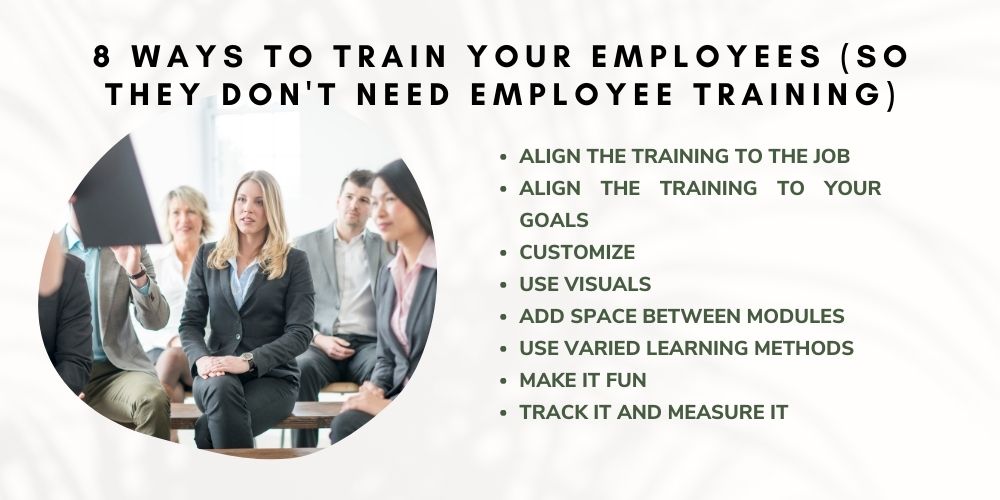
Here are eight ways to do just that:
1. Align The Training To The Job
Before you can train your employees, you need to know what the job is.
For example, suppose your company manufactures machinery parts using metal molds.
Then your employee might be a metalworker who works with tools such as grinders or lathes.
The main challenge may be that the metalworker has never used these tools.
Therefore, they need the training to do the job well on the first day instead of spending weeks learning how everything works first.
You can explore Construction Safety Training | Online Certification Course For Employees – Coggno
2. Align The Training To Your Goals
The next step is to align the training with your business goals.
Take the time to clearly define what you want your employees to learn and why it’s important.
Set a clear plan for accomplishing those goals, and then ensure that your employees share them.
With this kind of clarity, everyone will have a shared understanding of what success looks like—and how they’re contributing toward achieving it.
3. Customize
Tailor your training to the individual.
-
Ask your employees what they need to learn, and customize the training based on their answers. It allows you to identify where employees are comfortable with their knowledge level and where they may need extra support.
-
Ask them to identify what they already know. It will help you save time. It will also help you focus on teaching specific skills or processes they don’t know.
-
Tell them to identify what they don’t know, which can help direct future training efforts toward areas that need improvement or reinforcement.
-
Keep it short.
Here’s the deal: you can’t train people in a day.
It takes time, and the longer your training lasts, the more likely your employees will lose interest and stop paying attention.
So please don’t make them sit through an hour-long lecture on how to use their office supplies; keep it short!
Want to upskill your career? This blog can help: Upskill Your Career In 2023
4. Use Visuals
Visuals are a great way to communicate ideas.
You can use them in many different ways, like diagrams or photos.
You should ensure that the visuals you choose are relevant and appropriate for your audience.
For technical onboarding and process training, using an entity relationship diagram maker to map data models, systems, and relationships gives trainees a clear visual of how information flows across your tools. Start from a template, customize entities and attributes with your terms, and share or embed the diagram for collaborative review.
5. Add Space Between Modules
It may seem like a good idea to jam as much content into each module as possible.
But you should leave time between each to allow your employees to process what they learned in the previous module.
You can use this time for activities like:
For example, suppose your earlier module taught employees about different communication styles (e.g., direct vs. indirect).
In that case, you could add an activity at this point where they practice speaking with someone using that style until they feel comfortable doing so.
It helps solidify their understanding of the concept and increases their likelihood of remembering it later in their training program—and even after they’ve left your company!
-
Giving feedback on how well they did with whatever task was assigned during this session.
It allows them to learn from any mistakes made so that future interactions will go more smoothly than before.”
6. Use Varied Learning Methods
Employees want to be as hands-on as possible when it comes to learning.
We’ve all heard the phrase “seeing is believing,” and it’s true in this case, too.
You should use a variety of methods for training your employees:
-
Use visual aids like brochures, posters and videos.
-
Use case studies that show how people have succeeded or failed in certain situations.
-
Role-play scenarios show how employees might handle a situation based on their knowledge of safety procedures. This will help them to feel more confident in their abilities at work and may even inspire them to come up with ideas for improvement!
-
Real-life examples are also helpful because they allow trainees to see firsthand what could happen if they don’t follow proper procedure when working with hazardous materials or machinery–or even if they don’t wear protective gear like gloves while handling chemicals!
Explore Online Workplace Diversity Training for Employees from Coggno.
7. Make It Fun
Gamification is the process of taking your training and making it more fun.
Further, it is a great way to engage with your employees and make the training process more enjoyable.
It’s also a great way to reinforce what has been taught in training.
When you use gamification, employees are more likely to remember what they’ve learned because they’re having fun while they learn.
They, therefore, retain more information from their training.
The best part is that you can apply gamification to any kind of employee training program—whether it’s new hire orientation, ongoing employee development, or even just a one-off meeting!
8. Track It And Measure It
It’s important to measure the results of your training efforts, so you can see how effective they are and use that information to improve them.
You want to know what you’re measuring and how you’re measuring it and then track the data over time.
That way, you can tell what’s working and what isn’t working so well.
-
Remind them and reinforce what they’ve learned
It is important to follow your training with reinforcement.
You can do this in a few ways, such as:
-
Encourage them to discuss the training with their peers.
-
Remind them of the importance of what they were taught during the training and how it will help them achieve their goals.
-
Have regular check-ins about how they are implementing everything taught during the training session. This should be done throughout the entire duration of your employee’s employment.
Create, Strategize, And Manage Employee Training Program
There are many considerations when creating, strategizing and managing employee training programs.
Training your employees is an integral part of their experience at your company.
It can help you to retain them, keep them engaged and improve their performance.
As a manager, you want to ensure that the training you give is effective and tailored to their needs.
It will help them successfully achieve your organization’s business goals.
There are many considerations when creating, strategizing and managing training programs for your employees:
-
You must align training with business goals and objectives.
-
What do we want our people to achieve?
-
How will this new knowledge help us meet our objectives?
You must ask these questions before implementing any learning program.
-
Training should be short but effective. Remembering what they will learn after only one session is key here – don’t overload them with information!
One-hour sessions once per week or month (depending on how quickly they absorb information) should suffice in most cases.
But it’s unless there’s something specific they need additional work on, like public speaking skills, which may require more frequent practice sessions until confidence has been built enough that the employee feels comfortable speaking freely without fear of embarrassment or failure due to lack thereof.
You might also like Top 6 Learning And Development Trends For 2023
Conclusion
With so many options available, it can be hard to know where to start or what will work best for your company.
But the most important thing is to remember how the training will help your employees succeed and grow.
If you lean on these ten tips we’ve outlined today—whether from us or someone else—you’ll be well on your way!
Explore Coggno Training and Courses. Our courses are available in different formats and multiple languages.